
An oil spill has spread over hundreds of square kilometers in the Strait of Hormuz
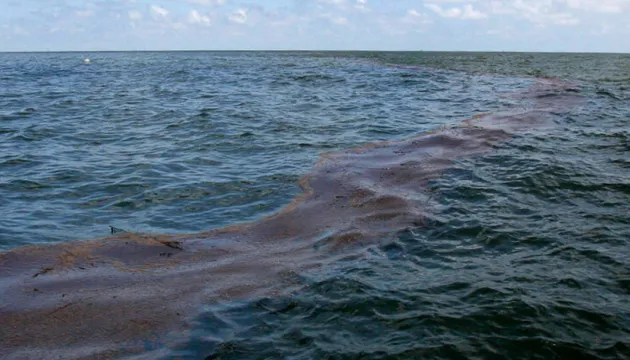
A large oil slick covering an area of more than 300 square kilometers has formed in the Strait of Hormuz near the Iranian island of Qeshm. According to the BBC’s analysis of satellite images, the spill may have begun after the Minoan Pioneer bulk carrier was struck on August 3. The oil has already reached the shore and may threaten mangrove forests, coral reefs, sea turtles, and local fishing communities.
The scale of the spill became known after analyzing satellite images. The BBC compared data from different dates and determined that the pollution near Qeshm Island had gradually spread following the incident involving the Minoan Pioneer. The attack on the tanker occurred on August 3 in Omani waters. A week later, on August 10, satellite images already showed an oil slick covering more than 300 square kilometers.
For comparison, this area is roughly equivalent to more than 40,000 soccer fields. In other words, this is not a small, localized spill, but a large-scale pollution of the marine environment. “I would call this a major oil slick,” said John Amos, CEO of SkyTruth, a specialized environmental satellite monitoring group. He estimates that more than 380,000 liters of oil may have spilled into the sea.
The oil has already reached the coast of Qeshm
The situation is particularly concerning due to the island’s location. Qeshm lies directly in the Strait of Hormuz—one of the world’s most important maritime routes. In addition to its strategic importance, the island is home to valuable natural areas. Keshm is surrounded by mangrove forests, coral reefs, and sea turtle nesting sites.
That is why even a partial oil spill on the shore could have serious consequences. An oil slick can block oxygen from reaching the water, pollute the coastline, and harm marine life. Environmentalists warn that not only wildlife but also people who depend on the sea could be at risk. In particular, this concerns local fishing communities.
Of particular concern are sea turtles, which use the region’s coastline for nesting. Some species of these animals are already endangered.
Who Is Behind the Attack on the Ship
The causes of the incident and responsibility for the attack remain a subject of debate. Analysts quoted by the BBC suggest that Iran may have been behind the attack on the Minoan Pioneer. At the same time, Tehran has not officially acknowledged responsibility for the attack. Iranian state media initially reported that an investigation was underway to determine the source of the pollution.
Later, a spokesperson for the Iranian Ministry of Foreign Affairs stated that the source of the spill was a “foreign bulk carrier.” Thus, the Iranian side acknowledges the fact of the pollution but does not confirm the theory that the strike on the vessel caused the spill, and certainly does not admit responsibility for the attack itself.
What is known about the Minoan Pioneer
The Minoan Pioneer is a bulk carrier—that is, a large cargo ship designed to transport bulk cargo. According to satellite monitoring data, the oil slick began to spread immediately after the attack on the ship. At first, the extent of the pollution may not have been obvious. But over the course of the following week, the spill spread over a significant area and eventually reached the coast of Keshma.
Satellite imagery is particularly important in such situations. It allows us to see the extent of the pollution from the air and track how it changes over time, even when access to the site is limited. It was precisely by comparing these images that the area of the spill was estimated at approximately 300 square kilometers.
Authorities announced that the spill had been contained
A local official responsible for environmental protection later stated that the spill had been almost completely contained. However, environmental impacts may persist even after visible oil has been removed from the water’s surface. Some of the pollution may wash ashore, seep into the soil, or remain in sensitive marine ecosystems.
It is particularly difficult to completely clean oil from mangrove forests and other natural areas. The contamination can affect animals not only directly but also through their food and by disrupting their natural habitat. Therefore, the true consequences of the incident can only be assessed after further monitoring.
Why the Strait of Hormuz Is So Important
The Strait of Hormuz is a narrow maritime corridor between Iran and Oman through which a significant portion of the world’s maritime oil shipments passes. As a result, any serious incident in this area has implications far beyond Iran’s borders. An attack on a vessel, a fire, an oil spill, or a blockade of the route could immediately affect maritime safety, energy prices, and international trade.
Qeshm Island also holds military significance for Iran. It is located in a strategically important area and serves as one of the Iranian military’s bases. Therefore, the situation surrounding the Minoan Pioneer has several dimensions—military, environmental, and economic.
What Happens Next
The main questions at this point are who exactly attacked the ship, what caused the spill, and how severe the consequences will be for the environment around Qeshm. Satellite data indicates widespread pollution, and the oil has already reached the shore. At the same time, Iranian officials claim that the spill has been almost completely contained.
Environmentalists have yet to assess the extent of the damage to mangrove forests, coral reefs, sea turtles, and other inhabitants of the region. For now, the incident remains one of the largest recent pollution events in the Strait of Hormuz, and its exact causes and the parties responsible for the attack have not yet been definitively determined. This is reported by the BBC.
Two vessels belonging to the Abu Dhabi National Oil Company (ADNOC) were attacked while passing through the Strait of Hormuz on the evening of August 13. The company itself reported the incident, and the UAE accused Iran of the attack.


