
Scientists have discovered that bumblebees have an unexpected ability to use tools
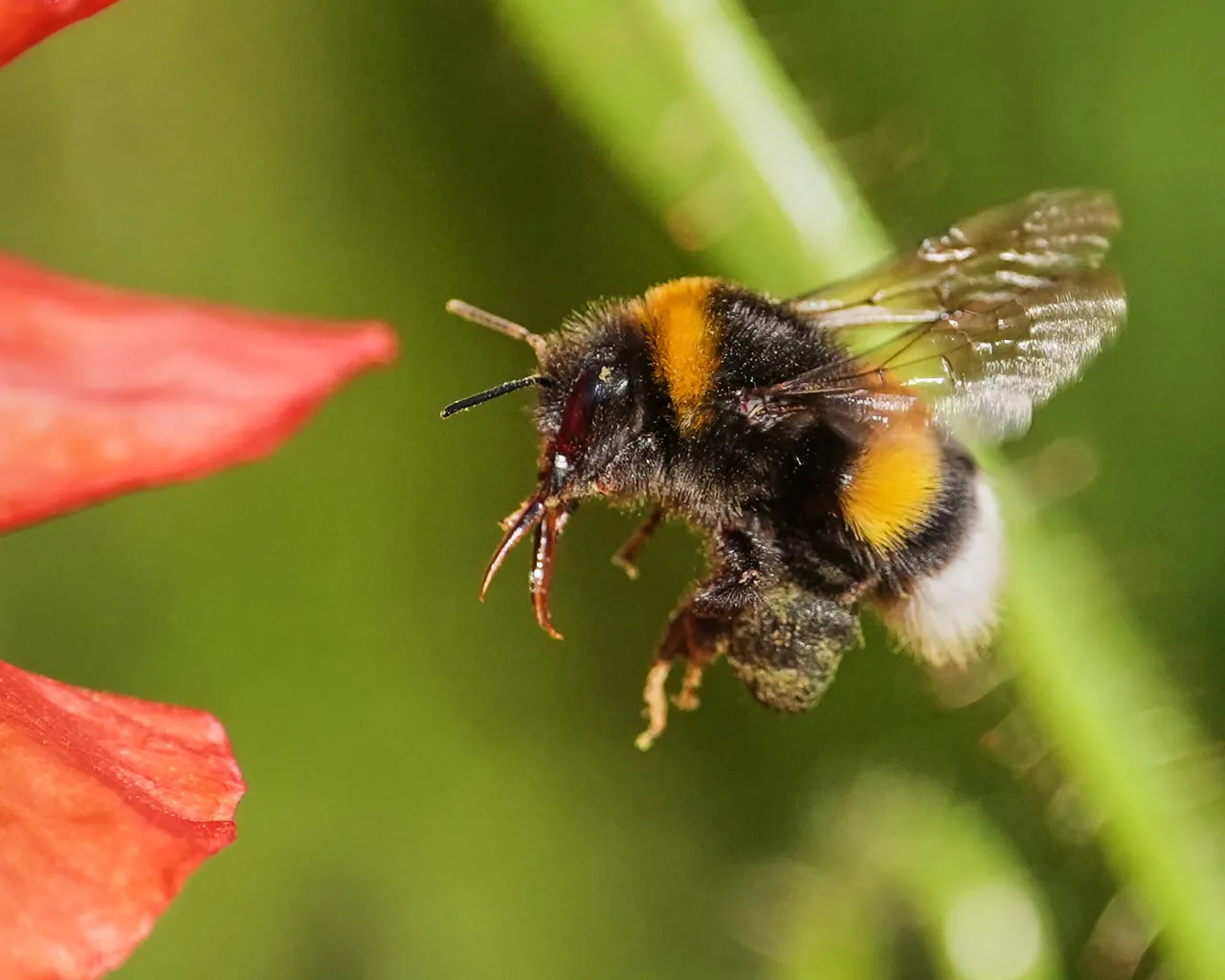
Researchers have found that bumblebees are capable of using tools to perform new tasks, demonstrating a significantly higher level of cognitive ability than previously thought.
This is detailed in a new study published in the journal Science. The findings suggest that these insects can find unconventional ways to solve problems and adapt their behavior to new conditions, broadening scientists’ understanding of their intellectual capabilities.
As part of the experiment, scientists adapted a well-known task for bumblebees—one that, over a century ago, helped demonstrate for the first time that chimpanzees were capable of complex problem-solving. In that experiment, the animals found a way to reach an out-of-reach banana by stacking boxes on top of one another.
Subsequently, similar skills were also observed in some primate species, elephants, and corvids. Now, bumblebees can be added to this list.
During the study, the insects were presented with a task in which they had to reach an artificial flower containing a sugar reward. The flower was placed beneath the ceiling of a transparent chamber at a height that prevented the bumblebees from reaching it directly. At the same time, there was not enough space for them to hover near the flower.
A polystyrene foam ball was placed inside the chamber. To access the reward, a bumblebee had to roll the ball under the flower and then climb onto it.
Prior to the experiment, the insects had not been trained to perform this specific task and had never before encountered such a sequence of actions.
First, the researchers taught young bumblebees to associate a blue artificial flower with a sugar solution. Afterward, the insects were transferred to the test chamber, where they had to figure out on their own how to reach the reward.
In the simplest version of the experiment, 75% of the bumblebees successfully completed the task.
The study’s senior author, Ollie Lowcol, noted that this experiment is analogous to the classic “box and banana” problem.
“Essentially, this is an insect version of the classic box-and-banana problem. The animal must realize that an object can be moved and then used as a tool to reach an inaccessible goal. It is particularly important that such spontaneous problem-solving has now been demonstrated in insects,” the researcher explained.
The scientists also wanted to ensure that the bumblebees weren’t achieving the result by chance. To do this, they created more complex test conditions.
In the latest version of the experiment, the insects were first allowed to explore the chamber and locate the flower. Afterward, the chamber was illuminated with red light, which made it impossible for the bumblebees to see the blue flower, and only then was the ball placed in the chamber.
Under these conditions, the bumblebees had to memorize the location of the reward and move the ball to the correct spot on their own.
Twenty-three out of 30 insects successfully completed this task.
According to Lowcock, the results suggest that even a very small brain is capable of finding effective solutions in new situations.
“We’re not claiming that bumblebees think the same way humans do. But our results show that even a very small brain can find flexible solutions to new tasks in ways we’re only beginning to understand,” he added.
The researchers believe that these findings could change common perceptions about insect behavior.
“Most people view insects as a kind of machine that operates on reflexes. It’s generally believed that they cannot experience emotional states or feel pain. Some people don’t even realize that they have brains. I hope these results will help change that perception,” the researcher noted.
Source: The Guardian
Scientists plan to send manned missions to Titan.
Previously, scientists discovered that Saturn’s magnetic field exhibits pronounced asymmetry and a shift, which distinguishes it from Earth’s.
A powerful X1.4-class solar flare occurred on Monday, March 30, 2026, causing disruptions in radio communications on Earth and raising concerns about preparations for the launch of NASA’s Artemis 2 mission.
On Wednesday, April 1, 2026, NASA successfully launched the Artemis II mission, which became the first crewed flight around the Moon in more than half a century.


