
War in Iran is strengthening energy ties between Russia and China — NYT
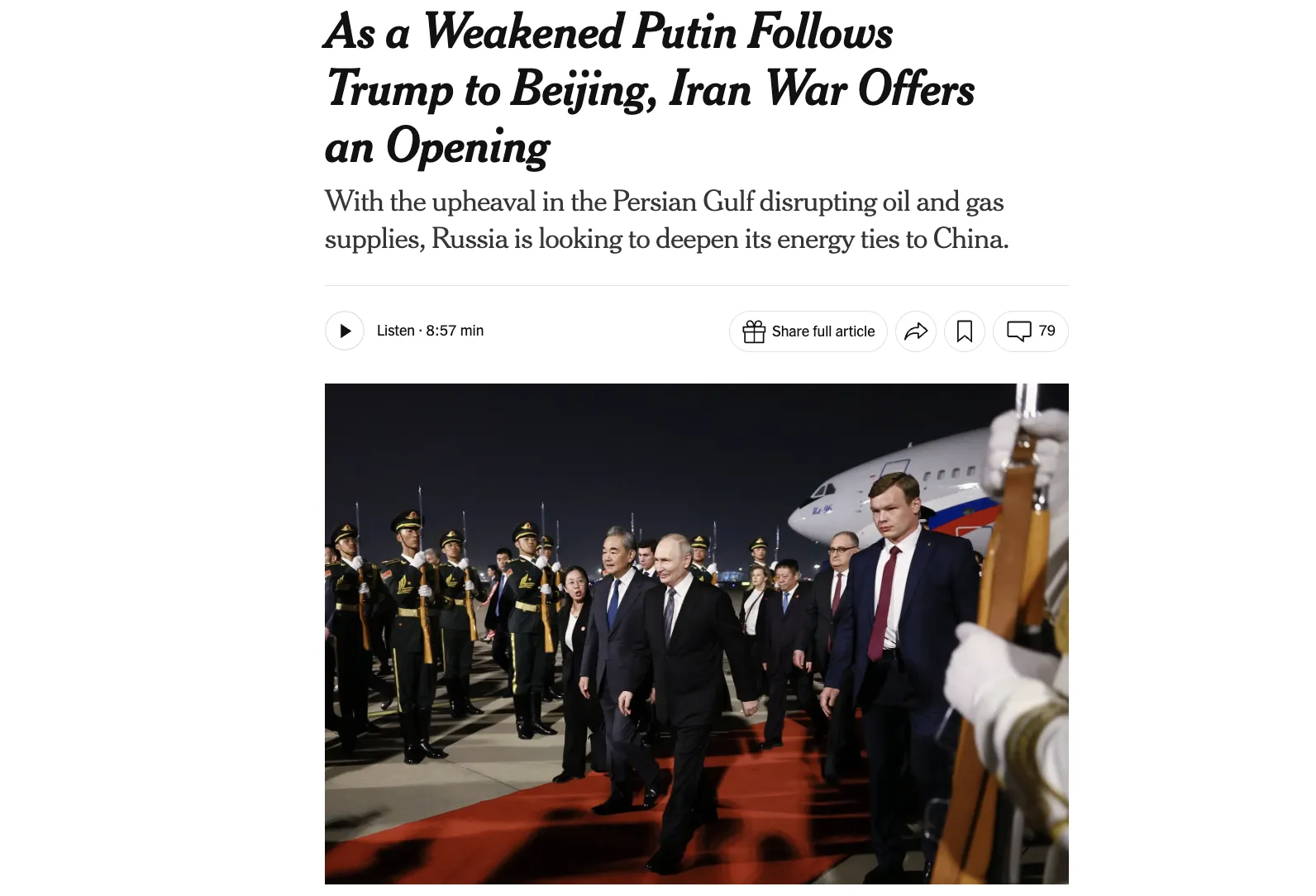
Amid instability in the Persian Gulf, Russia is seeking to deepen its energy cooperation with China, according to an analysis by The New York Times. The publication reports that disruptions in oil and gas supplies caused by regional conflicts could increase global markets’ dependence on alternative routes and partnerships, particularly between Moscow and Beijing.
Russian dictator Vladimir Putin arrived in China on a state visit amid obvious domestic difficulties: the Russian military has made little progress in Ukraine, Moscow is suffering from drone strikes, the economy is facing serious problems, and the population is growing weary of the protracted war. Given the significant economic imbalance, China holds enormous leverage and can dictate its own terms for bilateral cooperation.
Despite its status as a “junior partner,” Russia remains important to China due to its larger nuclear arsenal, which is relevant given the potential superpower confrontation over Taiwan. Furthermore, Moscow positions itself as the leader of a new non-Western world order, a vision supported by Beijing.
The war against Iran, launched by the U.S. and Israel, has opened up new opportunities for rapprochement. The turmoil in the Persian Gulf, provoked by the policies of U.S. President Donald Trump—who visited Beijing five days before Putin—has disrupted the stability of energy supplies to China. Russia is attempting to capitalize on this crisis by positioning itself as a secure logistical alternative to the Middle East. This significantly increases the chances of realizing the stalled “Power of Siberia 2” gas pipeline project through Mongolia, which Beijing had previously hesitated over, demanding lower prices and fearing excessive dependence.
For his part, Xi Jinping, by hosting Putin immediately after Trump, seeks to present China as an indispensable global power that builds equal-footing relations with the U.S. while maintaining deep strategic ties with Russia. The leaders of China and Russia are united by a shared desire to counter American dominance. Despite Beijing’s calls not to use nuclear weapons, Moscow is acting independently—Russian troops are currently conducting nuclear exercises in Belarus, where they previously deployed such weapons. However, for China, Russia remains a predictable partner, unlike the U.S.
Russia’s dependence on China is increasingly evident at the everyday level: Russian highways are filled with Chinese cars, schools in Moscow offering Chinese language courses are overflowing, and due to the conflict in the Middle East, hundreds of thousands of Russians have shifted their vacation plans to China’s Hainan Island, taking advantage of the visa-free regime. In addition, businesses in both countries have successfully adapted to Western sanctions: transactions between banks now take less than half an hour, whereas they used to take weeks.
Earlier, Vladimir Putin arrived in China for a two-day visit, where he will hold talks with Chinese leader Xi Jinping amid sanctions pressure and Russia’s growing dependence on the Chinese market.
On May 19, China’s Foreign Ministry denied a Financial Times report that Xi Jinping had allegedly spoken negatively about Russian President Vladimir Putin’s actions during talks with Donald Trump.
Earlier, Trumppointed out the catastrophic consequences of a mistake in choosing a successor – Fortune.
On May 18, U.S. President Donald Trump posted an AI-generated image in which he is allegedly depicted alongside an “alien” and accompanied by “space forces.”
U.S. President Donald Trump plans to hold a meeting with his national security team this week to discuss possible military action against Iran. According to Axios on May 18, these discussions are taking place amid deteriorating diplomatic efforts and rising tensions between Washington and Tehran.


