
War in Iran Weakens U.S. Position — Politico
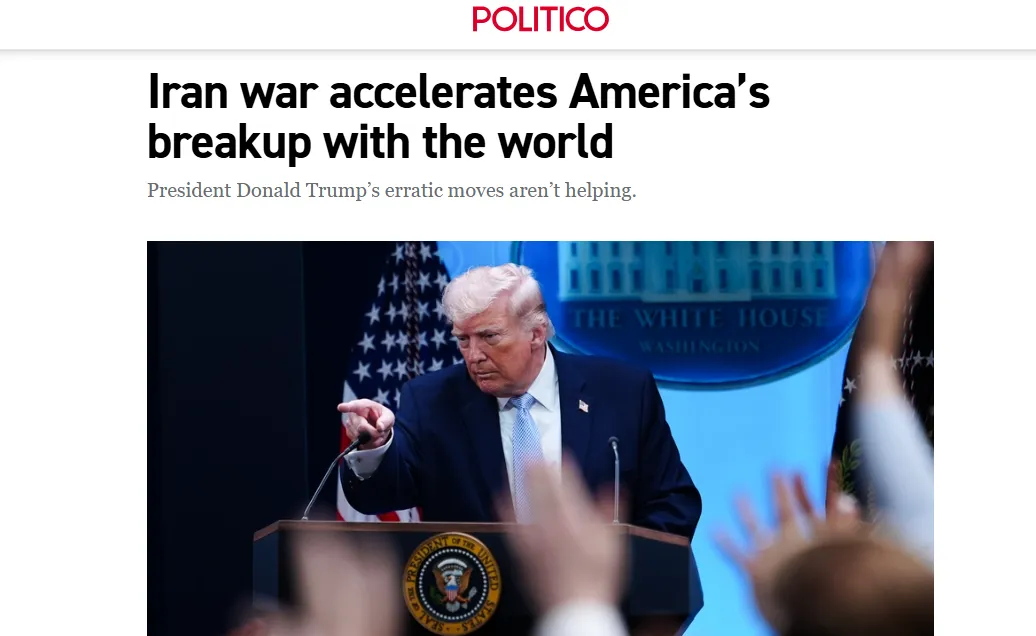
War in Iran undermines U.S. influence around the world and complicates relations with countries that have already felt the effects of Donald Trump’s policies.
According to Politico, this situation could have long-term consequences, and U.S. rivals, particularly China, are trying to capitalize on Washington’s weakened position.
As the publication notes, from Bangladesh to Slovenia, fuel rationing has paralyzed transportation, sparking discontent among leaders forced to deal with the consequences of a war they did not want.
In Muslim-majority countries, the airwaves are filled with anti-American rhetoric, often with the tacit consent of governments.
Even America’s NATO allies have limited their assistance to the U.S., with some emphasizing that the Trump administration did not consult with them before launching military operations against Iran.
“It seems the war is accelerating what some call the U.S. ‘disconnect’ from most of the rest of the world since Trump returned to office and began chaotically wielding economic and military power, including the imposition of tariffs,” the article states.
As one diplomat in Washington put it, “many are fed up with how chaotic this war has been and are frightened by the potential economic fallout, though I haven’t seen any major protests in response.”
"If a more level-headed person becomes the next president, the U.S. image may improve, but this poses complex long-term questions for politicians regarding the alliance: how far can we go in our loyalty to the U.S., and what should we do if we can no longer rely on them," he said.
Foreign Countries Distancing Themselves
Another sign of foreign nations distancing themselves was a statement by Canadian Prime Minister Mark Carney. In a recent video address, he called his country’s economic ties with the U.S. “weaknesses” that need to be corrected.
“We must take care of ourselves because we cannot rely on a single foreign partner,” emphasized Carney, who has increasingly criticized Trump, partly due to his threats toward Greenland.
“We cannot control destabilization from our neighbors. We cannot stake our future on the hope that this will suddenly stop,” he added.
Some former U.S. officials explained that Trump’s constant vacillation regarding his goals in Iran does not inspire confidence.
“Allies don’t know what to believe, adversaries don’t know what to fear, and his own cabinet doesn’t understand what his strategy or intentions actually are,” said Thomas Wright, a former National Security Council staffer in the Biden administration.
“The long-term outlook is not set in stone. But the question is what China, Russia, North Korea, and Iran will do over the next two years and nine months if this drift continues,” he noted.
In response to a request for comment, White House Press Secretary Anna Kelly stated that Trump’s “America First” approach has led to better trade deals, expanded partnerships in the fight against drug trafficking, and increased defense spending by allies.
"World leaders have been talking about the threat from Iran for 47 years, but no one had the courage to address it. Once all our goals are achieved, including the final elimination of the Iranian nuclear threat, the whole world will become safer, more stable, and better," Kelly emphasized.
Fewer allies on the battlefield
Tensions within America’s military alliances cannot be ignored as the war continues, the article states. In previous wars in the region, U.S. presidents managed to rally even those allies who were reluctant to cooperate.
This includes the Trump administration, which requested assistance in defending Israeli cities and civilian infrastructure from Iranian attacks last year.
This time, the Trump administration did not brief even its closest allies in advance and has not made clear requests of them since then, the journalists report.
This had consequences. In response to the closure of the strait, the United Kingdom and France held several meetings with dozens of allied nations—but without U.S. participation—to develop a plan to ensure the strait’s openness after the war ends.
The European initiative will focus on conducting defensive operations to protect commercial shipping, but the timeline and composition of the forces remain under development.
This comes as the European Union is also exploring ways to strengthen the bloc’s collective defense mechanism, Article 42.7, in case it is put to the test in response to threats by the Trump administration to seize Greenland by force.
However, the article emphasizes that U.S. defense ties around the world are deep and difficult to sever.
Trump has repeatedly threatened to sever some of them (including withdrawing from NATO), but has not taken serious steps in that direction. Many countries, despite their dissatisfaction with Trump, still want to have U.S. military power on their side.
Diplomatic Failures
The war in Iran has also damaged America’s reputation and influence in countries where U.S. efforts to strengthen relations face stiff competition.
In an excerpt from a State Department cable, U.S. diplomats in Dushanbe, Tajikistan, warned that “the conflict in Iran has led to the emergence of a persistent anti-American narrative in Tajikistan’s extremely limited media space, as foreign actors increase their influence.”
The excerpt adds: “Our competitors are spending resources to ensure their narrative dominates in a country at the crossroads of Chinese, Afghan, Russian, and Iranian interests.”
Similar dispatches from Bahrain, Indonesia, and Azerbaijan also describe the spread of anti-American sentiment and warn that in some cases, U.S. security and diplomatic ties are at risk.
State Department spokesperson Tommy Pigott issued a standard statement: “Trump’s actions are making the United States and the entire world safer by preventing the Iranian regime from obtaining nuclear weapons. This is the reality, and the entire administration is acting in unison toward this goal.”
Trump’s actions in Iran have deepened the alienation of some allies, which began when he established the “Peace Council,” conceived as a body to implement an agreement between Israel and Hamas, but which critics suspect was intended to replace the UN.
Hungary and Bulgaria were the only EU members to officially join the council. Other EU countries preferred to keep their distance, according to media reports.
However, Trump’s supporters argue that any current difficulties caused by the president’s actions in Iran will be justified in the long run.
Alexander Gray, a senior National Security Council official during Trump’s first term, stated that the decision to deal with Iran now “will pay dividends for future presidents.”
Iran has officiallyrefused a second round of negotiations with the U.S. — Al Jazeera.
Iran has rejected Trump’s claims about transferring uranium to the US and accused him of manipulation
The U.S. and Iran are negotiating a potential deal that would involve exchanging enriched uranium for the unfreezing of approximately $20 billion in Iranian assets. Washington’s primary goal in the negotiations is to prevent Iran from accessing significant stockpiles of enriched uranium and to reduce nuclear risks.
U.S. President Donald Trump also announced progress in negotiations with Iran, under which Washington would allegedly receive all of Tehran’s enriched uranium without any financial payments.
Additionally, Israel agreed to a 10-day ceasefire with Lebanon and announced the start of a move toward a diplomatic settlement; however, Prime Minister Benjamin Netanyahu emphasized that the war against Hezbollah is not yet over and military operations will continue.


