
A Discussion on Democracy and Responsibility at the Lviv Media Forum
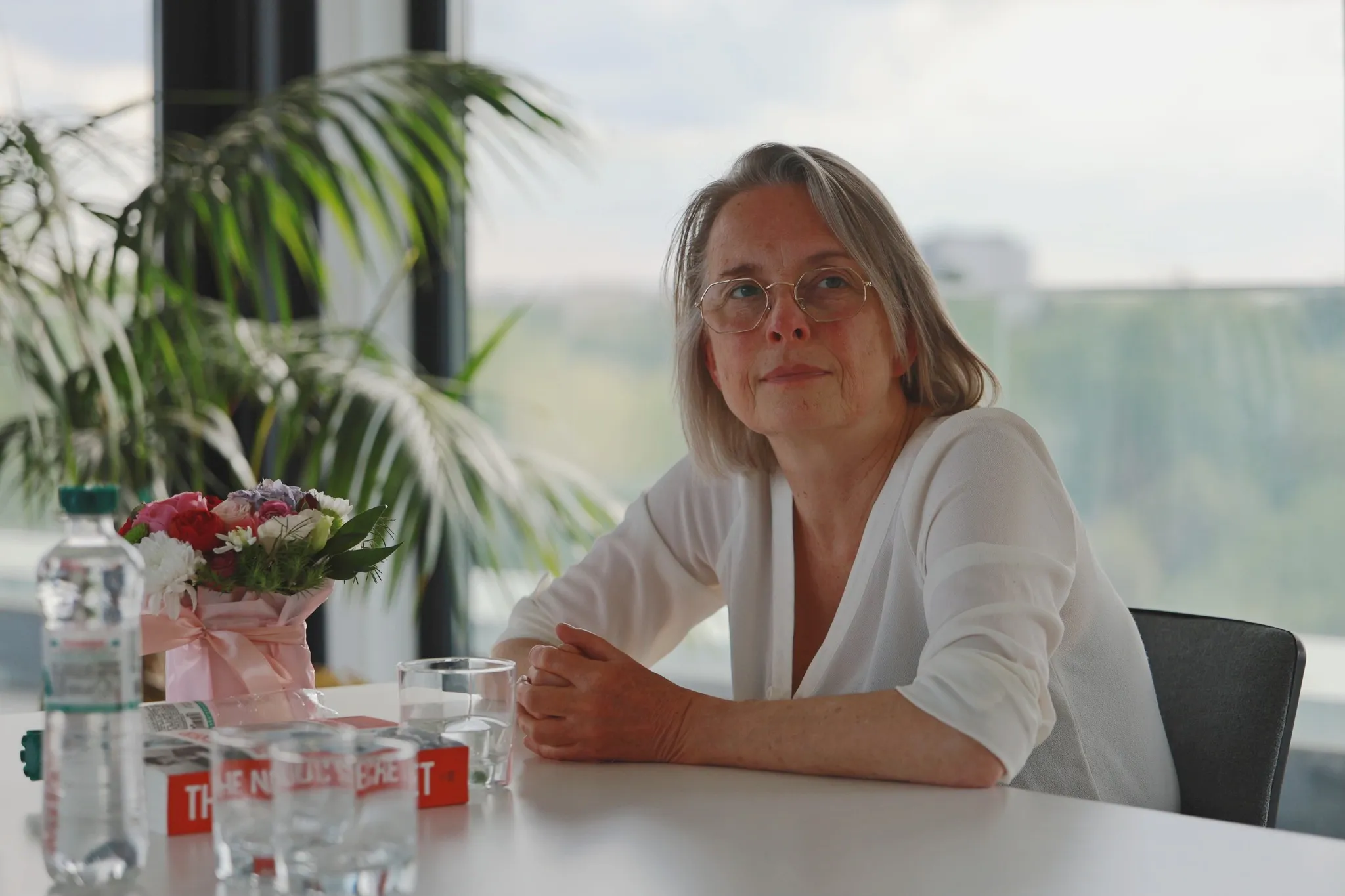
This year, the Lviv Media Forum served as a platform for various discussions on topics of public importance. One such discussion focused on the future of democracy. Danish thinker, futurist, and president of Nordic Bildung, Lene Rachel Andersen, and Ukrainian intellectual Valerii Pekar discussed why societies elect populists, how journalism fuels oversimplification, and what education can change if approached differently.
The brain wants simplicity—and that’s dangerous
The conversation began with Valery Pekar reminding the audience of the existence of the “Office of Simple and Quick Solutions” in Ukraine. People always want simple answers, especially during a crisis or war. And that is precisely what makes them vulnerable to manipulation.
Andersen explained that intuition is not a primitive reaction. It is backed by all of one’s life experience: books read, decisions made, mistakes committed. That is why a mature person is better at recognizing manipulation and is less likely to fall for simple answers to complex questions.
“You need life experience; you need to know as much as possible about the world, because then, when we encounter conspiracy theories, we can give a short answer and say: no, this is the correct answer,” Andersen added.
Three types of people: why most fall into the second category
Andersen identifies three types of people. The first lives solely by emotions. Such people do whatever they feel in the moment. The second type does what others expect of them. And the third is a free person. They are capable of choosing for themselves how to act.
It is the third type, according to the philosopher, that is the foundation of democracy. Because when the crowd is swept up in aggression, the “emotional” ones pour fuel on the fire, and the “obedient” ones simply join in. And only those who have learned to think for themselves are capable of stopping this mechanism.
The media is part of the problem
When the conversation turned to the “immature voter,” Andersen addressed the media:
“If journalists are only looking for conflict and a winner in debates—no one will learn anything. We need to turn journalism into a learning process.”
To back up her point, Andersen cited an example from Denmark. She explained that in the last election, not a single televised debate mentioned the topic of artificial intelligence. Politicians argued about taxes, just as they did 30 years ago. Instead, the philosopher says, it would have been better to invite AI experts into the studio and let politicians, journalists, and viewers figure out the topic together.
On Trust and Responsibility
The topic of trust in institutions was also touched upon. Andersen replied briefly:
“Trust cannot be demanded. Responsibility lies behind it. You can build trust even by acknowledging failure—if you’re honest about it.”
What Ukraine and Denmark Have in Common
One of the most personal moments of the talk was Andersen’s story about how she discovered Ukraine through translations of her books. She drew a parallel between the Danish Bildung movement after 1864, when Denmark lost part of Jutland, and current developments in Ukraine.
“If we don’t know who we are, then what are we fighting for?” the writer asked rhetorically.
Andersen also mentioned the Ukrainian “Prosvita.” In her view, it was a movement that combined culture with civic education. This was precisely the role played by Danish folk schools in their time.
On “good” and “bad” nationalism
Is it possible to be a nationalist and remain a democrat? Andersen believes so, and distinguishes between the two concepts. Loving one’s country, its history, and its culture is normal. What is dangerous is when a nation considers itself superior to others and seeks to subjugate them. The problem in Europe, the philosopher says, is that intellectuals often despise national identity. By doing so, they push ordinary people toward populists.
Morality, Art, and “Moral Muscle”
The question arises: how do we raise a person capable of resisting manipulation? Andersen offers a simple answer—read and discuss. Not for the sake of evaluation, but to learn how to think. If you ask a child why Robin Hood acted the way he did and whether he was right—you’re already beginning to shape their moral character.
Of course, the questions raised by Andersen and Pekar don’t have quick answers. However, the willingness to ask them and seek answers is a step toward maturity—both personal and societal.


