
A Roundup of the Top News Stories by Vladimir Orlov for UA.NEWS
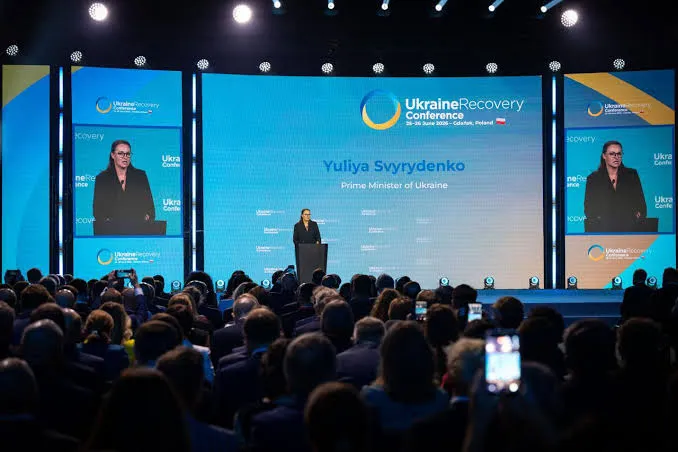
International News. The URC 2026 international conference on Ukraine’s recovery is kicking off in Gdańsk. This is one of the most important events of the year for the Ukrainian economy and the country’s future reconstruction. Despite some tension in relations between Kyiv and Warsaw, the Polish side is sending a clear message: “Historical claims remain a subject of discussion, but no one intends to derail Ukraine’s recovery or multibillion-dollar international projects.”
The Ukrainian delegation is led by Prime Minister Yulia Sviridenko. The main goal is to attract new funding and launch joint projects with international partners. Ukraine expects the conference to yield funding packages for the energy sector, as well as new projects from the European Bank for Reconstruction and Development and the European Investment Bank. It also anticipates the signing of contracts for Ukrainian and Polish businesses in the field of infrastructure reconstruction.
Another key area is the defense industry. For the first time, issues of security and the development of defense production will take center stage at the conference. The creation of mechanisms to insure against military risks for investors will also be discussed, which paves the way for private capital to flow into Ukraine even amid the war. In fact, what is being decided in Gdańsk today is not only the reconstruction of destroyed facilities, but also the shaping of conditions for Ukraine’s economic development in the coming years. In my view, what matters for the country today is not whether Zelenskyy attended or not. What matters is how many agreements will be signed. If the event brings new funds for energy, defense, and reconstruction, then in a week’s time, only political commentators will remember the diplomatic scandal.
Continuing this topic: Another important signal for Ukraine ahead of the conference came from the American business community. According to a survey by the American Chamber of Commerce, most companies are not only continuing to operate in Ukraine during the war but are also considering participating in the country’s future reconstruction. Among the main challenges, businesses cite security risks, a labor shortage, and complex logistics. At the same time, investors are demonstrating a willingness to remain in the Ukrainian market and invest in new projects. In fact, this is one of the most important signals in recent times, because Ukraine’s recovery is impossible to achieve solely through international aid and loans. The country needs private investment, new enterprises, and new jobs. That is precisely why, at the conference, Ukraine is counting not only on financial support from its partners but also on attracting major international businesses.
If American companies are already ready to operate in Ukraine today, it means they see prospects for the country’s development after the war ends. For Ukraine, this isn’t just an economic issue—it’s a matter of trust. After all, major investors vote not with statements, but with their own money.
Let’s talk about anti-corruption news. It seems another front has opened up in Ukraine. Only this time, it’s not in the east of the country, but in the offices of Kyiv. An interesting document from NABU has appeared online. In it, the bureau asks ministries and agencies to report exactly who has been appointed to their ranks from the SBU. A logical question arises: why? The SBU’s Active Reserve Officers’ Institute has existed for many years. This is no secret; it’s not a state secret. Moreover, there are quite a few officials in Ukraine who have risen to high government positions specifically from the SBU under such appointments. For example, Serhiy Lysak, head of the Odesa City Military Administration, has worked in the SBU system for many years and has headed military administrations since 2023. Therefore, if this document is genuine, it appears that the NABU has decided to conduct its own inventory of individuals connected to the security service. This already seems quite strange, especially during wartime. Fighting corruption is one thing, but information about how government agencies interact with the security service is quite another. Now for the main question: How will the service itself react to this? Will it remain silent, or will it remind everyone where the authority of one agency ends and that of another begins? The story surrounding NABU’s letters may turn out to be much more interesting than it seems at first glance. My personal opinion, given the latest events in the country, is that there will be no reaction whatsoever—neither from the service nor from the country’s leadership.
Let’s talk about the defense forces. Ukraine continues to strike at critical infrastructure in Russia and occupied Crimea. The main news is the strike on the railway bridge across the North Crimean Canal. It was through this branch that military supplies were delivered to the Russians in Crimea. At the same time, strikes have been confirmed on gas processing plants and industrial facilities in Russia’s Orenburg region, which serve the Russian economy and the military-industrial complex. A separate issue is the Moscow oil refinery in Kapotnaya. According to available information, the damage is so severe that the facility’s full restoration could take as long as until 2027. This is one of the key refineries that supplied fuel to Moscow and central Russia. The reaction in Russia is becoming increasingly tense. Russian military bloggers are openly questioning the effectiveness of air defense systems, and residents of oil-producing regions are increasingly complaining about fuel shortages. Whereas before the war was something far away on TV for most Russians, today it is increasingly affecting their logistics, energy sector, and, most importantly, their wallets.
Finally, a note on the National Cashback program. No one is canceling the National Cashback program, but some of the funds may indeed expire on June 30. This is precisely why there are so many sensational headlines and confusion. By June 30, you must use the funds that have already been credited to your National Cashback card from previous periods. If you don’t spend them, they’ll be returned to the state budget. An important point: The program itself is not being shut down. Cashback for purchases of Ukrainian goods will continue to be credited in the future. In other words, the news is not about the program being canceled, but about the government setting a deadline for using the accumulated funds. So check your National Cashback card balance; if there are funds credited earlier, use them by the end of June.
If you do nothing, the funds will simply disappear from the card and be returned to the state budget. During the program’s run, 67% of Ukrainians have used the cashback at least once. The total amount of payouts has already exceeded 8 billion UAH.
That’s all for now. Take care of yourselves. If you can, spend the weekend relaxing and recharging your batteries before the new week begins. Thank you.
Subscribe to the UA.News YouTube channel, the official channel of a team of independent and unbiased media professionals and journalists.


