
An exhibition of Winston Churchill's paintings has opened in London — Euronews
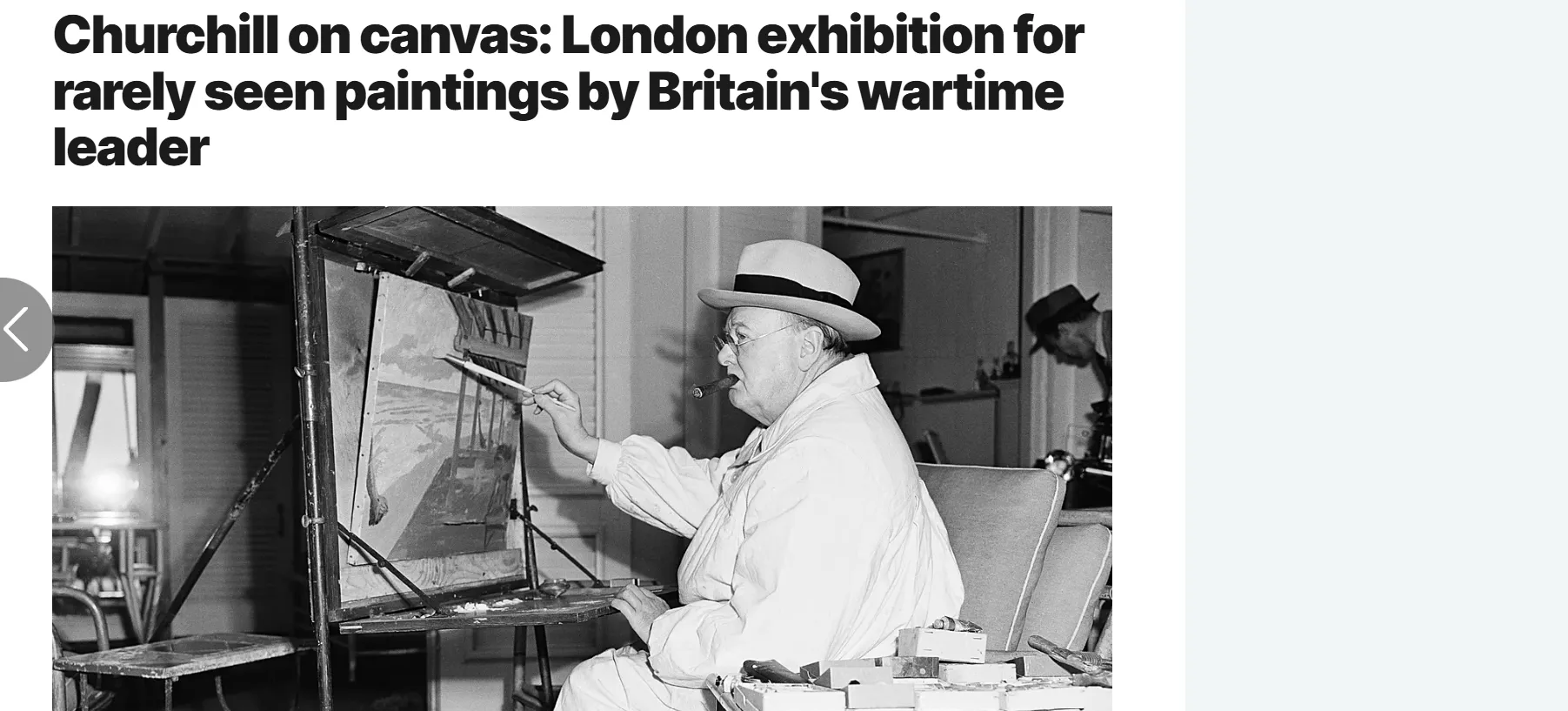
A unique exhibition dedicated entirely to the artistic work of legendary British politician Winston Churchill has opened at the Wallace Collection in London.
Euronews reports on this.
The organizers have brought together more than 50 paintings in a single space, a significant portion of which were previously unavailable to the general public.
The project’s curators officially call this event the most extensive display of the former prime minister’s artistic legacy in the last six decades.
The future head of the British government became seriously interested in painting during World War I. This happened in 1915, when he was forced to leave public office due to the failure of the Dardanelles operation and the tragic Gallipoli campaign.

As exhibition curator Lucy Davis notes, it was the visual arts that helped Churchill overcome severe stress, depression, and political disillusionment.
The famous politician was largely self-taught, although in the early stages of his artistic journey he sought professional advice from the artist John Lavery.
Over time, the amateur artist became passionately devoted to creating landscapes, drawing his main inspiration for his works during trips abroad to Morocco and the south of France.

His signature style is easily recognizable by his use of exceptionally vivid shades of blue and ochre.
A special place in the London exhibition is held by the famous painting “The Tower of the Koutoubia Mosque.” This is the only artwork that Winston Churchill created directly during World War II.
After the historic Casablanca Conference concluded, the artist personally presented this work to U.S. President Franklin Roosevelt.

Many years later, this rare work was part of Hollywood actress Angelina Jolie’s private collection, and in 2021, it was sold at a prestigious international auction.
Despite his extremely turbulent political career and constant involvement in world events, Churchill practically never depicted the historical upheavals of his time on canvas.
Experts note that his paintings reveal a completely different side of his personality to the public—one that is cheerful, thick-skinned, witty, and genuinely captivated by the beauty of nature.
Painting remained an integral part of his life until his death in 1965, and later even gained recognition at the Royal Academy of Arts.
Seventeenth-century paintings, believed to have been lost for nearly a century, were found in Spain
We previously reported that the recent discovery of two skeletons, mutilated in the same manner, suggests that limb amputation was used as a punishment during the Eastern Zhou Dynasty in China, over 2,000 years ago.
We also recall that during excavations in the ancient city of Laodicea in the Turkish province of Denizli, which is included on UNESCO’s tentative list of World Heritage Sites, a statue of Asclepius, the god of medicine in Greek and Roman mythology, and the head of a statue of his daughter Hygieia were discovered.


