
Mongabay reports opaque terms in South Africa’s spekboom carbon credit market
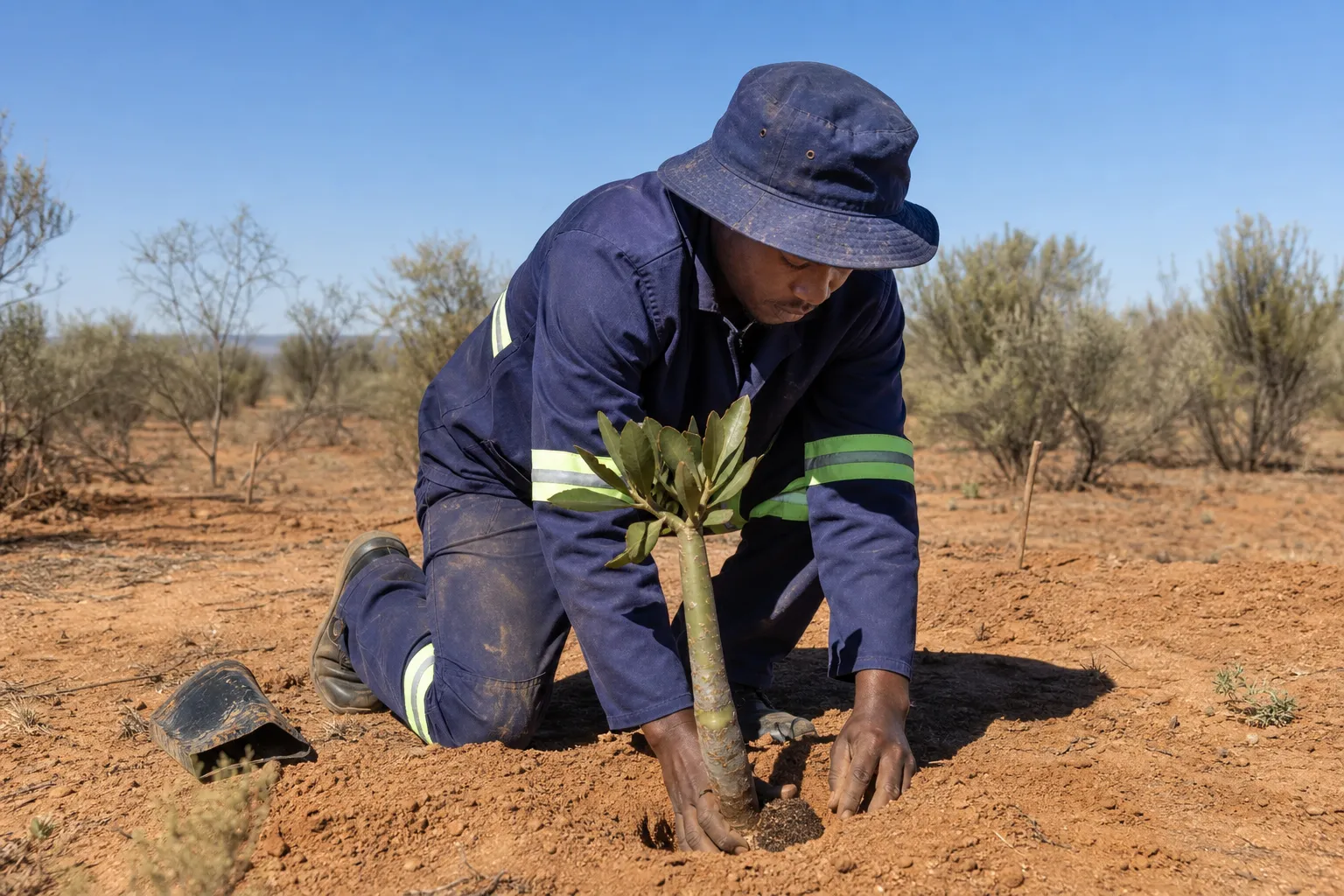
The World Bank created a $120 million outcome-based bond to restore the degraded Albany thicket biome in South Africa using spekboom, a succulent plant. At the same time, the terms of investment, revenue sharing and carbon credit trading remain only partially accessible to public scrutiny, according to an investigation by Mongabay.
The biome in the Eastern Cape province covers 1.71 million hectares, or 2.4% of South Africa’s area. According to the outlet, about 90% of this territory is partially or severely degraded, including as a result of prolonged intensive livestock grazing. Spekboom, or Portulacaria afra, can grow on damaged land in hot and arid conditions, so its large-scale planting is seen as a way to restore vegetation and absorb carbon dioxide.
Project financing
The first project to use funds from this World Bank bond was a project by Singaporean company Imperative Global Solutions. The company began pilot plantings on 10,000 hectares in November 2024 and completed this stage in just over a year. It then raised $91 million in loans: $25 million was provided by the World Bank bond, while another $66 million came from other investors.
Imperative plans to plant spekboom on 100,000 hectares by 2030. According to the company’s forecast, the plantings could absorb 41.6 million tonnes of CO2 equivalent over 40 years, corresponding to the same number of carbon credits. However, the actual accumulation of carbon in plants and soils can only be determined 10–15 years after the first plantings.
More current news is available on the UA.News Telegram channel Telegram.
Amazon’s role and deal terms
Amazon agreed to purchase 1.95 million credits from part of Imperative’s 50,000-hectare project. This represents 9.4% of the projected 20.8 million credits that this part of the project could generate over four decades. According to Mongabay, the corporation does not plan to use these credits to offset its own emissions, but intends to sell them to partners in its supply chain through the Sustainability Exchange platform.
Amazon did not disclose the commercial terms of the deals, including prices, possible discounts for large volumes and the markup structure for administering transactions. The company said it would include a small margin in the sale price to cover costs for staff, technology, registries and other needs. According to Carbon Market Watch, intermediaries and carbon credit exchanges typically charge administrative fees of 5% to 30%.
Imperative also did not disclose the terms of its contracts with farmers regarding the distribution of revenue from credits. The company leases rather than purchases land and expects that the project’s first 60,000 hectares could bring local communities about $500 million over 40 years through wages, lease payments, taxes, revenue sharing and small-business support.
Closure of a previous pilot project
Mongabay also mentions a small spekboom project in the region that was closed by South Pole. This happened after the scandal surrounding the Lake Kariba forest project in Zimbabwe. According to The New Yorker, as cited in the investigation, the project, covering more than 700,000 hectares, significantly overstated the volume of supposedly avoided emissions, and more than half of its 27 million carbon credits were found to be fabricated. South Pole told Mongabay that its South African initiative was an early pilot project that it decided to close after assessing its commercial viability.


