
Astronomers have observed the Helix Nebula dispersing into the interstellar medium
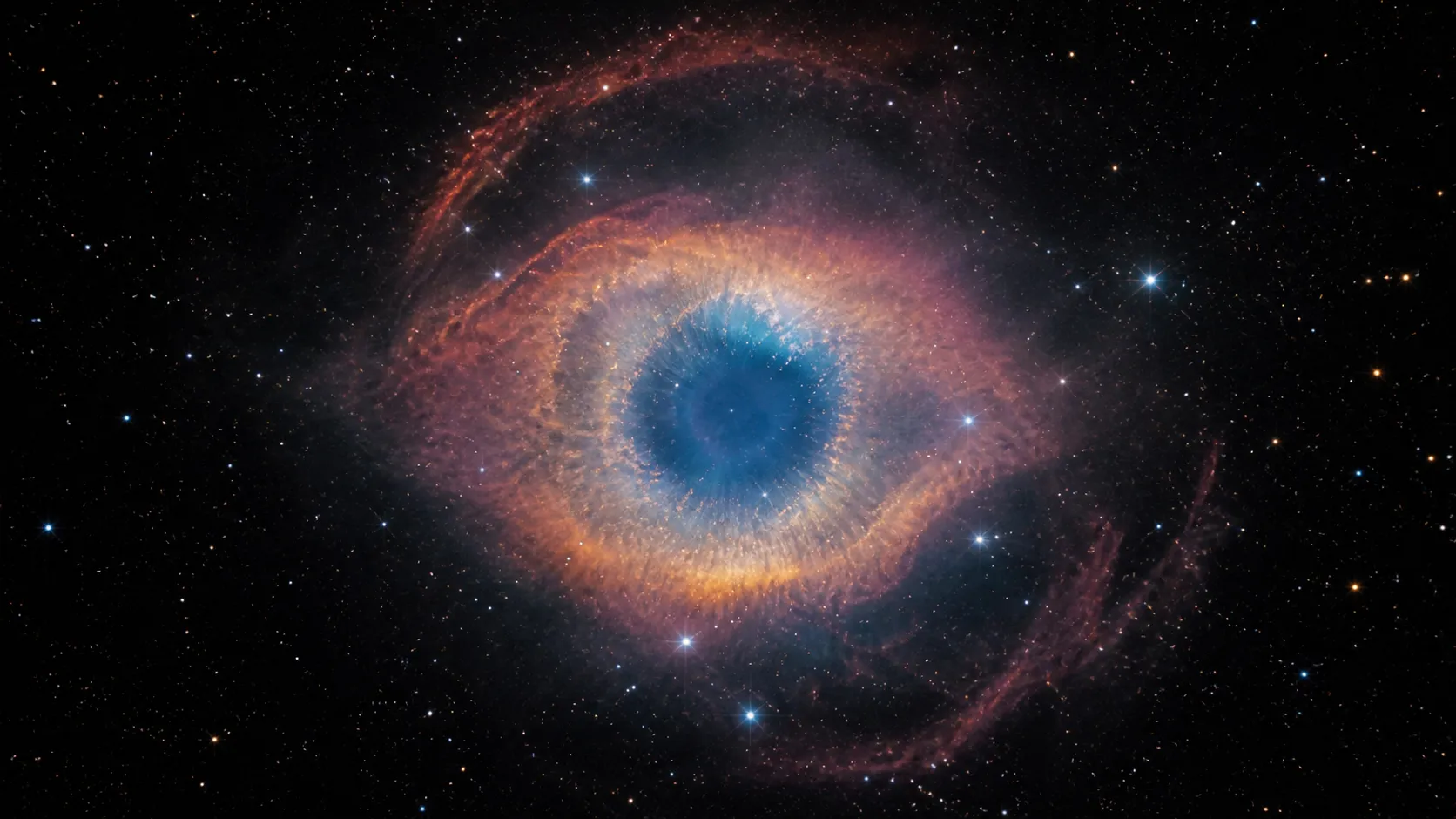
Astronomers have detected complete or partial arc-shaped gas structures in the outer halo of the Helix 22 nebula. According to the researchers, these structures show how matter ejected by a star at the end of its evolution gradually breaks down and mixes with the Milky Way’s interstellar medium. The nebula is located approximately 650 light-years from Earth in the constellation Aquarius, according to Space.com.
The observation was made by chance by a team led by Yale University astronomer Peter van Dokkum while calibrating the new MOTHRA — Modular Optical Telephoto Hyperspectral Robotic Array — at the El Sausse Observatory in Chile. Once complete, the system will consist of 1,140 telephoto lenses and will search for traces of faint gas in the Milky Way.
The Helix Nebula formed after its central star, similar to the Sun, exhausted its supply of hydrogen for nuclear fusion reactions in its core. The star swelled into a red giant and later shed its outer layers into space. Its inert core collapsed and became a white dwarf. The outer edge of the nebula’s bright ring spans 5.7 light-years in diameter, beyond which lies a faint outer halo.
For more breaking news, follow the UA.News Telegram channel.
The arc-shaped structures observed are shock waves. They form when gas clumps expanding from the planetary nebula collide with the interstellar medium. The structures closer to the central star are larger, thinner, and more sharply defined, while those farther away become smaller, fuzzier, and more fragmented. This indicates the gradual disruption and dispersion of the ejected material into the interstellar gas.
Researchers estimate that after coming into contact with the interstellar medium, the material of a planetary nebula can persist for about 10,000 years before it completely disintegrates and is absorbed by it. Elements formed in stars enrich molecular gas clouds, from which new stars and planets will form in the future. In about five billion years, scientists estimate, the Sun will also undergo a similar stage of evolution. The study’s findings were published on August 12 in the journal *Nature*.




