
Astronomers have discovered a rocky "mega-Earth" 23 times more massive than Earth
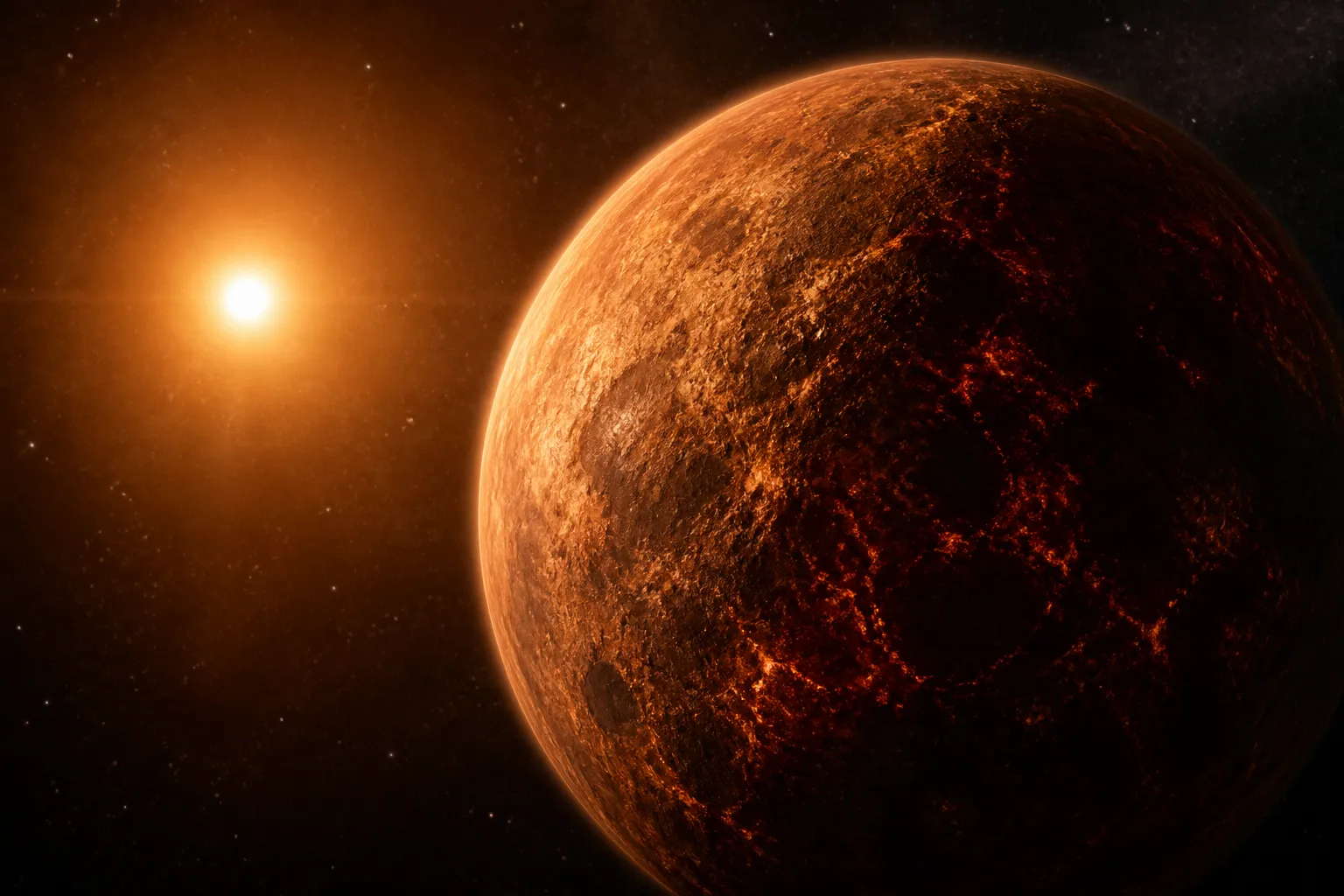
Astronomers have discovered the exoplanet GJ 523b, whose mass is approximately 23.5 times that of Earth, although its radius is only 2.55 times that of Earth. The high density of this world suggests that it is likely mostly rocky and has relatively little gas in its atmosphere, according to Space.com.
Such large and dense planets are informally referred to as “mega-Earths.” Researchers estimate that GJ 523b has a density of about 126.82 grams per cubic inch. The planet orbits its star in 17.75 days, and the age of its system is estimated to be nearly 170 million years.
The exoplanet candidate was first detected by NASA’s TESS satellite, which records periodic dips in the stars’ brightness as the planet passes in front of them. The object was subsequently studied using the ground-based 3.5-meter WIYN telescope at Kitt Peak Observatory in Arizona. Scientists measured the planet’s gravitational influence on its star using a spectrograph.
For more breaking news, follow the UA.News Telegram channel.
The parameters of GJ 523b pose a challenge to planetary formation models. Planets begin to form from cores of rock and metal, which can attract hydrogen and helium from the gas-dust disk surrounding a young star. In the Solar System, scientists believe that gas giants like Jupiter and Saturn began rapidly accumulating massive gas envelopes when their cores reached about 20 Earth masses.
GJ 523b already exceeds this mass threshold, but its high density suggests a relatively small amount of gas. Lead author Max Croft noted that dense planets do exist, but they are usually small and similar to Earth or Mercury.
Among the possible explanations, scientists are considering the loss of a primordial dense atmosphere or a collision between two planets, which could have formed a larger rocky object and ejected a significant portion of the gas envelopes into space. The paper has been submitted to The Astronomical Journal; it is also available on the arXiv preprint server and has not yet been peer-reviewed.




