
Researchers estimate RSA-2048 could be cracked in 3 days — ScienceAlert
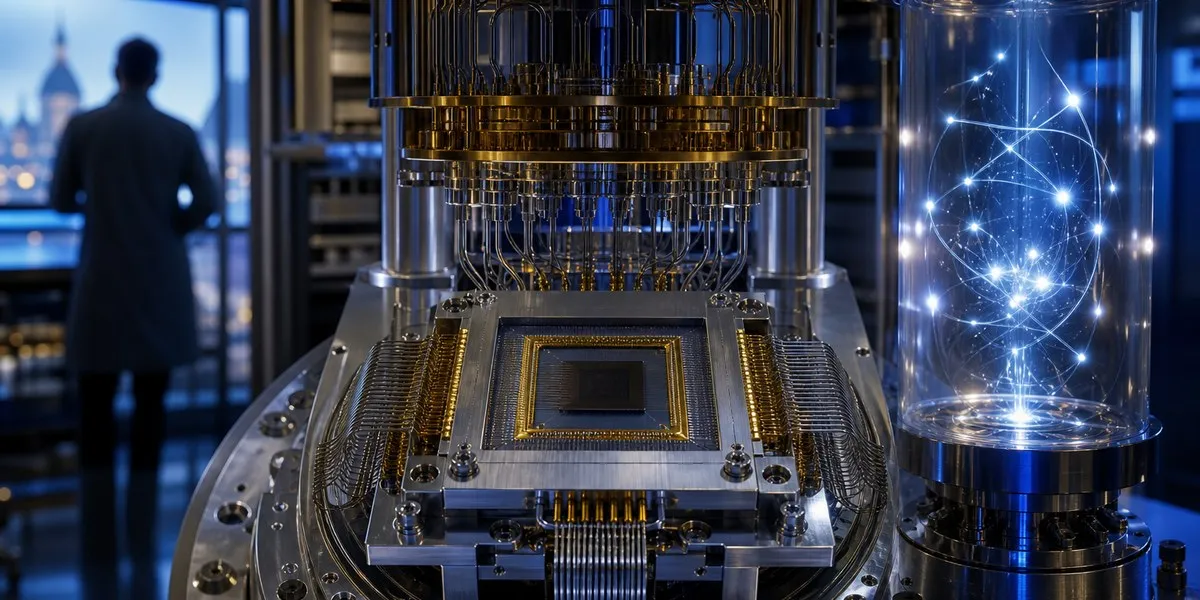
A team led by researchers from the French quantum company Alice & Bob presented a resource estimate for factoring an RSA-2048 key using Shor’s quantum algorithm. According to the calculations, a system with 22,593 superconducting cat qubits could complete the task in 3.14 days, ScienceAlert reports. The study was published as a preprint in the Cryptology ePrint Archive and has not yet undergone peer review.
Estimate for a quantum system
RSA-2048 relies on the mathematical difficulty of factoring a large number into prime factors. Shor’s algorithm, proposed by mathematician Peter Shor in 1994, is designed to significantly accelerate such computation on a quantum computer.
The authors considered an architecture based on cat qubits — quantum bits made of photons held in an oscillator. According to the researchers’ explanation, this approach can exponentially suppress bit-flip errors while linearly increasing phase-flip errors. Alice & Bob’s estimate is lower than previous calculations for other architectures: in 2023, the company estimated that 350,000 qubits would be needed, while the current model calls for fewer than 23,000.
More current news is available on the UA.News Telegram channel Telegram.
Limitations of current technologies
The calculation does not mean that such a quantum computer already exists. The authors note that no one currently has a functioning system with 23,000 qubits. The largest array, created by engineers at the California Institute of Technology, contains 6,100 qubits held by lasers, but it is not a ready quantum computer for such calculations.
The model also relies on the assumption that cat qubits will be able to avoid bit-flip errors for 100 years. At the same time, Alice & Bob researchers reported achieving an average time to such an error of 44 minutes for a qubit with 11 photons. If a time to bit-flip error of around one hour is assumed, factoring RSA-2048 would require approximately 45,000 qubits, according to the study’s estimate.
A separate estimate for Bitcoin
The researchers also estimated a system for breaking the elliptic-curve cryptographic protection used to confirm Bitcoin ownership. According to their calculations, 29,588 cat qubits could perform such a computation in 61.8 minutes. However, blocks on the Bitcoin network are created approximately every 10 minutes, so this speed would not meet the time constraint for intercepting a cryptocurrency transaction.




