
Live Science reviewed the Celestron StarSense Explorer DX 130AZ telescope
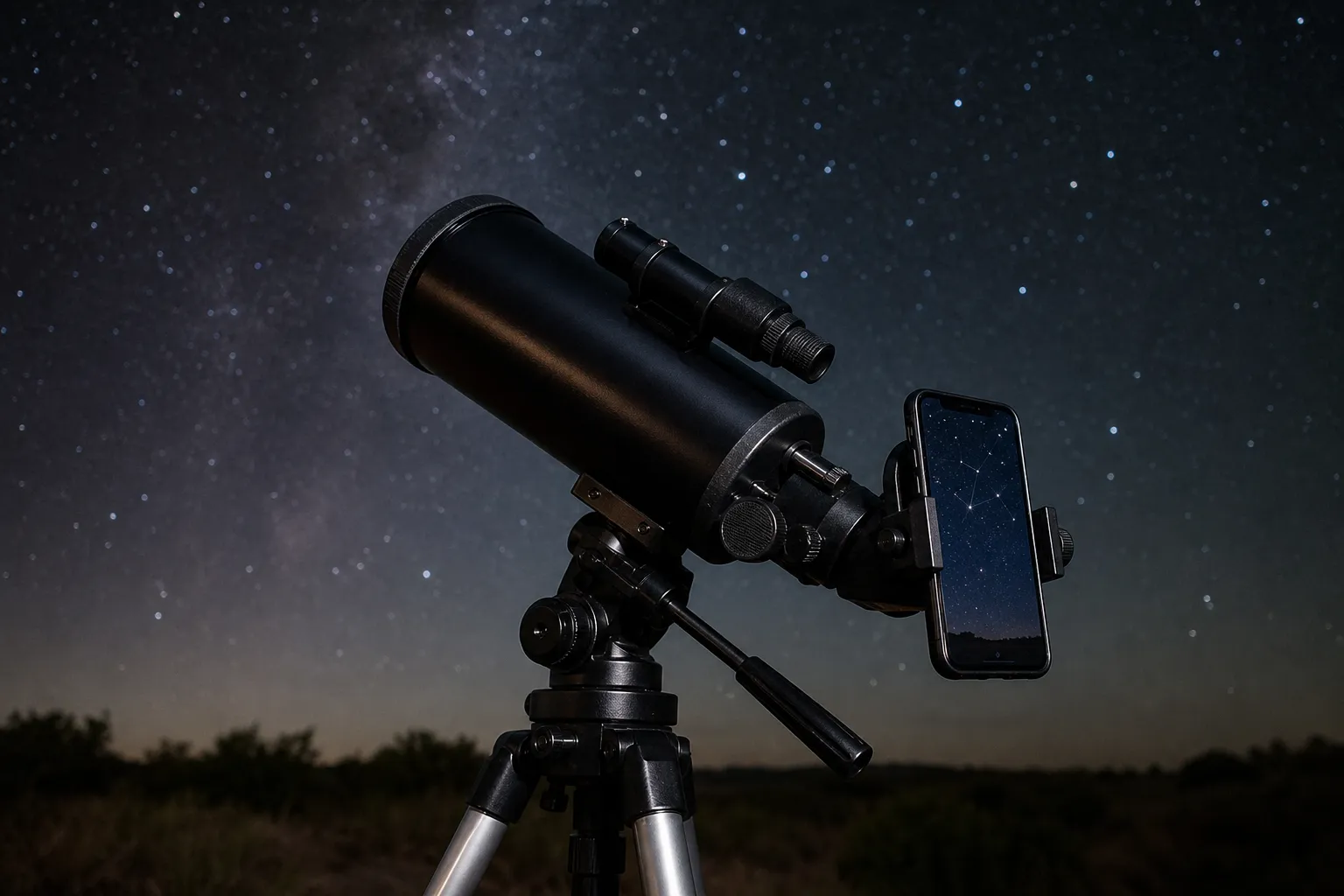
The Celestron StarSense Explorer DX 130AZ telescope combines a 130 mm Newtonian reflector, a manual alt-azimuth mount and a smartphone-guided pointing system. As Live Science reports, the model is suitable for observing the Moon, planets and bright deep-sky objects. The telescope can also be used manually, without the StarSense app.
Optics and accessories
The model has a 130 mm aperture, a 650 mm focal length and an f/5 focal ratio. The package includes 1.25-inch eyepieces: a 25 mm eyepiece with 26x magnification and a 10 mm eyepiece with 65x magnification. The total weight of the set is 8.16 kg.
The reviewer noted the sharp parabolic optics, wide field of view and portability of the device. At the same time, the included eyepieces have plastic housings, which may cause internal reflections. The author also recommends considering higher-quality eyepieces for a better image and a wider choice of magnifications. The Newtonian reflector requires periodic mirror alignment, but no collimation tool is included.
Smartphone-guided pointing
StarSense Explorer uses a phone holder and an app that helps point the telescope at objects without a motorized GoTo system. To begin observing, users need to assemble the tripod and mount, attach the optical tube and eyepiece, place the phone in the holder and perform alignment in the app.
More current news is available on the UA.News Telegram channel Telegram.
For quick observation of the Moon or Jupiter, a smartphone is not required: the telescope can be pointed manually. When using the app, the reviewer recommends reducing screen brightness and enabling red mode in order to have less effect on the eyes' dark adaptation. The system can also help identify Neptune among faint star-like points.
Capabilities and limitations
According to the review's author, the telescope shows details on the Moon, shadows of moons on Jupiter's disk, the Great Red Spot, Saturn's rings and several of its moons. Under dark skies, the instrument is suitable for observing large galaxies, nebulae and star clusters, while light pollution limits the visibility of faint objects.
Among the model's limitations are its small aperture, the lack of motorized pointing and tracking, as well as the mount's design. When pointing above approximately 70–75 degrees, the tube may hit the mount or tripod legs. The author notes that, for a similar price, manual Dobsonian telescopes with a larger aperture or motorized GoTo models can be considered.




