
Simulation recreated the formation of the Milky Way from thousands of galaxies — Live Science
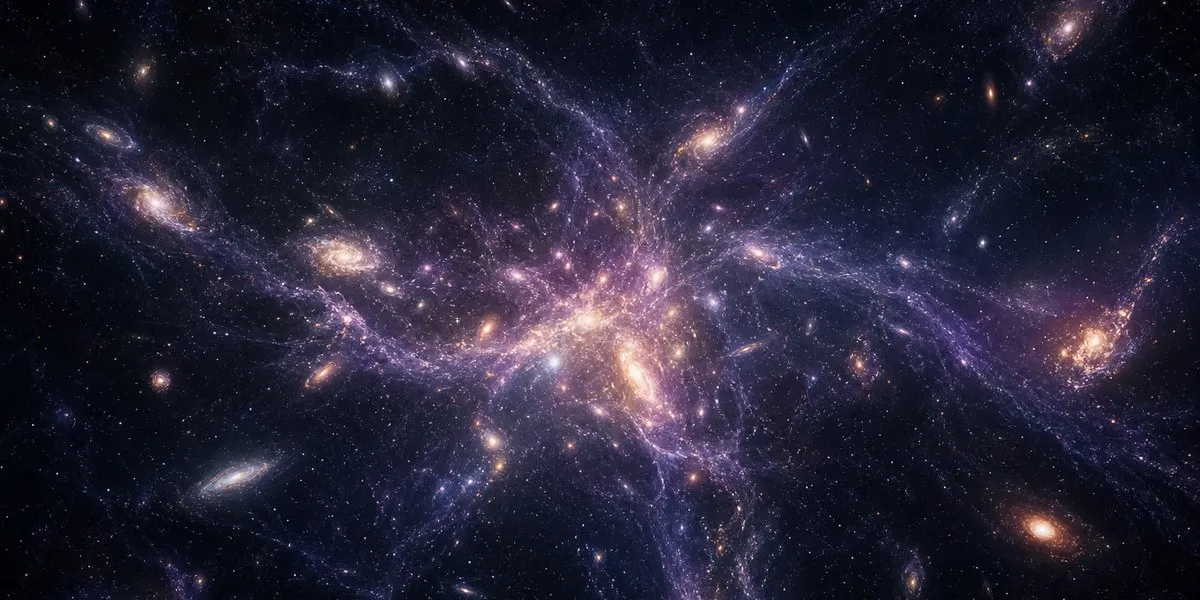
MEGATRON supercomputer simulations suggest that during the first 2 billion years after the Big Bang, the region of the Universe from which the Milky Way later formed was filled with thousands of small galaxies of different shapes and sizes. They later collided and merged, forming the galaxy that contains the Solar System, Live Science reports.
A model of the early Universe
The simulation was created over three years. It covers the period from 180 million years to 2 billion years after the Big Bang. At the initial stage, according to the model, there were still no stars or galaxies in the Universe — it contained only primordial gas.
The simulation tracks the formation of the first stars, their deaths, and the spread of heavy elements, including carbon, oxygen, and iron, through the surrounding gas. These elements became building materials for subsequent generations of stars and planets. The calculations also predict characteristic light and spectral signatures of virtual galaxies.
More current news is available on the UA.News Telegram channel Telegram.
Comparison with Webb telescope data
The MEGATRON results can be directly compared with spectral observations from the James Webb Space Telescope, which collects data from a similar span of cosmic time. The telescope has already detected unexpectedly bright galaxies and compact objects known as “little red dots” in the early Universe, which did not fully align with previous computer models.
Comparing the simulation with observations of early galaxies and chemical traces in ancient stars is expected to help test competing models of the first stars. The results were described in one of six papers by the MEGATRON collaboration, published on September 30 in The Open Journal of Astrophysics. The next generation of simulations is expected to account for more complex physics, including active black holes, which the Webb telescope has found to be a common phenomenon in the early Universe.




