
Three physicists receive award for altermagnetism — ScienceDaily
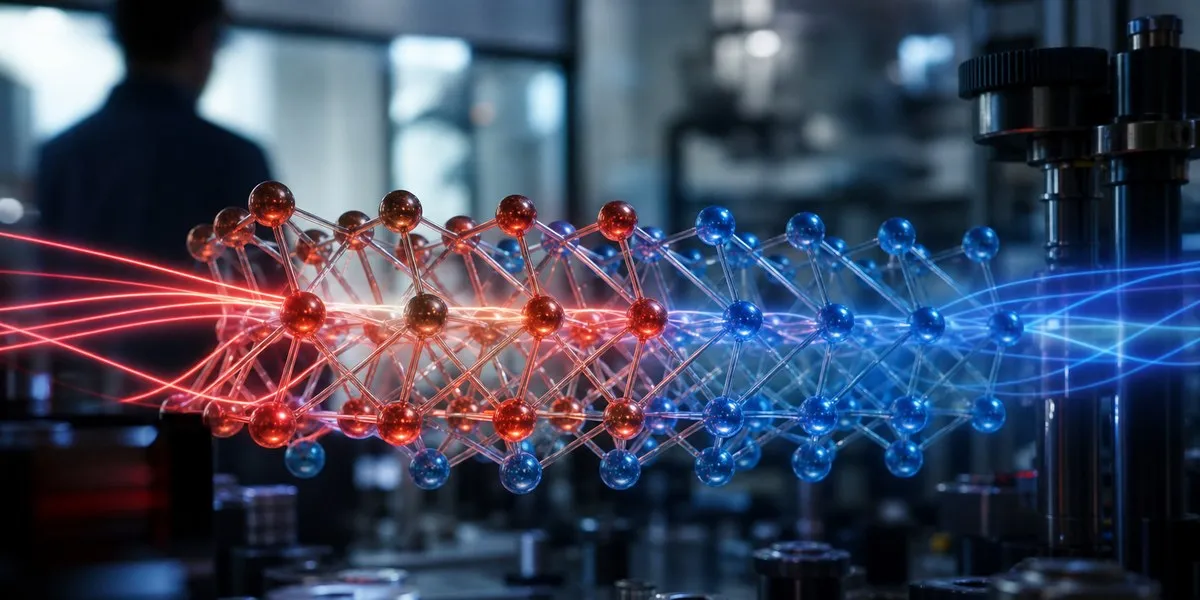
The European Physical Society has awarded the 2026 Europhysics Prize to Professor Jairo Sinova, Dr. Libor Šmejkal, and Professor Tomas Jungwirth for research into altermagnetism, a new type of collinear magnetic order. The prize, whose award ceremony was scheduled for September 2026 in Graz, Austria, was granted by the Condensed Matter Division of the European Physical Society, ScienceDaily reports.
Established in 1975, the Europhysics Prize recognizes significant achievements in condensed matter physics. This year's award was granted for theoretical and experimental work that established altermagnetism as a distinct form of collinear magnetic order.
The third category of collinear magnetism
For more than a century, collinear magnets have generally been divided into ferromagnets and antiferromagnets. In ferromagnets, magnetic moments produce a net magnetization, while in antiferromagnets, oppositely directed moments cancel each other out.
Like antiferromagnets, altermagnets have no net magnetization. At the same time, their electrons can exhibit properties previously associated with ferromagnets. In particular, such materials can sustain electric currents with strongly spin-polarized electrons and demonstrate very fast magnetic dynamics.
More current news is available on the UA.News Telegram channel Telegram.
These properties may be promising for spintronics, a field that uses electron spin in electronic devices. Altermagnetism is also linked to research into topological phenomena, unconventional superconductivity, and quantum materials with strong interactions between electrons.
From a theoretical model to experiments
The discovery resulted from years of collaboration between Sinova's group at Johannes Gutenberg University Mainz and Jungwirth's team at the Institute of Physics of the Czech Academy of Sciences in Prague. Šmejkal worked in Mainz from 2016 to 2024, first as a doctoral student and later as a postdoctoral researcher, and played a leading role in developing the theoretical foundation of altermagnetism.
In 2022, the researchers published a comprehensive symmetry classification of altermagnetism and identified hundreds of materials in which it could potentially occur. Experimental groups later tested these predictions using angle-resolved photoemission spectroscopy and electrical transport measurements. The results in several materials confirmed altermagnetic behavior.




