
Mosaic crystal structure discovered in a cuprate — ScienceDaily
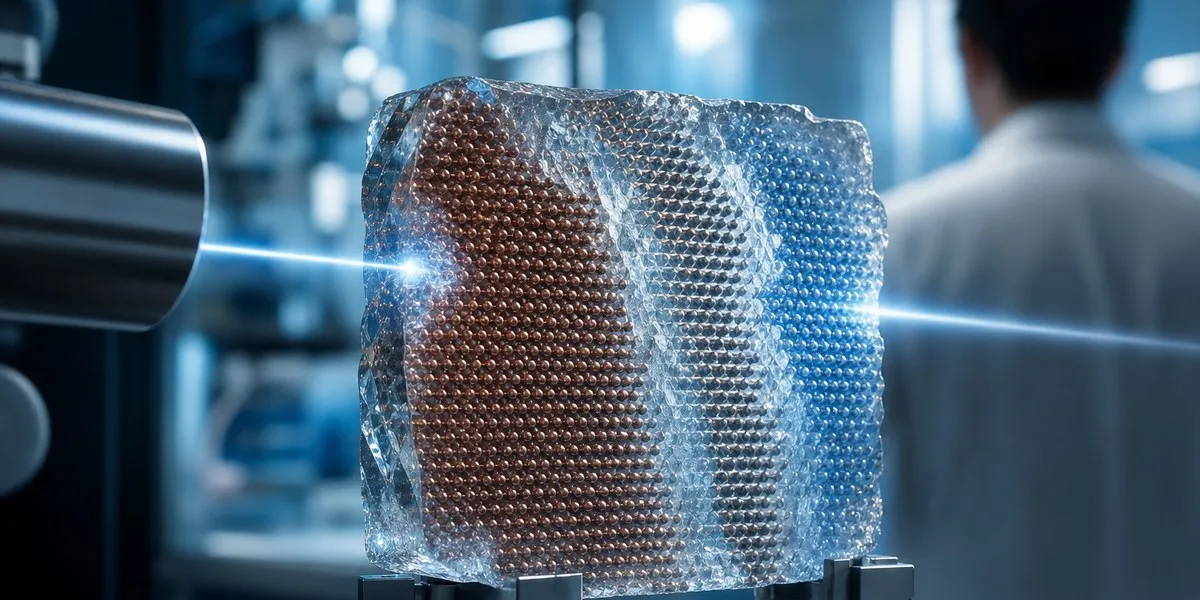
Researchers at the University of Warwick, in collaboration with the European Synchrotron Radiation Facility in France, have found that the internal structure of the cuprate superconductor they studied is not uniform. Instead of a single type of crystal structure, the material contains regions with two slightly different atomic configurations, ScienceDaily reports.
Three-dimensional study of the crystal
The scientists used scanning three-dimensional X-ray diffraction, a method that makes it possible to study the arrangement of atoms inside a crystal. In principle, this approach is similar to computed tomography, but instead of tissues and organs, it maps the material's atomic structure.
Three-dimensional imaging showed that the crystal consists of a mosaic of structural regions. The boundaries between them were found to be hundreds of times wider than researchers had expected. These transition zones are large enough to behave almost like separate structures and could potentially affect the flow of electric current through the material.
More current news is available on the UA.News Telegram channel Telegram.
Implications for theories of superconductivity
Cuprates are copper-containing superconductors capable of conducting electric current without resistance at relatively high, though still very low, temperatures. For around 40 years, theories of their superconductivity have largely relied on the assumption that the crystal structure of such materials is the same throughout their entire volume.
Research leader Professor Mark Senn noted that the broad boundaries between structural regions likely do not merely coexist with superconductivity, but may hinder it. According to the team, this may explain differences in the properties of various superconducting materials and will require a rethinking of some previous measurements of their bulk properties.
The results were published in the journal Physical Review Letters. The researchers suggest that similar hidden structural features may be widespread among other cuprates, as well as related materials being studied for superconductivity under extreme pressure. The measurements became possible after a €150 million upgrade of the European Synchrotron Radiation Facility.




