
MeerKAT radio telescope in South Africa detects hydrogen signals from the ancient universe
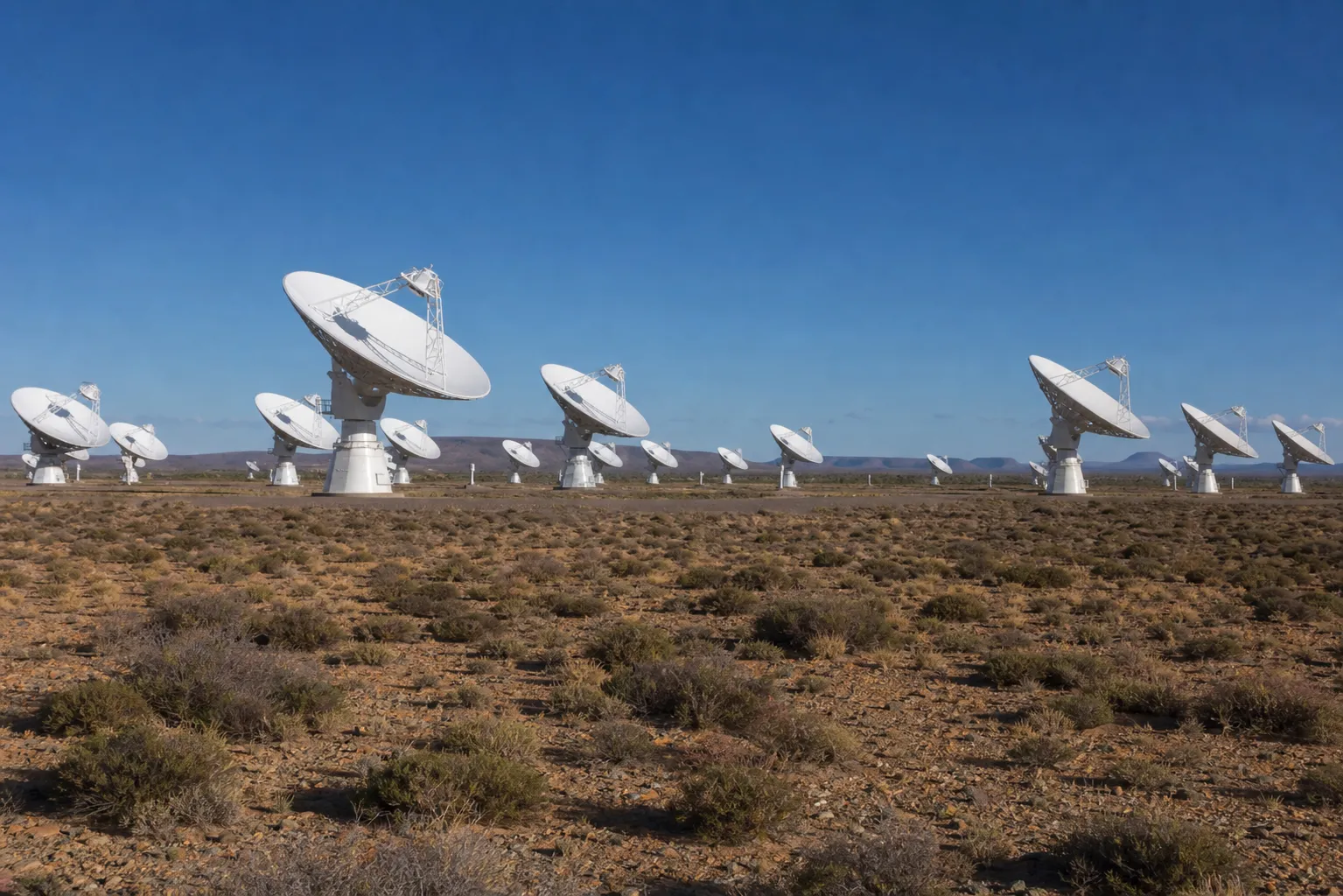
In South Africa’s Northern Cape province, astronomers using the MeerKAT radio telescope detected signals of neutral hydrogen from distant regions of the universe. They originate from a period when the cosmos was billions of years younger than its current age of 13.8 billion years. As Space.com reports, the result could help create more detailed maps of the large-scale structure of the universe.
The 21-centimeter hydrogen line
Neutral hydrogen emits a weak radio signal known as the 21-centimeter line. As a result of the universe’s expansion, the wavelength of this radiation increases — a phenomenon known as redshift. From the magnitude of the redshift, astronomers can determine how long the signal traveled to reach us and to which period in the history of the universe the hydrogen that emitted it belongs.
The method is called hydrogen intensity mapping. It makes it possible to track the combined radio emission of hydrogen across large cosmic volumes without the need to detect each galaxy individually. This allows researchers to create a three-dimensional image of the universe’s largest structures and study the distribution of matter and the evolution of galaxies.
More current news is available on the UA.News Telegram channel Telegram.
Analysis of MeerKAT data
The team analyzed about 96 hours of observations from MeerKAT, an array of 64 antennas in South Africa’s Northern Cape province. The researchers isolated hydrogen signals dating from a period approximately 4–5 billion years ago. Previously, hydrogen intensity mapping required combining radio observations with data from visible-light galaxy surveys. In the new study, the hydrogen intensity map was built from radio waves recorded by MeerKAT.
Team leader Surabh Paul noted that the signal is extremely weak and difficult to separate from background radiation, human-made radio interference, and instrumental effects. The researchers plan to conduct longer observations over larger areas of the sky to obtain more detailed maps of hydrogen distribution. The results were published in the July issue of The Astrophysical Journal Letters.




