
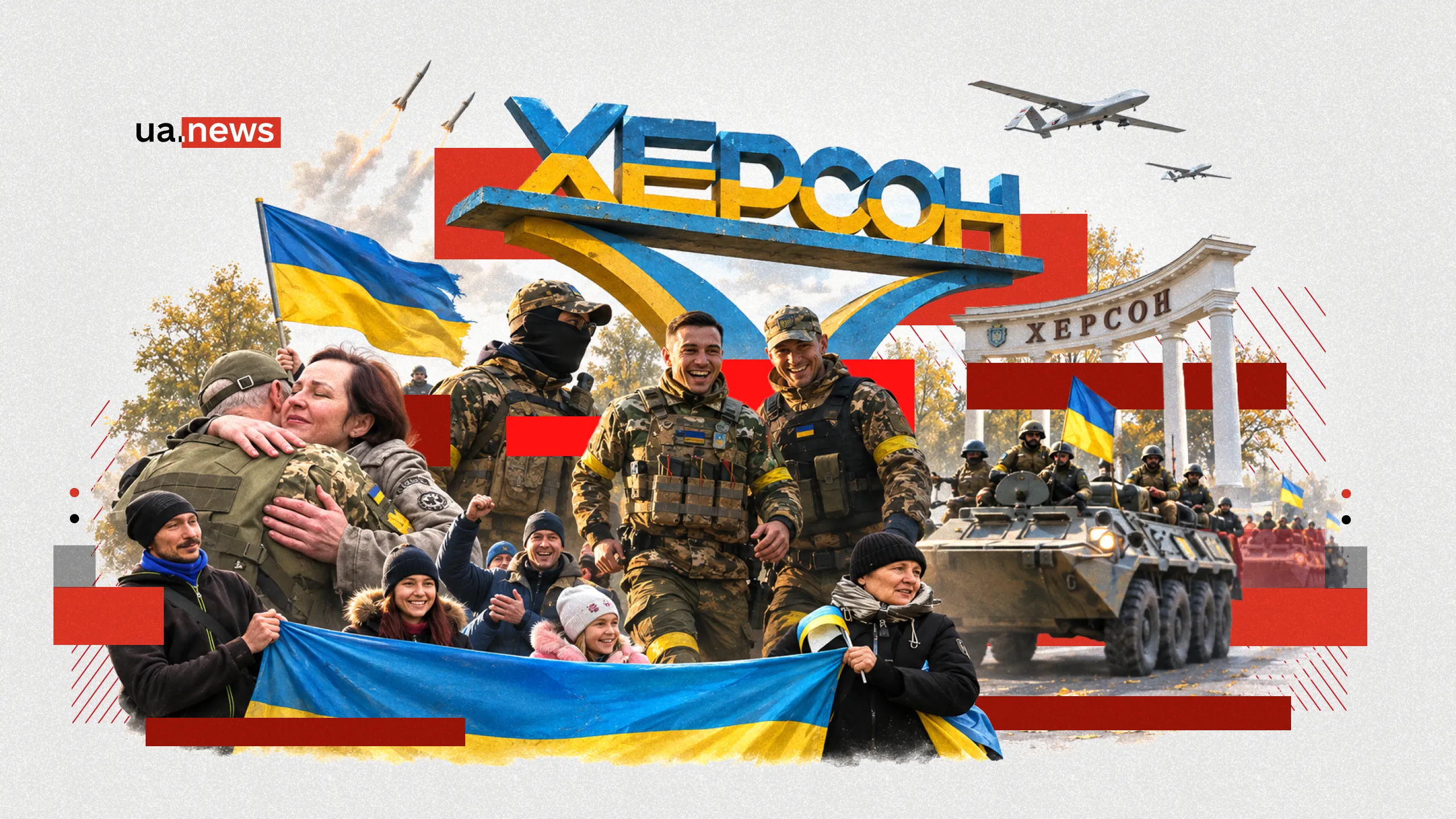
Today marks exactly four years since a day that remains one of the most memorable in this war for many Ukrainians. On November 11, 2022, the Armed Forces of Ukraine entered Kherson—the only regional capital that Russian troops managed to capture following the full-scale invasion and which they were later forced to abandon.
Of course, there had been other occupied regional capitals and regional centers before that: Simferopol, Sevastopol, Donetsk, and Luhansk. But that was part of a different phase of the war, one that began long before 2022. Kherson, however, became, in essence, Putin’s only truly significant “trophy” in this war—and he lost it.
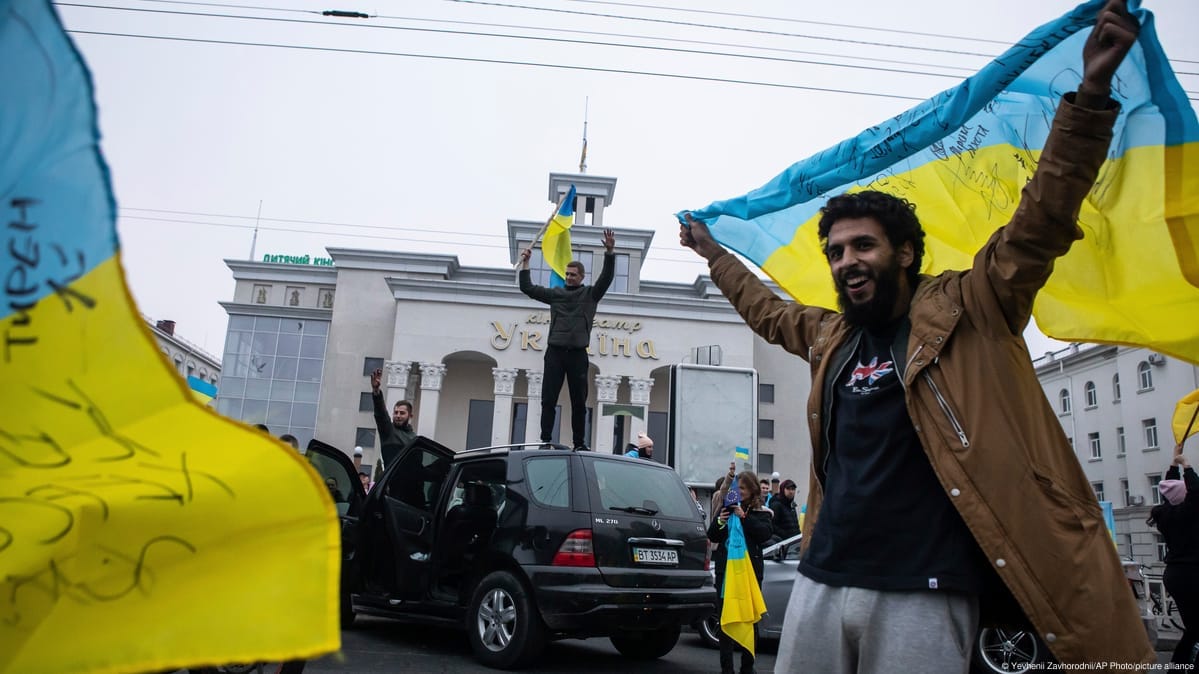
Those days are well remembered: the general elation, the tears of joy from residents on the streets of Kherson, hugs with soldiers, Ukrainian flags flying over buildings, and so on. It seemed that victory was near and that the war would soon end. But the liberation of the city, unfortunately, did not bring peace to its residents. Russia continues to terrorize the city and the people it considers “its own,” and in certain areas of Kherson, even simply stepping outside still poses a very real risk to one’s life.
Looking back at those events proves that negotiations should have taken place right then. That was the moment of Ukraine’s greatest strength and the Putin regime’s greatest weakness in this war. But no one seriously considered negotiations at that high point. So the war continued—and continues to this day.
And yet, today is a day of celebration for the people of Kherson, because four years ago, their city returned home. How was Kherson captured, what was life like under occupation, how was it liberated, and what is happening there now, four years later? Read more in this UA.News article.
8.5 Months of Occupation: How Russia Captured and Held Kherson
Kherson was occupied from the very first days of the full-scale invasion, as early as March 3, 2022. The city remained under the control of Russian troops for about 8.5 months, and this period proved to be a severe ordeal for its residents. The occupying authorities immediately began imposing their own rules. Those who refused to cooperate faced screening procedures, illegal detentions, and sometimes even murder. Women—and in some cases even men—were raped as a “measure of influence.”
The repressive machinery began operating from the very first days of the occupation. Dozens of people were killed for dissent, and many are still considered missing. Screening procedures were carried out right on the streets: the occupiers stopped minibuses, trolleybuses, and buses, checked documents, and took those who aroused suspicion to torture chambers. People lived in constant fear for themselves, their children, their parents, and so on. Many tried to leave, but it was dangerous—and sometimes simply impossible.

The
situation with public utilities worsened with each passing month. First, the internet went out; then water supply disruptions began; eventually, electricity and telecommunications were cut off. The occupiers took everything they could: ambulances, fire trucks, buses, household appliances, equipment, pipes, metal, grain, and even cultural artifacts from museums. Kherson was gradually losing all signs of normal life.
But the worst happened in the fall of 2022, when the Ukrainian Armed Forces were already approaching the city. The occupiers prepared for their withdrawal in such a way as to inflict maximum damage on literally everything living. Before retreating, they blew up the thermal power plant and completely destroyed the transformer substation that supplied power to the right bank of the Kherson region and a significant part of the Mykolaiv region. Three main power transmission lines were destroyed, and the water utility and boiler rooms were blown up. The city was left without heat, light, or water—and this was done intentionally, as part of a “scorched earth” tactic, to make life as difficult as possible for those who remained and for those who would come.

How Kherson Was Liberated: The Operation That Forced the Enemy to Retreat
The liberation of Kherson was neither a coincidence nor a sudden breakthrough. It was a meticulously planned offensive operation that lasted for months. The offensive in the Kherson direction began in late August 2022, even before the Kharkiv offensive operation. As early as mid-June, reports began appearing in the media that a large-scale offensive by the Defense Forces would take place precisely in the Kherson region. These reports, repeated numerous times, were intended to mislead the enemy and force it to redeploy reserves to the south, pulling them away from other sectors—primarily the Kharkiv region. And it worked: the Russians truly expected the main strike to come in the south.
The offensive in the Kherson region unfolded in three stages. Ukrainian troops intensified pressure on enemy positions while simultaneously disrupting the logistical support for the Russian force group on the right bank of the Dnipro River. By September 5, 2022, they had already liberated Novodmytrivka, Arkhangelske, Tomyna Balka, Pravdyne, Ternovi Pody, and Vysokopillia, and established a bridgehead on the eastern bank of the Ingulets River near Bilohirka. Each liberated settlement brought closer the moment when the Russians would realize they would not be able to hold Kherson.
The legendary Chornobaivka—a village near Kherson that became famous far beyond the region’s borders—played a key role in this operation. Russian troops attempted to use it as a defensive stronghold but suffered significant losses each time. Ukrainian artillery destroyed concentrations of enemy equipment, ammunition depots, and command posts. Chornobaivka changed hands several times but ultimately came under the control of the Ukrainian Armed Forces.

The destruction of the enemy’s logistics was
no less important. The Antonivsky Bridge—the main crossing over the Dnipro River—was under constant fire from the Ukrainian Armed Forces. On the night of November 10, the occupiers blew it up themselves to hinder the Ukrainian Armed Forces’ advance, but this could no longer save their forces. Russian troops found themselves in a difficult situation: on one side, the Ukrainian offensive; on the other, the destroyed crossings over the Dnipro. Supplies of ammunition, food, and reinforcements became impossible. Therefore, the Russian command decided to retreat.
On the morning of November 11, 2022, the Ukrainian Armed Forces entered Kherson, Beryslav, and Chornobaivka and reached the Dnipro River. There were virtually no urban battles for Kherson: the Russians withdrew without ever daring to engage in street fighting. So the Ukrainian Defense Forces simply entered the city, and that was essentially it. Overall, as a result of the Kherson offensive operation, Ukrainian units advanced up to 40 km, liberated an area of up to 5,700 km², and freed up to 200 settlements.
It was a major military success and a symbol of Ukraine’s ability to reclaim what was rightfully its own. Back then, in November 2022, it seemed to many that this was the beginning of the end of the war. But, unfortunately, things turned out quite differently.
Four Years Later: Peace That Never Came
Today, four years later, Kherson remains a frontline city. The front line has shifted to the left bank of the Dnipro, but the Russians have not stopped their terror. They continue to shell the city daily with artillery and destroy it with KAB bombs and drones. FPV drones and their veritable “hunt” for civilians pose a particular problem. The occupiers are deliberately targeting people on bicycles, in strollers, at bus stops, and on minibuses, as well as utility workers who provide the city with water, electricity, and gas. These are not accidental casualties, but a deliberate strategy to destroy the city and its population.
The situation is just as dire when it comes to basic necessities. The state of affairs regarding electricity, water, and everything else ranges from simply bad to catastrophic, depending on the situation.
And yet, people remain in the city. They do not want to leave their homes, they fear looting, they do not know where they would live or how they would make a living elsewhere, and so on. Evacuation is still possible—both by train and by road. But those who have not left Kherson in all these years will most likely never leave it, because, no matter how you look at it, this is their home, and they have nowhere else to go.

Looking back, four years after Kherson’s liberation, we can assess everything that has happened with some perspective. The city’s recapture was a major military, political, and symbolic victory for Ukraine and its army. To be frank, Kyiv has not achieved any victories on such a scale since then. But the liberation of Kherson did not mark the beginning of peace: unfortunately, it was the start of the next phase of the war, which continues to this day.
In retrospect, it becomes clear: negotiations should have taken place right then, in November 2022. That was the point of Ukraine’s greatest strength and the Putin regime’s greatest weakness. Russia was retreating on several fronts, its army was suffering significant losses, its logistics were in shambles, and so on. It was the moment when it would have been possible to try to solidify the status quo that had emerged by then. But that did not happen. The public was on a high; almost no one wanted to hear about compromises or negotiations (those who did were practically labeled “traitors”), and the political leadership lacked the courage to propose unpopular but life-saving solutions.
So the war continued and continues to this day. And no matter how it ends, the terms of this very, very hypothetical conclusion will be significantly worse for Ukraine than they could have been in November 2022. Because time is not on Kyiv’s side. During this same time, Russia has fully rebuilt and modernized its army, found new allies in the form of North Korea, Iran, China, and others, adapted to sanctions, etc. Meanwhile, Ukraine is becoming severely depleted and is totally dependent on Western aid, which is becoming increasingly unstable.
But today, no matter how you look at it, is still a celebration: both for the people of Kherson and for many Ukrainians in general. The bitterness of hindsight should not overshadow it. Four years ago, Kherson returned home. For the thousands of people who took to the streets with Ukrainian flags back then, it was an incredibly important moment—and it remains so today.




