
Fake Electricity Bills: How to Avoid Falling for Scammers' Tricks
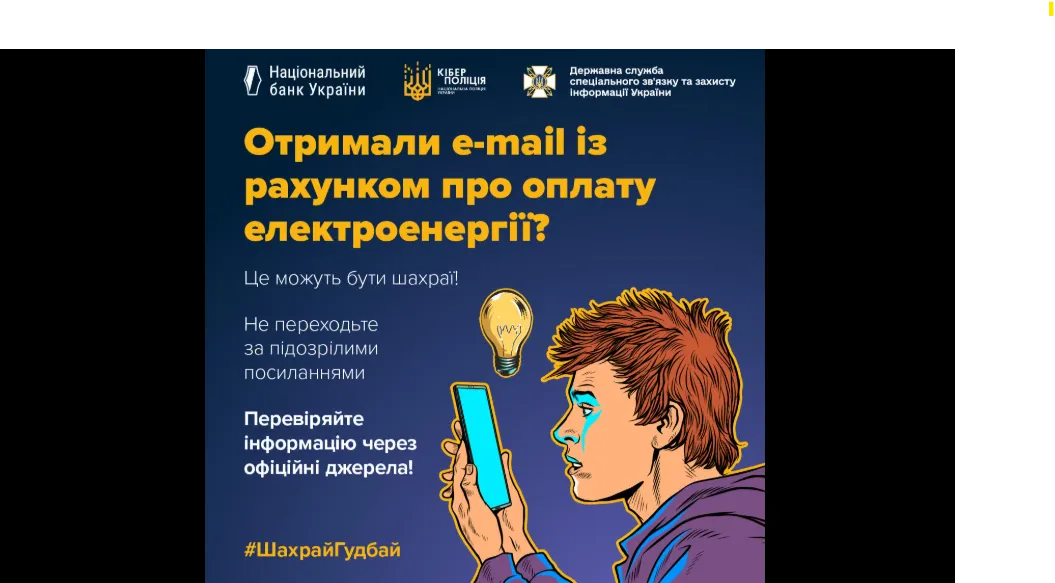
The Cyber Police are urging citizens to be cautious about emails and messages in instant messaging apps regarding electricity bills. Scammers may disguise such messages as official letters from the Ministry of Energy of Ukraine.
The message may contain information about an alleged debt, a bill, or a request to make an urgent payment. To make it seem convincing, scammers use official logos, the names of government agencies, and the standard formatting of official communications.
The main goal of this scheme is to trick people into clicking on a link. It may lead to a phishing website where the user is asked to enter their credit card details, username, password, or other personal information. Additionally, malware may be distributed under the guise of an invoice or document.
As a result, cybercriminals can gain access to bank accounts, email, social media, and other accounts.
Important: The Ministry of Energy of Ukraine does not send electricity bills to consumers and does not collect utility payments. Bills are issued by the electricity suppliers with whom the consumer has entered into a contract.
Be cautious with emails and messages if:
- they contain a link for “urgent” bill payment;
- you are notified of a non-existent debt and are required to pay it off immediately;
- the sender uses an email address that does not belong to an official institution;
- you are asked to enter your credit card information, password, or an SMS code;
- an unknown file is attached to the message and you are asked to download or open it;
- the text contains errors, unusual phrasing, or gives the impression of being rushed.
How to Protect Yourself
Do not click on links in suspicious emails or messages. If you need to check your electricity bill, go directly to your provider’s official website or app and check your account balance yourself.
Do not enter personal information, banking details, passwords, or verification codes on websites linked to in an email or messaging app.
If a message raises doubts, don’t rush to pay the bill. Verify the information through your electricity provider’s official channels.
Remember: Just because a message displays the logo of a government agency or the name of a well-known company doesn’t mean it’s genuine. Scammers can mimic the appearance of official correspondence to gain your trust.
If you’ve already clicked on a suspicious link, entered your banking information, or lost funds, you should contact your bank as soon as possible to block your payment methods. Also, save the correspondence, email, link, phone number, and other evidence.
You can report fraud by contacting the Cyber Police via an online form.
More information about current fraud schemes and ways to protect yourself can be found on the “Cyber Brama” portal—stopfraud.gov.ua.
Don’t rush to click on links or pay bills received from unknown sources. Verify information through official channels and use only trusted services.


