
Ukrainian polar explorers showed off huge snow donuts
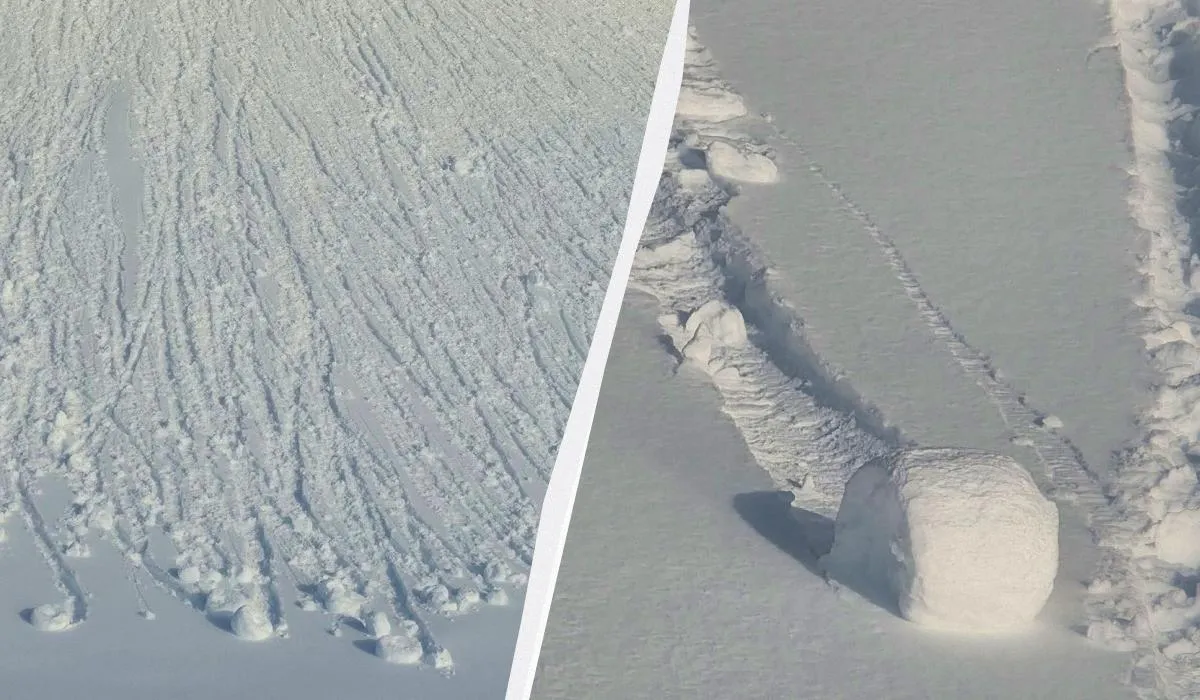
Ukrainian polar explorers near the "Academician Vernadsky" station photographed a rare natural phenomenon—snow donuts. Under the influence of wind and under specific weather conditions, snow twists into multi-layered rolls that sometimes have a hollow center and truly resemble giant donuts.
Ukrainian researchers working at the “Academician Vernadsky” Antarctic station observed this unusual phenomenon. They took photos of the snow rolls on Mount Demaria on the Antarctic continent, across from Galindez Island, where the station is located. The National Antarctic Scientific Center jokingly dubbed these formations “snow donuts.” “Antarctica knows how to ‘bake’ snow donuts. And huge ones at that,” the experts noted.
In reality, these aren’t just lumps of snow. Such formations consist of several layers that twist around one another. The snow inside often remains loose, so over time, some of it may simply blow out. Because of this, a hole sometimes appears inside the snow roll. It is this hole that makes the formation resemble a donut.
How snow rolls Form
For this unusual phenomenon to occur, a very specific combination of weather conditions is required. Strong winds alone aren’t enough. There must be two distinct layers of snow on the surface. The bottom layer must be frozen or covered with a thin crust of ice. It acts as a kind of base over which the upper layer can move. On top, there needs to be fresh, loose, and moist snow. It’s important that it doesn’t freeze to the lower layer. Then the wind can dislodge it and begin to twist it.
Another important condition is temperature. It must be close to the melting point of ice—that is, slightly above 0°C. The wind must be strong enough to move the snow, but not so strong as to immediately break them apart. If all these conditions are met, the snow begins to roll. Gradually, it winds itself into layers and forms a roll. Interestingly, the center of such a roll can remain very loose. That is why the wind can eventually blow the snow out from the center, leaving a hollow.
Why snow rolls are more common on slopes
Snow rolls are most commonly seen on slopes. Here, they’re helped not only by the wind but also by gravity. Fresh snow tends to move down the slope more easily. As it does so, it can twist and gradually take the shape of a roll. It was precisely these formations that Ukrainian polar explorers photographed near the “Academician Vernadsky” station. “For the most part, this phenomenon can be observed on slopes, since snow slides down more easily there under the influence of gravity,” the scientists explained.
At the same time, a slope isn’t strictly necessary for a “snow donut” to form. Such rolls can also form on flat ground if the wind has the right strength and direction. But spotting them is still no easy task. The temperature, snow moisture content, surface conditions, and wind strength must all align at the same time. That is why scientists call snow donuts a rather rare phenomenon.
Unusual Snow Shapes
Snow rolls can vary in size. Some are only a few centimeters in diameter, while larger formations can exceed one meter. Their shapes resemble more than just donuts. Researchers compare them to rolls, scrolls, or even bales of hay lying in fields.
Their shape depends on how the snow moved and what the weather was like at the time of formation. If the wind changes direction or becomes too strong, the roll may fall apart before it has a chance to grow large. That’s why encountering such formations is quite a rare event for polar explorers. It’s particularly interesting that they were spotted specifically near the Ukrainian Antarctic station.
An emperor penguin has already visited the “Academic Vernadsky”
This is not the first unusual sighting by Ukrainian polar explorers in recent times. Earlier, an emperor penguin visited the “Academician Vernadsky” station. This species is the largest of all penguins. Emperor penguins live in Antarctica but usually choose much colder regions.
During the Antarctic winter, they can venture hundreds of kilometers inland. It is there that the penguins form colonies and breed amid extreme cold and darkness. The area around the “Academician Vernadsky” station is too warm for them. The nearest emperor penguin colony is located more than 300 km from the Ukrainian station.
That’s why the appearance of such a guest near the Ukrainian polar researchers was a real event. And now, researchers have another unusual reason to observe—this time, not an animal, but the Antarctic snow itself. This is reported on the National Antarctic Scientific Center’s Facebook page.
Alona Shevtsova will moderate a panel on innovations in the field of payments at MEBIS 2026 in Dubai.




