
Ukrainian shopping malls set a new "record" due to air raid alerts

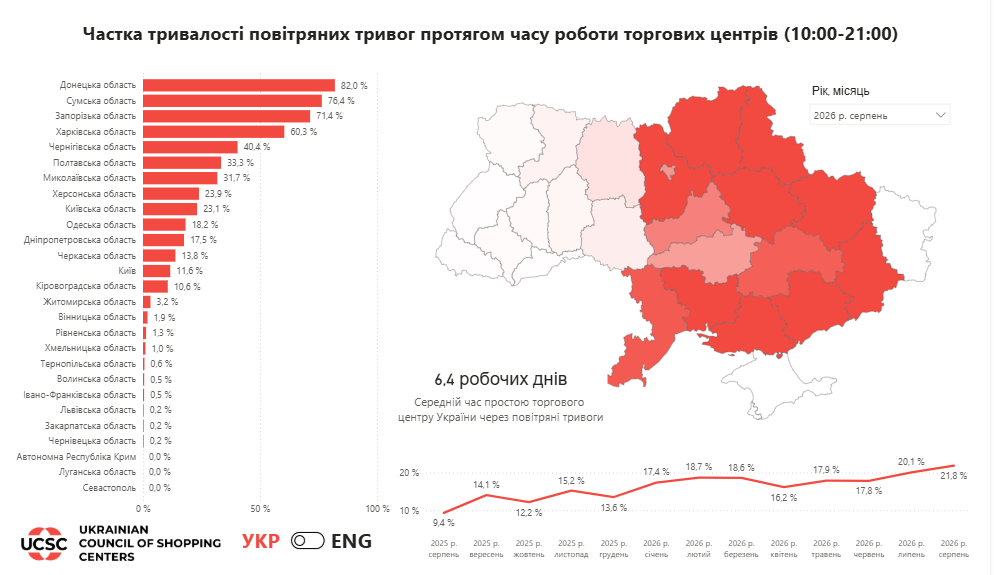
In August, shopping centers in Ukraine lost an average of 6.4 business days due to air raid alerts. These alerts accounted for 21.8% of the total operating time of shopping centers—the highest figure for the entire observation period. The situation remains most challenging in the frontline regions, but a noticeable deterioration over the month was also recorded in Kyiv and the Kyiv region.
Air raid alerts are having an increasingly severe impact not only on people’s daily lives but also on business operations. In August 2026, Ukrainian shopping centers faced a new record low since the start of the full-scale war. According to the Ukrainian Council of Shopping Centers, air raid alerts lasted for 21.8% of shopping centers’ operating hours during the month. In other words, nearly one in every five hours that shopping centers were supposed to be open coincided with an air raid alert.
As a result, on average, each shopping center in Ukraine was forced to remain closed for 6.4 working days in August. For businesses, this means not just temporarily closed stores, but a loss of customer traffic, disrupted staff operations, and additional costs. The new figure turned out to be worse than the previous record low. That record was set just a month ago, in July, when alerts accounted for 20.1% of shopping centers’ operating hours.
By comparison, in August 2025, this figure stood at just 9.4%. Thus, over the course of a year, the proportion of working hours that shopping centers have lost due to air threats has more than doubled.
The situation worsened in August
All key indicators tracked by the Ukrainian Council of Shopping Centers rose over the course of the month. In particular, the total number of air raid alerts, the number of alerts occurring specifically during shopping center operating hours, and their total duration all increased. Consequently, the time that retail facilities were forced to remain closed also increased. This is particularly significant for shopping centers, as even a single prolonged alert can disrupt the operations of stores, cafes, movie theaters, and other establishments for several hours.
When an air raid alert is announced, employees and visitors must take shelter. The shopping center itself cannot operate normally during this time. If the alert lasts a long time, some people simply leave the shopping center and do not return after the all-clear. Therefore, the actual business losses may be greater than just the number of hours during which the facility was closed.
Where the Situation Is Most Difficult
Shopping centers in regions that regularly face Russian attacks lost the most time due to air raid alerts. The Donetsk region took the top spot. Between 10:00 a.m. and 9:00 p.m., air raid alerts lasted 82% of the time there. In other words, during this period, shopping centers could operate normally for only about one-fifth of the time. Under such conditions, it becomes extremely difficult for businesses to operate at full capacity.
The Sumy region ranked second, with air raid alerts accounting for 76.4% of working hours. In Zaporizhzhia Oblast, the figure was 71.4%, and in Kharkiv Oblast, 60.3%. In Chernihiv Oblast, air raid alerts lasted for 40.1% of the time during the specified period.
These figures illustrate just how much the security situation varies from region to region. In regions near the front lines, retail businesses are effectively forced to constantly balance the need to operate with security requirements.
Kyiv and the surrounding region also saw a deterioration
At the same time, August brought a noticeable deterioration of the situation in Kyiv and the Kyiv region. It was here, according to the Ukrainian Council of Shopping Centers, that the most significant growth in key indicators was recorded over the month. This is particularly important for the capital, as Kyiv remains one of the country’s largest retail and business hubs. A large number of shopping centers, stores, restaurants, and other establishments operate here, and their operations directly depend on their ability to safely welcome visitors.
The increase in the number of air raid alerts means that shopping centers are increasingly forced to suspend operations. At the same time, people’s safety remains a priority, so during an air raid, shopping centers must cease operations and direct visitors and employees to shelters.
How Much Time Have Shopping Malls Already Lost?
The August figure represents only a portion of the total losses. Since the start of the full-scale Russian invasion, shopping centers in Ukraine have collectively been shut down for 166.8 working days due to air raid alerts. On average, 6.4 working days were lost each month. This is a significant amount of time for the retail sector, where revenue directly depends on the number of visitors and operating hours.
For large shopping centers, every hour of downtime means that dozens or even hundreds of tenants must simultaneously suspend operations. These include clothing stores, supermarkets, restaurants, coffee shops, movie theaters, children’s entertainment centers, and other businesses. At the same time, shopping mall administrations cannot simply ignore these alerts. They must ensure people’s safety and act in accordance with established procedures during an air threat.
Why This Is Important for the Economy
Prolonged air raid alerts are gradually becoming one of the constant factors affecting the operations of Ukrainian businesses. Business owners are forced to factor them into their planning of working hours, sales, employee schedules, and retail space leases. For visitors, this also means changes to their usual routine. A person may arrive at a shopping center but, due to an air raid alert, be unable to reach the store they need or end up spending a significant portion of their time in a shelter.
The more frequently such situations occur, the harder it is for businesses to forecast revenue. This is especially true in regions where alerts can last for hours and recur several times a day. Despite this, shopping centers continue to operate where the security situation allows. Businesses are adapting to the new conditions, but August’s record-low figures show just how strongly the war continues to impact normal economic activity.
Thus, August 2026 became the most challenging month for Ukrainian shopping centers in the entire observation period. Air raid alerts took away an average of 6.4 working days, and their share of shopping centers’ operating hours reached 21.8%. For regions near the front lines, the problem is even more severe. Meanwhile, the deterioration of indicators in Kyiv and the surrounding region indicates that the threat of air attacks is increasingly affecting business operations even in regions located far from the front lines. This information comes from the Ukrainian Council of Shopping Centers.


