
Zelenskyy Explained the Decision Regarding Fedorov
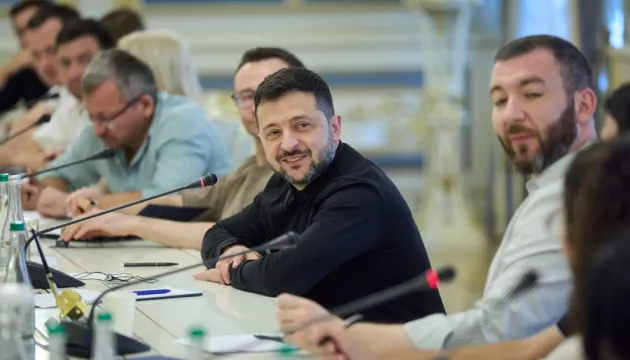
President Volodymyr Zelenskyy stated that he has a positive opinion of former Defense Minister Mykhailo Fedorov, but believes that Fedorov either made the wrong decisions on his own or was pushed into making them. According to the president, he offered Fedorov various options for future work on four separate occasions, but Fedorov turned them all down.
Zelenskyy emphasized that he has a good and long-standing working relationship with Fedorov. At the same time, he views the former minister’s recent decisions negatively. “I really did have—and still have—a very positive attitude toward Mykhailo. We’ve been through a lot together. But I believe that he’s either choosing on his own—or being pushed—toward the wrong path,” the president said.
According to Zelenskyy, he personally met with Fedorov four times and offered him various options for continuing to work on the team. “I don’t usually meet with people four times just to offer them a job, because I think that’s simply unproductive. In this case, I did so, given our good and long-standing relationship,” the head of state explained.
Fedorov, according to the president, turned down all four offers. “Mykhailo turned down all four offers. Well, that’s his choice,” Zelenskyy added.
Zelenskyy Mentioned the Conflict with Syrskyi
The president also spoke about the situation between Fedorov and former Commander-in-Chief of the Armed Forces of Ukraine Oleksandr Syrskyi. He emphasized that he is grateful to both of them for what they have done for Ukraine. However, according to him, a situation should not have arisen between the leaders where they effectively stopped communicating. “But whatever the case may be, you can’t let it escalate into a conflict where they aren’t even talking to each other, and then both claim there was no conflict at all. ‘How could that be? You only meet and discuss things in my office,’ Zelenskyy said.
According to the president, he tried to give the parties the opportunity to resolve the issue on their own. “Two weeks before the decision, I told them that I was giving them a chance—meet on your own, work it out. They didn’t meet,” the head of state explained. Zelenskyy believes that such a situation is unacceptable for a country at war.
The president identified the main problem
Zelenskyy explained that the Ministry of Defense and the military command have different but interrelated areas of responsibility. According to him, the military is directly responsible for conducting operations, while the Ministry of Defense is responsible for supporting the army. “We had agreements with the Ministry of Defense of Ukraine—with the minister. There is a way the army operates. There are those who handle operations. There cannot be a conflict at this level between leaders,” the president emphasized.
He explained that problems arise when one party begins to interfere in the other’s sphere of responsibility. “If there is a particular operation on the battlefield, it is handled first and foremost by the military. The Ministry of Defense of Ukraine is responsible for logistical support. If someone encroaches on another’s area of responsibility, it will inevitably lead to conflict,” Zelenskyy said.
According to him, this is exactly the kind of conflict that eventually arose. “And a conflict did occur—a very serious one. The Commander-in-Chief of the Armed Forces of Ukraine cannot operate without the Ministry of Defense or the Minister of Defense, and the Minister of Defense cannot operate without the Commander-in-Chief. This is simply a disaster for a country at war,” the president concluded. The head of state made these remarks during a conversation with journalists.
Russia has not ruled out the theoretical possibility of an offensive from the Bryansk region toward the Chernihiv and Kyiv regions. At the same time, no Russian troops have been detected in the Bryansk region along this axis, although Ukrainian military personnel have spotted Russian military equipment along the border.
Ukrainian defense forces have almost completely liberated the Dnipropetrovsk region from Russian troops. According to Volodymyr Zelenskyy, about 10 square kilometers remain under Russian control there—three small villages where,




