
Russia's offensive has stalled, and the occupiers have lost 116 square kilometers in a month, according to the ISW
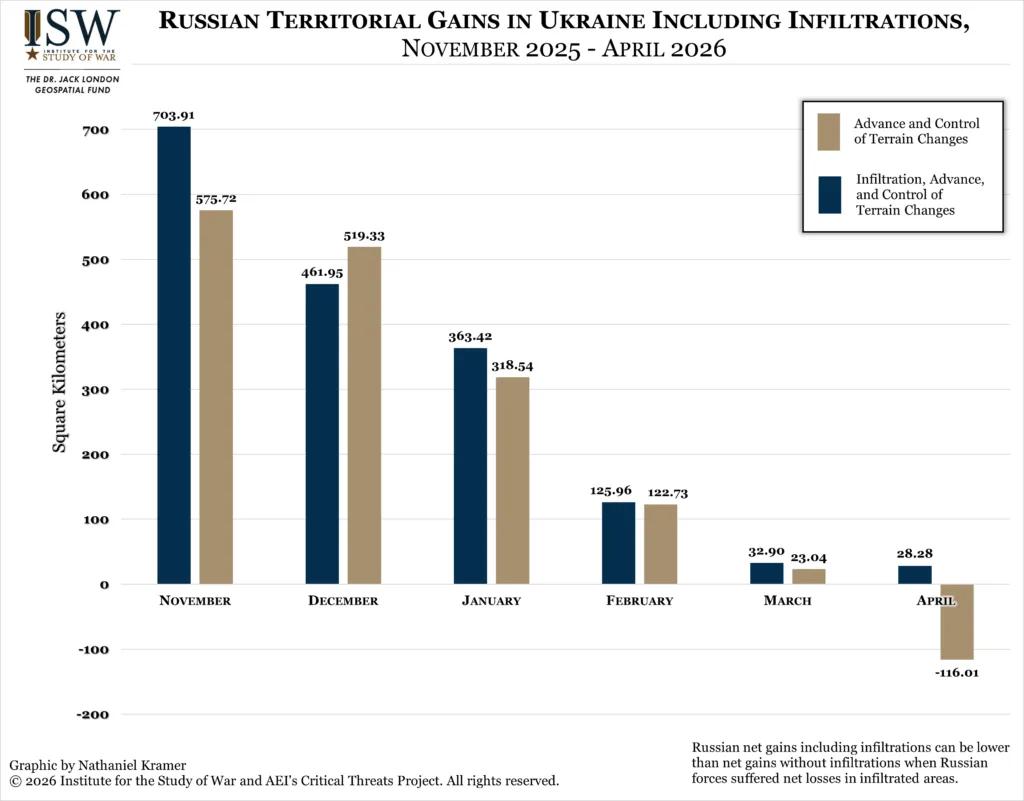
The Russian offensive in April didn’t just slow down—it reversed course. Over the course of the month, the occupiers lost more territory than they were able to capture. This is according to the ISW (Institute for the Study of War).
In April 2026, the Russian army posted a result it hadn’t seen in a long time—a net loss of territory. Instead of advancing, the occupiers lost control of 116 square kilometers. The last time a similar situation occurred was back in August 2024, when Ukrainian forces were conducting active operations in the Kursk region.
Analysts say: the Russians’ problems have been building up for months. The pace of the offensive began to slow as early as November 2025. And now it has become obvious. Ukrainian forces are actively counterattacking and striking key targets in the rear. Under attack are enemy warehouses, headquarters, and logistics. Because of this, the Russians are forced to defend themselves where they had planned to advance. “Without stable communications, coordinating the offensive has become nearly impossible,” ISW analysts note.
Communication is a separate issue. According to the report, in February 2026, Starlink terminals began to be blocked en masse in the occupied territories. At the same time, the Kremlin restricted Telegram’s operations. As a result, units lost normal communication with one another. Added to this are the Ukrainian Armed Forces’ strikes on logistics. Supplies have become more difficult, and responding quickly has become significantly harder.
The weather also played a role. The winter was colder than usual, and there was more precipitation. Now, the front lines are experiencing classic spring mud. The ground has turned into mud, in which equipment gets stuck. Because of this, the Russian Federation’s mechanized units have effectively lost their mobility.
The Russians usually try to step up their efforts in May, when the ground dries out. But whether they will be able to do so this time remains an open question. Another point is how Russia reports on its “successes.” According to analysts, the Kremlin often uses the tactic of so-called infiltration. Small groups enter the “gray zone” between positions.
They have no control over these territories, but in their reports, they present this as a capture. “The Russians are trying to create the illusion of continuous forward movement,” the ISW notes.
The figures confirm this. From November 2025 to April 2026, Russia captured 1,443 square kilometers. During the same period a year earlier, it was 2,368. The average rate of advance has also dropped by nearly three times. Whereas it used to be about 9.7 square kilometers per day, it is now only 2.9.
In fact, most of the territories claimed by Russia remain disputed. The occupiers cannot establish a foothold there. And until the situation changes—whether in terms of logistics, communications, or weather—a rapid breakthrough from them is not to be expected.
In the Sumy region, there is one fatality and several casualties due to enemy shelling.
Ukrainian air defenses successfully neutralized the vast majority of drones used by Russian forces to attack the country on Saturday, May 2.


