
Ukrainian Attack on Moscow: A Detailed Analysis of the Breach of Russia's Air Defense Systems
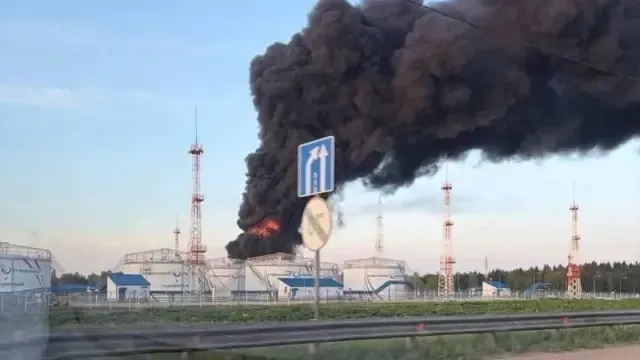
The attack by Ukrainian drones on Moscow and the Moscow region on May 17, 2026, was one of the most successful of the entire full-scale war. Analysts at “Military” note that despite a multi-layered air defense system, individual drones had previously breached the defenses of the Russian capital region, especially after they were strengthened in 2025.
Overall, as of spring 2026, Moscow is protected by two dense rings of air defense systems in addition to several positions within the city itself. According to Ointer’s estimates, there are 130 positions for anti-aircraft systems in and around the city.
The second ring of air defense positions was established as early as 2025—between May and September of that year, the Russians erected approximately 43 new specialized towers for air defense systems around the capital.
The backbone of the Russian capital’s air defense consists of about a hundred “Pantsir-S1” anti-aircraft missile and gun systems and a small number of “Tor” air defense systems, designed to intercept Ukrainian drones and cruise missiles. These are supplemented by about two dozen S-400 batteries designed to intercept cruise and ballistic missiles.
Not all of the established positions can be occupied by air defense systems simultaneously; however, as of April 2026, observers have verified the presence of at least 89 Pantsir-S1 anti-aircraft missile and gun systems within a 50-kilometer radius of Moscow.
To set up air defense positions, the Russians use two types of structures—earth embankments with a platform and an access road made of concrete slabs, and towers made of metal structures onto which the anti-aircraft systems are hoisted by cranes.
These structures are designed to house Pantsir-S1 anti-aircraft missile and gun systems to combat Ukrainian drones and missiles.
The use of such structures allows for an expanded detection and engagement range against small targets flying at low altitudes, as the visible horizon increases with altitude.
In addition, a significant number of air defense systems are deployed in the region, away from the capital, to protect key defense industry enterprises, infrastructure, and military facilities. As of May 2026, they do not yet form additional continuous lines of defense on the approaches to the capital, but they create numerous “danger zones” for Ukrainian UAVs.
Nor should one underestimate the role of the Russian Aerospace Forces and Army Aviation, which intercept a certain percentage of attack drones using fighter jets and helicopters, as well as the overall strengthening of air defense ahead of the May 9 parade in Moscow.
It is known that during the attack on Moscow, the Defense Forces managed to confirm hits on a number of targets, including the “Angstrem” plant in Zelenograd, near Moscow. This enterprise is a key component of the Russian military-industrial complex and is involved in the production of microelectronics, radio-electronics, optical systems, and robotics for the enemy’s military needs.
They also struck the Soniachnogorsk oil loading station in the village of Durikino, located approximately 40–45 kilometers from Moscow, and the Moscow Oil Refinery, located in the Kapotnensky District of the Russian capital.
In addition, the Security Service of Ukraine reported striking the Volodarskoe oil pumping station in the village of Konstantinovo, approximately 22 kilometers from the outskirts of the city. However, there is currently no publicly available photo or video evidence to verify the strike.
According to the 1st Separate Unmanned Systems Center of the Ukrainian Armed Forces’ Unmanned Systems Forces, “more than” 120 drones were used in the attack on Moscow, which “in an instant shattered the myth of the enemy’s ‘impregnable’ capital.”
According to the General Staff, Ukrainian-designed drones were used to strike targets in the Moscow region, specifically the Fire Point FP-1, the RS-1 “Bars” jet drones, and the previously unknown “BARS-SM” GLADIATOR drone.
Of the three known successful strikes, only one location—the Moscow Oil Refinery—is situated within Moscow itself, behind the two rings of air defense systems, approximately 7–8 kilometers from the nearest known position of the “Pantsir” air defense system.
The Angstrom plant is located between the first and second air defense rings, just over two kilometers from the nearest known air defense position. The farthest from Moscow is the Soniachno-Gorskaya oil loading station, situated right up against the outer perimeter of the second ring—three kilometers from an air defense position.
At the same time, open sources have identified and pinpointed ten additional recorded locations of debris falls, UAV flights, or strikes on high-rise buildings within the air defense perimeter. Six of these are located between the first and second rings, and four are within the first air defense ring.
This indicates that Ukrainian drones did indeed manage to successfully breach all Russian defense lines in significant numbers.
The attack on Moscow on May 17, 2026, demonstrates that even an extremely high density of air defense systems does not provide a 100% guarantee of protection, even against a relatively small number of attack drones. At the same time, the decisive factor in a successful strike is not the number of assets, but first and foremost reconnaissance to identify “blind spots,” route planning, and appropriate tactics of engagement.
On the night of May 17, a number of Russian military-industrial complex and energy facilities in Moscow and the Moscow region were struck. Strikes were carried out against the oil depot in Durikino, the oil refinery in Kapotnya, the “Angstrom” microelectronics plant, and the “Raduga” Design Bureau, which develops cruise missiles.
On the morning of May 16, Moscow also came under attack by drones, causing airports in the Russian capital to temporarily suspend operations.
The “ATESH” partisan movement claimed responsibility for a sabotage operation in the Moscow region, which disrupted the functioning of elements of the Russian air defense system on the outskirts of the capital.


