
About 2,000 people remain in Oleshky — the head of the Military-Civilian Administration on the evacuation
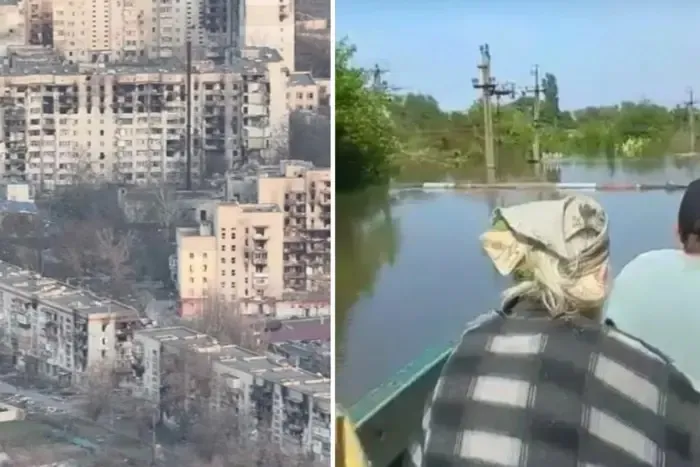
Residents of occupied Oleshky have effectively been left without a safe route out, and evacuation efforts are hampered by mined roads and constant drone attacks. Tetyana Hasanenko, head of the Oleshky City Military Administration, urged people not to accuse those who remain in the city of having allegedly chosen to stay under occupation of their own free will. According to her, not everyone was able to leave on their own, and among those who remained are people waiting for the city to be liberated.
Residents of the temporarily occupied town of Oleshky in the Kherson region find themselves in a situation where leaving the town without risking their lives is practically impossible. Tetyana Gasanenko, head of the Oleshky City Military Administration, who is currently in territory controlled by Ukraine and maintains contact with community residents, spoke about this in an interview with “Glavkom.”
According to her, Oleshky is effectively under siege today. Access to food and medicine is limited, the roads are mined, and Russian drones are constantly flying over the city. “They’re not physically holding you there, but you can’t even move around within the city,” Gasanenko said in another part of the interview. She added that it is dangerous not only to leave but also to move around within the city itself.
Why People Couldn’t Leave
Gasanenko noted that after the full-scale invasion began, there was no official evacuation from Oleshky. By February 24, 2022, Russian troops were already in the city. At first, those who were able to leave were mainly people who had their own cars and were able to get their bearings quickly. Later, the situation became much more complicated due to Russian checkpoints and the dangers on the roads.
According to the head of the Municipal Administration, some people were simply physically unable to organize their own departure. “People couldn’t leave for various reasons—for example, there was no one to transport bedridden relatives. Volunteers did provide transportation, but there were certain conditions—such as children or people with disabilities. For everyone else, you had to pay, and the amounts varied over time,” she explained.
In other words, for many residents, leaving wasn’t as simple as just getting in a car and leaving the city. Today, the problem is even more acute. Even if a person is ready to leave, there is virtually no safe route. The area around Oleshky is mined, and any attempts to move around could attract the attention of Russian drones.
Those who stayed shouldn’t be called “waiters”
Against this backdrop, Gasanenko spoke out against accusations directed at everyone who remained under occupation. She cited the example of Anatoliy Tyurin—a coach and member of the Oleshky City Council. According to the head of the MBA, he was repeatedly offered the chance to leave, but he feared that Russian military personnel would detain him for refusing to accept a Russian passport.
“Take Anatoliy Tyurin, for example—a respected man, a coach, and a city council member. We offered him to leave so many times, but he understood that he would never accept a Russian passport, and that he would be detained at the very first checkpoint. And then—arrest and abuse. What has become of him now is unknown,” said Gasanenko.
She also believes it is wrong to label all residents who remained in Oleshky as people with pro-Russian views. “All the ‘waiters’ who switched sides had long since lost their spirit in Oleshky by 2023. They were in Zalizny Port, Skadovsk, or Crimea; they only came here to film propaganda videos pretending they were in Oleshky,” stated the head of the MBA.
According to her, the people who remain in the city today do not necessarily support Russia. On the contrary, after the liberation of Kherson, they found themselves effectively on the front lines and, as Gasanenko explains, are waiting for the Ukrainian military. This is important given the current situation in the city. As of the end of September, according to Hananenko’s estimate, about 2,000 civilians remain in Oleshky, including at least 45 children. In total, there may be about 6,000 people in the occupied Oleshky community, including 180 children.
What Is Happening in Oleshky Now
According to the head of the Municipal Military Administration, the humanitarian situation in the city has sharply deteriorated. The last full-scale food delivery, she said, took place on May 26. In September, an attempt to deliver food to the city also failed. Five vehicles reached the area near two gas stations, but the drivers saw that the road had been mined and decided to turn back. After that, the convoy was attacked by Russian drones.
Gasanenko said that after that, city residents tried to reach the site where the wrecked vehicles were left to retrieve the food. According to her, people understand that this might be a one-way trip due to constant drone attacks. At the same time, Oleshky faces problems beyond just food shortages. Earlier, Gasanenko spoke about the lack of adequate medical care, electricity, and the ability to provide assistance to the wounded. She said that even attempts to extinguish fires or help the injured could result in new drone strikes.
The occupation of Oleshky has been ongoing since February 24, 2022. In June 2023, the city also suffered severe damage due to the bombing of the Kakhovka Hydroelectric Power Plant and the subsequent flooding. Today, the situation is further complicated by the fact that a significant portion of the territory surrounding the city is mined. This effectively blocks normal movement and hinders any attempts to organize the evacuation of civilians.
Evacuation Remains the Main Challenge
According to Gasanenko, Ukraine and international organizations have been discussing the possibility of an organized evacuation of civilians for several months now. A humanitarian corridor was mentioned among the options, but this would require Russia’s commitment not to attack people during the evacuation. “Not to sit as observers somewhere in Velyki Kopani and wait for the convoys to arrive, but to go to Oleshky. Because the people there are in poor physical condition—even the young ones, not to mention the elderly, people with disabilities, and children,” Hanasenko said.
Ukrainian authorities and international organizations have stated their readiness to assist with the evacuation; however, without agreements with the Russian side, it is extremely difficult to carry out a safe operation. In June, the Oleshky Local Military Administration also reported that people were trying to leave on their own, risking their lives. Thus, the story of Oleshky is not merely a question of why people did not leave earlier. Some residents may indeed have chosen to stay of their own accord, but today, for many, leaving means mine-infested roads, Russian drones, the lack of a safe route, and the risk of being detained.
According to Hasanenko’s estimate, about 2,000 people currently remain in the city itself. Several thousand more are in other settlements within the occupied community. Five of the community’s 13 settlements, she said, have been completely destroyed. For those who remain in Oleshky, the main issue right now is not political judgments about their choice, but the ability to simply obtain food and medicine and to leave the city safely. That is why the head of the Local Self-Government calls on people not to shift responsibility for the situation onto civilians who find themselves under occupation.
The Ukrainian military used drones to deliver about 4 metric tons of food to residents of occupied Oleshky. The humanitarian aid was distributed among 100 designated locations throughout the city.




