
Ukraine is testing humanoid combat robots on the front lines
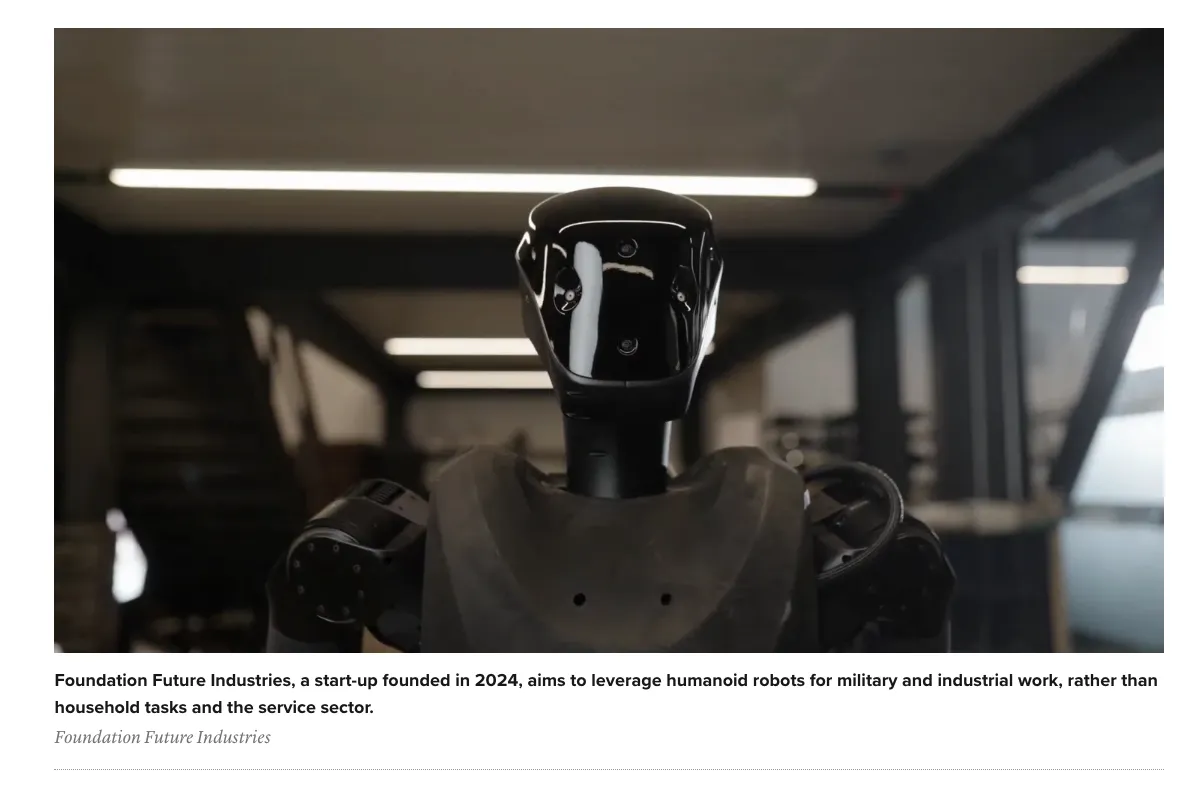
Foundation Future Industries, an American startup that may be linked to Trump, is conducting tests of humanoid combat robots in Ukraine. They are being tested directly on the front lines of the war launched by Russia.
This is reported by CNBC.
According to the publication, Foundation is based in San Francisco and specializes in robotics. Moreover, it is linked to the family of U.S. President Donald Trump.
The media outlet notes that this startup, at the very least, sees a completely new application for humanoid robots. While other companies are developing them to stack boxes and pour coffee, Foundation sees the technology being used in war or in other potentially dangerous and even deadly professions.
Specifically, the company is developing autonomous dual-purpose humanoid robots designed for both heavy industry and military purposes. Early prototypes are being tested in Ukraine for potential use in combat. Moreover, they are being tested on the battlefield, in the actual war that Russia launched against Ukraine.
In an interview with CNBC, the company’s CEO, Sanket Pathak, stated that the company is founded on the belief that humanoid robotics should be directed toward solving humanity’s most critical problems, rather than performing household chores and providing services.
The startup has set ambitious goals: Pathak plans to ramp up production to thousands of units this year and begin testing on the front lines with U.S. troops over the next 18 months.
Earlier this year, Foundation gained wider global recognition by sending two of its Phantom MK-1 robots to Ukraine for a pilot demonstration. According to the company’s statement, this marked the first known instance of humanoid robots being deployed in a combat zone.
The extended trials, supported by the U.S. government and conducted in collaboration with Ukrainian officials, focused on performing logistical tasks in hazardous areas.
Ukraine was a natural choice for the debut, as the war in the country has already turned into a vast testing ground for robotics and artificial intelligence in combat conditions. Here, in particular, ground robots are used to deliver supplies to the front lines, while autonomous, AI-equipped drones are used for precision strikes and reconnaissance.
According to Patak, testing the MK-1 in Ukraine has already demonstrated the robot’s potential for performing cargo delivery tasks that often put soldiers in danger.
But there is a caveat. While the MK-1s help demonstrate the usefulness of the underlying technology, they are far from being super soldiers, carrying only about 20 kg of payload. Additionally, they lack water resistance and sufficient battery life for widespread deployment.
Foundation plans to send new, improved robots—the Phantom 2—to Ukraine this year. According to the CEO, this robot will have “superhuman capabilities and twice the payload capacity of the Phantom 1.”
Foundation expects that the results of its tests in Ukraine will be useful for future work with the U.S. military. The startup has already secured government research contracts totaling $24 million to test applications in the fields of inspection, logistics, and weapons handling within the Army, Navy, and Air Force.
According to Patak, discussions with government officials have shifted from research to the issue of scaling up the use of robots. He aims for Foundation to deploy its technologies within the U.S. armed forces and, if necessary, on the front lines in conflict zones over the next 12 to 18 months.
CNBC reports that this goal will be achieved with the help of Eric Trump, Donald Trump’s second son, who recently joined the company as chief strategy advisor. A Foundation representative told the publication that Eric Trump was an investor in the firm before becoming its advisor, and says that both parties shared a common vision of bringing manufacturing back to the U.S.
As a reminder, Zelenskyy identified the mainshortfall in air defense and spoke about Ukrainian missiles.
Recall that Zelenskyy is ready to hold elections and a referendum on a peace agreement simultaneously.
Zelenskyy also explained who will foot the bill for Ukraine’s reconstruction.


