
Dubai is creating virtual air corridors to manage its UAV fleet
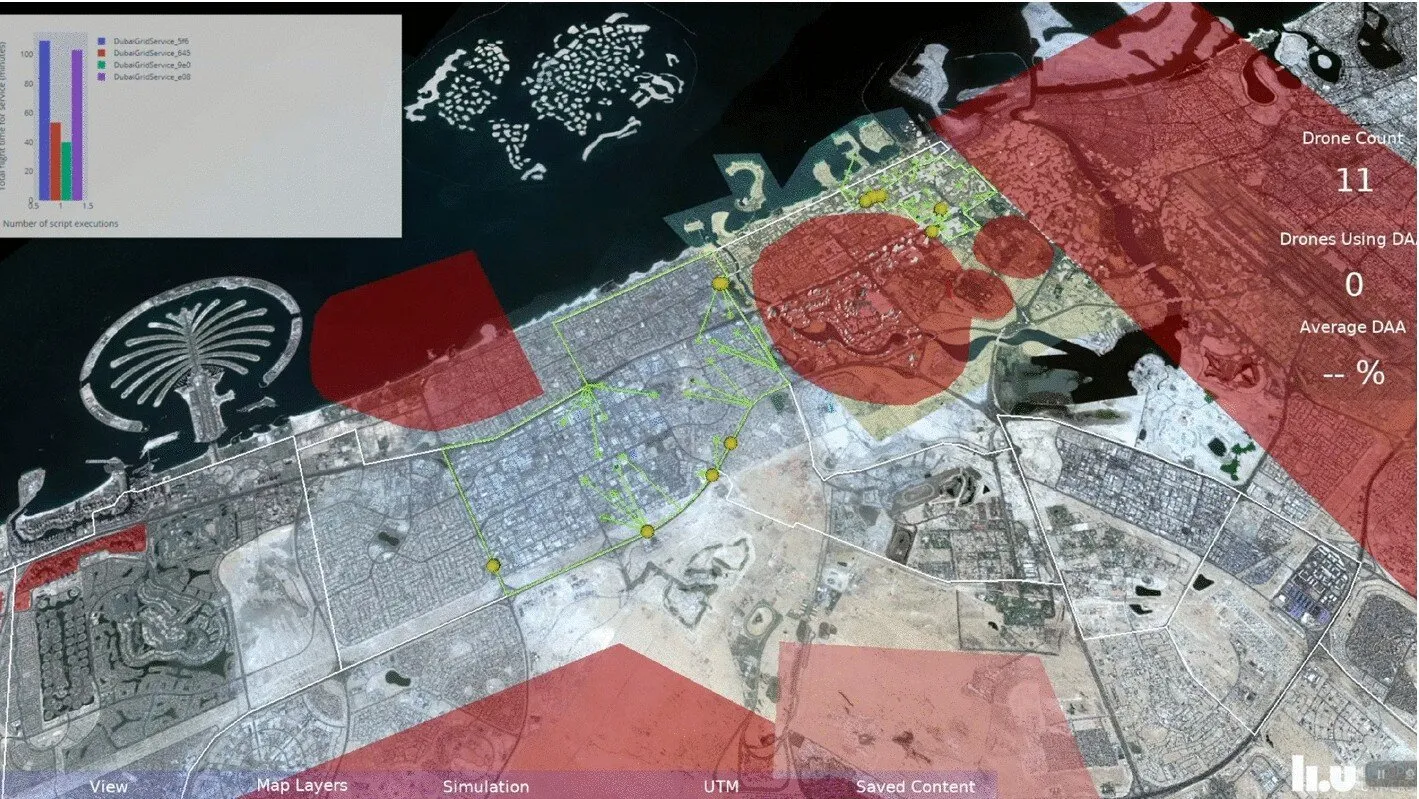
An international group of researchers has developed a comprehensive plan to reform Dubai’s urban airspace, which involves creating a complex system of virtual air routes.
This was reported by the technology publication Tech Xplore, citing a study in the journal Annals of Operations Research. The new concept is designed to address safety and coordination issues for drone flights in the dense high-rise environment of the metropolis.
The proposed model divides the airspace above the city into two main levels depending on the height of the skyscrapers. In the “red” zone (above 72 meters), UAVs are permitted to fly exclusively over major roadways, while in the “yellow” zone (below 72 meters), routes may also pass over building rooftops. At the same time, the maximum flight altitude is limited to 122 meters, and clear safety distances are established between the aircraft.
Three-dimensional traffic management will be based on artificial intelligence and mathematical algorithms. Testing of various approaches has shown that the genetic algorithm is the most effective: it increases the profitability of logistics operations by 9% and triples the speed of real-time calculations. The system also includes an automatic load balancing feature that prevents air traffic congestion.
The project was implemented using the “triple helix” model through collaboration between the University of Sharjah, UAE government aviation agencies, and Swedish partners, including SAAB. Despite successful modeling, the developers acknowledge the system’s current limitations, as it does not yet account for dynamic weather changes and battery charging schedules. Further research will focus on creating a network of charging stations and AI-based weather forecasting.
South Korea has begun testing an urban air taxi.
Hyundai and Rolls-Royce have joined forces to create an electric aircraft. Its prototype is expected to be unveiled in 2025.
In Stuttgart, Germany, a Volocopter drone—intended for use as an unmanned taxi—was tested in urban conditions for the first time.
Previously, Volocopter’s unmanned flying taxi was demonstrated in Dubai (United Arab Emirates).
In addition, Tesla will launch its own driverless taxi service.


