
Hubble captures decagonal atmospheric wave near Saturn’s south pole
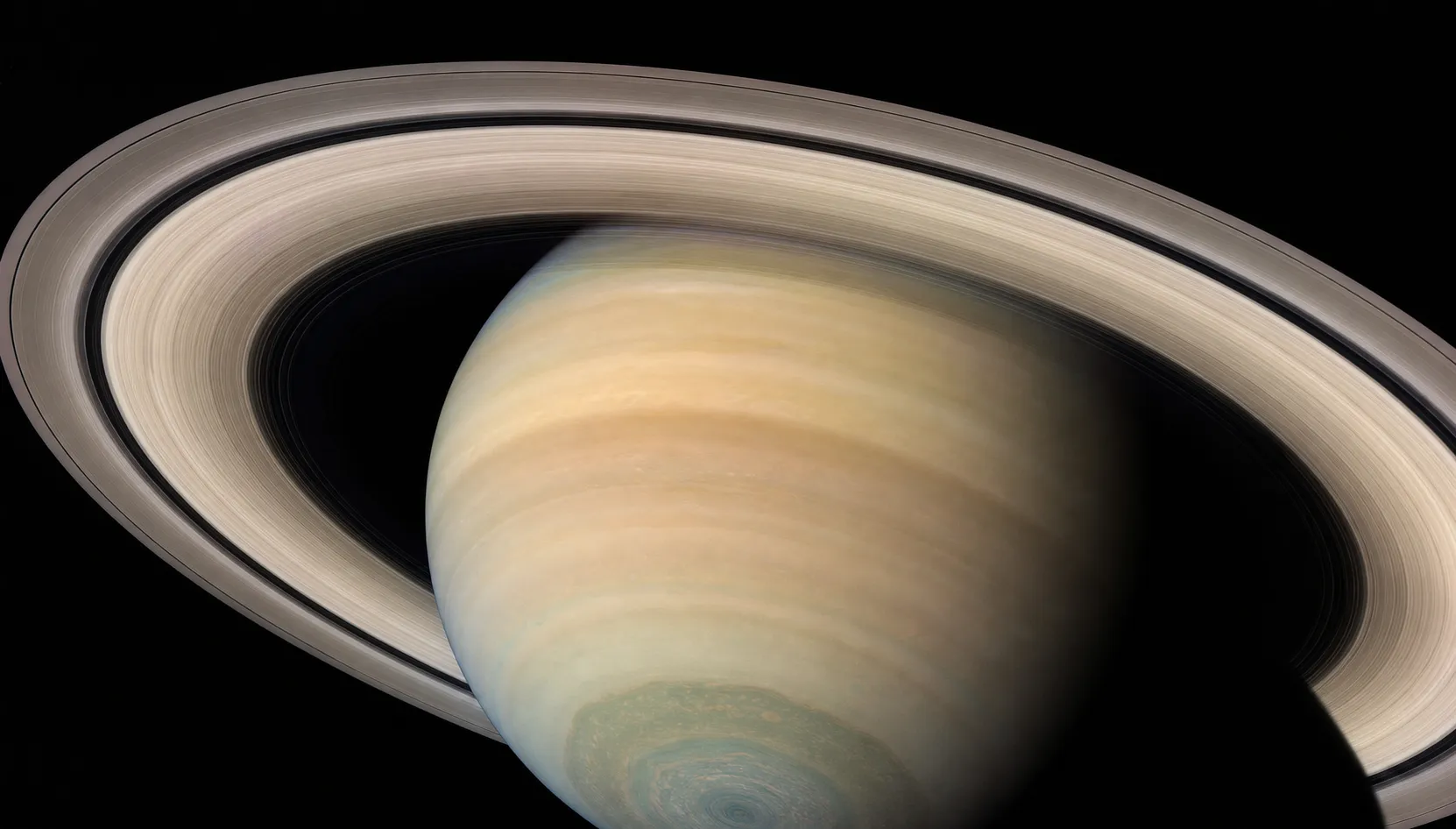
The Hubble Space Telescope has captured images of a large atmospheric structure in the shape of a decagon forming around Saturn’s south pole. According to Live Science, the telescope’s archival images indicate that this atmospheric wave may have begun forming in 2023.
Wave in the jet stream
Scientists detected the structure in Saturn’s large jet stream. It can be traced through several atmospheric layers, meaning it extends beyond the cloud tops. Observations in 2025 showed that the wave began taking the shape of a decagon. Hubble captured high-resolution images of it without interference from Earth’s atmosphere.
Researchers still need to determine how this wave forms and what it may explain about the atmospheres of large gas giants. This will require further observations with Hubble and the James Webb Space Telescope.
More current news is available on the UA.News Telegram channel Telegram.
Difference from the northern hexagon
The new structure differs from the well-known hexagonal wave near Saturn’s north pole, which has been observed for more than 40 years. Amy Simon, a senior research scientist at NASA’s Goddard Space Flight Center, noted that the northern hexagon has been recorded during all relevant observations, while the southern structure appears to be intensifying.
The first signs of the wave near the south pole were recorded by ground-based observatories in 2024. It was spotted by Agustín Sánchez-Lavega of the University of the Basque Country and amateur astronomers Trevor Barry and Jean-Paul Auger using the university’s Planetary Virtual Observatory Laboratory. The Cassini spacecraft, which orbited Saturn from 2004 to 2017, did not record this structure.
The Hubble images were obtained as part of the Outer Planet Atmospheres Legacy program, under which the telescope observes Jupiter, Saturn, Uranus and Neptune each year. Saturn’s south pole is currently clearly visible from Earth because of the planet’s position during its roughly 29-year orbit around the Sun.


