
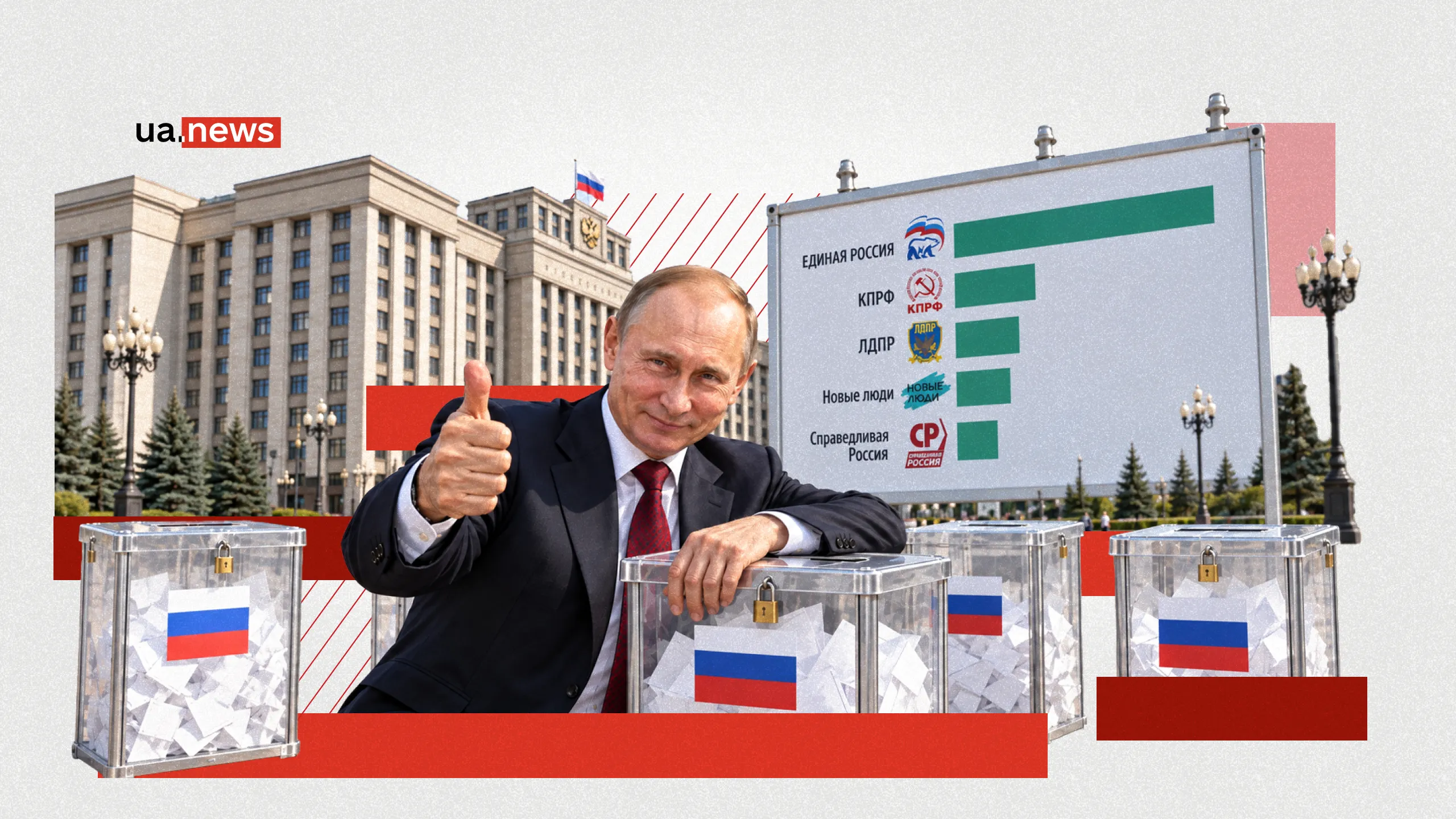
The elections to the Russian State Duma have officially concluded. They took place without any surprises, without any incidents, and without a single event that would in any way threaten the current government. The system passed the stress test successfully: everything went exactly as planned. There were no mass protests, no unexpected results, and not even a hint that anything might have gone off script. The “special election operation” in Russia has officially concluded—and it ended well for the regime.
But it is far more important to discuss not the fabricated percentages or who received how many seats in this fictitious parliament. It’s more important to understand something else: why does the Kremlin need this electoral process at all, what does it mean for the system as a whole, and what conclusions can be drawn from it? After all, elections in Russia aren’t about choice or change—they’re about something entirely different.
UA.News political analyst Mykyta Trachuk delves into exactly what that is. Read more in our article.
The Math Behind the Electoral Farce: Who Gained Ground, Who Lost It, and What Do Kadyrov and Kim Jong-un Have to Do With It
Let’s start with the numbers. According to data from over 96% of the ballots counted, voter turnout exceeded 59%. This, by the way, is an interesting figure in and of itself, but more on that later.
The breakdown by party at the time of writing looks like this:
- “United Russia” — 57.83%;
- CPRF — 13.76%;
- LDPR — 9.01%;
- “New People” — 7.96%;
- “Fair Russia” — 5%.
Preliminary results show that the ruling party, “United Russia,” will secure at least 355 seats in the new parliament. This constitutes a constitutional majority and an all-time record for the party since its inception. It is also interesting to note that “United Russia” is sending 86 veterans of the war in Ukraine to the Duma: nearly 20% of its future parliamentary faction.
Now let’s compare these results with those from 2021. Back then, the figures were as follows:
- “United Russia” — 49.82% (324 seats);
- CPRF — 18.93%;
- LDPR — 7.55%;
- “Fair Russia—For Truth”—7.46%;
- “New People” — 5.32%.
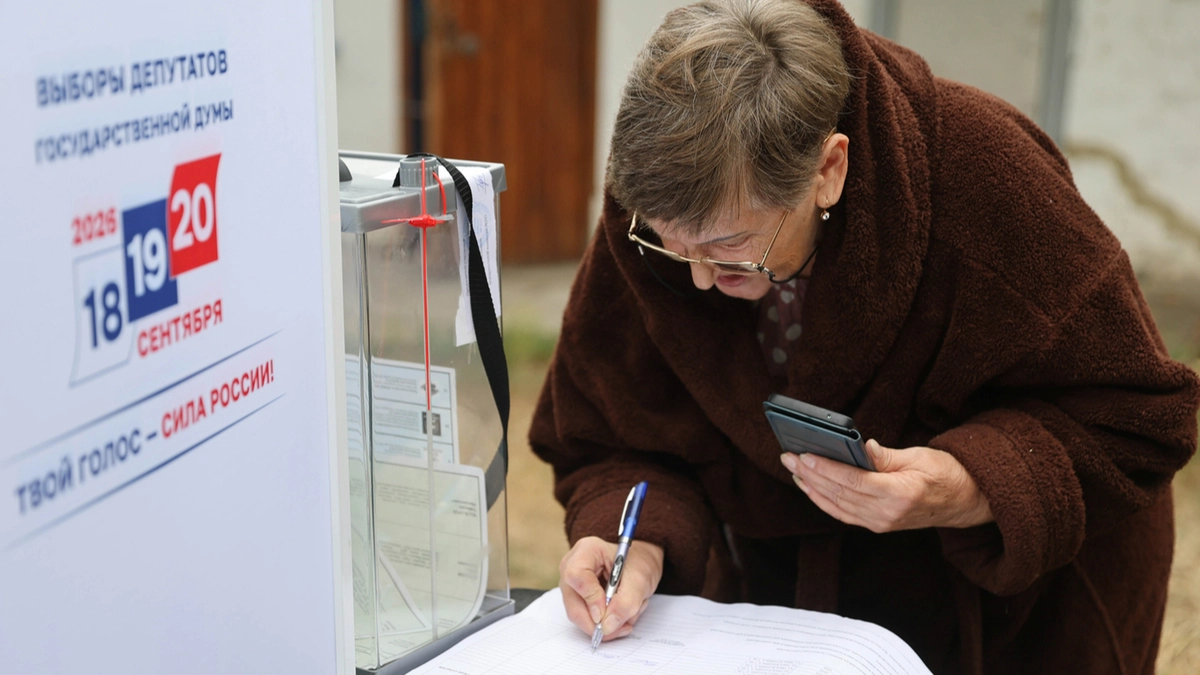
What do we see? The ruling party didn’t just hold its ground—it significantly improved its position: an 8% increase in the vote share and a gain of over 30 (!) seats. The CPRF declined—from nearly 19% to less than 14%. The LDPR grew slightly. “Fair Russia” fell all the way to the 5% threshold. But “New People”—a party entirely controlled by the Presidential Administration, a very, very loosely “liberal” project aimed at the urban middle class—nearly doubled its share: from 5.32% to 7.96%.
This is probably the only result that someone could, with a huge stretch, present as a sensation—but no. “New People” is not the opposition; but a system-aligned project that serves a specific function: to gather the votes of those who want to appear as if they are “not for the government,” yet are not ready to vote for the Communists, the Socialist Revolutionaries, or—much less—anyone who is truly in opposition.
It’s worth mentioning “Yabloko” separately—the only anti-war party that was initially allowed to participate but was later barred from these elections through a formal court proceeding (which more closely resembled a show trial). It was ultimately allowed to run in exactly one region—the Novgorod Oblast. There, it won seats in the local regional Duma with 6.2% of the vote. A result in just one single region out of the entire country speaks volumes.
And finally, the icing on the cake. Chechen leader Ramzan Kadyrov “won” the republic’s election with… 99.85%. An impressive figure, but it fell just short of North Korean leader Kim Jong-un, who received 99.93% of the vote in this year’s election. As they say—there’s room to grow and work on!
So, the farce known as “elections” in Russia has come to an end. Everything went smoothly for the system; no serious crises were reported. But a question arises: if elections in Russia are a completely artificial procedure where the outcome is known in advance, then why are they necessary at all? Why spend over 30 billion rubles, herd people to the polling stations, fabricate vote percentages, and so on? The answer to this question is the key to understanding the entire Russian political system.
Why Do Autocracies Hold Elections?
Elections in authoritarian and totalitarian systems are not a nod to democracy, nor are they an imitation of it or an attempt to put on a show, as is commonly believed in the West. They are a distinct political institution with its own logic, functions, and purpose. This institution existed in the USSR and exists in North Korea, Iran, Syria, Russia, and other similar countries. There is no question here of democracy, openness, or fair competition. But what, then, is it?
First, it is not an electoral event, but an administrative one. Elections in Russia are not about voters choosing the government. They are about the government demonstrating its ability to organize a large, complex, multifaceted process and carry it out as required. It’s like the Olympics in Sochi: not just a sporting event, but a demonstration of the system’s strength, power, and capability.
Elections are literally that very “electoral Olympics.” Holding the “right” election, running everything by the book, and showing that the system controls every polling station, every observer, and every ballot—that is the ultimate goal. It’s a regular crash and stress test for the system, one that keeps it on its toes. It’s as if the system is testing itself: is everything working, is everyone in their place, can we rely on administrative resources, and so on.
Second, it’s a kind of referendum or even an act of acclamation. The authorities turn to the people to confirm: yes, you are still in power. And the people, in fact, confirm this. Government employees, the military, officials, and other administrative resources vote for the government because they’ve been told to. Genuine supporters vote for the government because they truly believe in it. Opposition voters, on the other hand, either do not show up to vote, or their votes are simply not counted—either by adding “correct” ballots to the tally or by falsifying the “necessary” figures in the final protocol.
And this brings us to the key issue—voter turnout. A 59% turnout seems like a fairly standard situation for parliamentary elections: in developed democracies, turnout is usually 60–70%. But in reality, such a relatively low figure is very advantageous for the ruling party. Because with low voter turnout, the regime has the opportunity to “fabricate” any result. And an opposition-minded voter, even in theory, can’t say anything about it, since they most likely didn’t even go to the polls in the first place—so what grounds do they have for complaint?
This is precisely the point of authoritarian elections. Those who show up are mainly the ones who would vote “correctly” anyway, while for everyone else, there simply isn’t a choice. It’s a farce in the democratic sense, but for the regime, it’s a test passed with flying colors and a sign that it can continue pursuing the same policies it has followed up to now. The system has tested itself—and confirmed that everything is fine, no matter what.
What’s Next: The Last Election Cycle and a New “Boost of Legitimacy”
It’s important to understand that this was the last election cycle in the Russian Federation for many years to come. No elections—neither parliamentary nor presidential—are planned for the coming years. The system has gotten everything it wanted: confirmation, acclaim, and legitimacy. And now it can continue to do whatever it deems necessary, paying no attention to anything.
Key point: Putin has received a new “boost of legitimacy.” He seems to genuinely believe that everything is fine, that his policies are supported, and that the 57.83% for “United Russia” are not fabricated figures but a true expression of the people’s will. This is likely the sincere belief of a man who has been in power for so many years that he has long since lost the ability to distinguish reality from his own world of pure abstractions. The tragedy is that the entire system is tailored to this person, his vision, and his decisions. And there are no internal mechanisms that could stop him or even correct his course.
What does this mean in practice? At the very least, it means that the war will continue and expand. There are no signs of a willingness to de-escalate. On the contrary: the new parliament, with “United Russia” holding an absolute constitutional majority, is a tool for further radicalization. Any legislative changes needed to continue the war will be adopted without any obstacles.
Some form of mobilization in the Russian Federation is also highly likely. It may be covert—not like in Ukraine, where everyone witnesses the lawlessness of the TCC and the police. But some form of it is entirely possible, and most likely, sooner or later, we will see it.
And here’s another rather sad conclusion from the Russian elections—they marked yet another failure for what remains of the opposition, liberals, anti-war advocates, and the like. Because systems like Russia’s do NOT change through elections. If an autocracy can be defeated at the ballot box, it’s not an autocracy. It’s something else entirely—like in Hungary, a sort of hybrid regime where the “permanent” Orbán was eventually simply replaced in fair elections.
But Russia is not a hybrid regime; it is a very old, highly personalized, and totally consolidated autocracy. Therefore, all the calls by liberal speakers to go out and vote were, unfortunately, nothing more than naive slogans. It didn’t help. Opposition voters simply did not show up at the polls because they see no point in doing so. And it’s hard to blame them for that, because there really is no point.
A regime like Russia’s cannot be changed through elections. It can be changed by a popular uprising, an armed or unarmed coup, the death of a leader, a conspiracy among the elites, and so on. But certainly not by another round of parliamentary elections—especially not amid a full-scale war. And the sooner the remnants of the opposition understand this—and finally switch to other methods of struggle—the better it will be for everyone: for Ukraine, for Russia, and for the world as a whole.
In
summary, the 2026 State Duma elections in Russia are not a democratic event but an administrative procedure. They are a test for the system—its exam and crash test. Understanding this is critically important, because otherwise we doom ourselves to eternal disappointment—“How could this be? Why didn’t people take to the streets? Why didn’t they cast protest votes? Why didn’t they change the government? This must be a nation of slaves!”
Thinking this way is very convenient and comforting—but that doesn’t make it true. The answer, however, is quite simple: it happened exactly “this way” and no other way because that is how the system itself works. It is its institutional design—that is, it is created precisely in such a way as to remain unchanged by elections. And it has once again successfully proven this.
For the West, this means it must abandon any illusions about being able to outmaneuver the Kremlin on its own turf. No elections, no sanctions, and no diplomatic initiatives will change Russia’s course or transform the Russian system from within. It is closed, self-sufficient, and self-perpetuating.
For Ukraine, this means an almost 100 percent guarantee of further escalation. Putin will not stop, and his new parliament—where 20% of the “United Russia” faction consists of occupiers who are “veterans of the ‘special military operation’”—is a signal of readiness to continue and radicalize the war.
And for those who, in the 26th year of Putin’s rule, still somehow believe in the possibility of changing the Russian system through elections, there is a simple truth, already mentioned above: if an autocracy can be defeated at the ballot box, it is not an autocracy. Russia is an autocracy. Elections there are not an instrument of change, but an instrument of self-preservation. They are designed precisely and solely to ensure that nothing changes. And they succeed in this task every single time. September 2026 was no exception—and could not have been.




