
The Baltic states are preparing for a possible attack by Russia and a scenario in which they receive no assistance from the U.S.
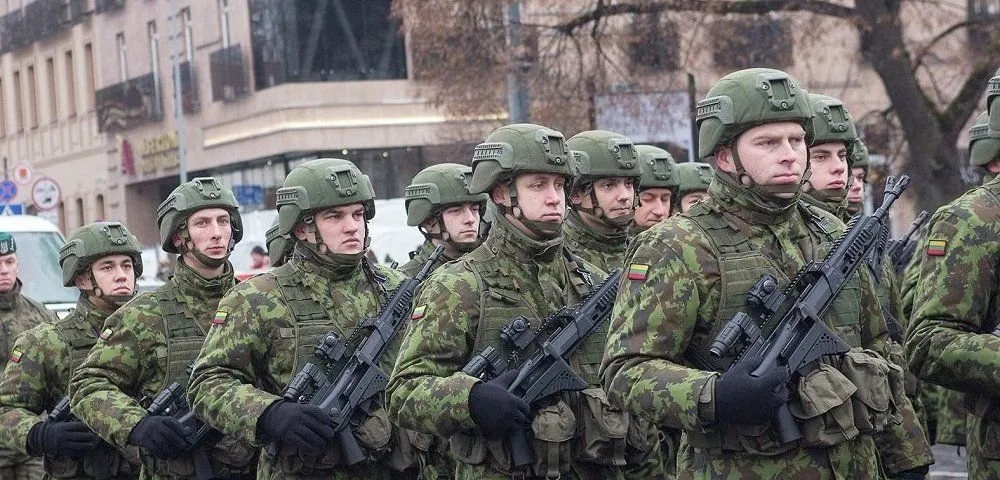
Lithuania, Latvia, and Estonia are strengthening their defenses in light of a possible Russian attack and, at the same time, are preparing for scenarios in which military aid from the United States might be limited or might not arrive at all.
One of the exercises Stanley-Becker observed was a large-scale simulation in the Lithuanian village of Bezdonis.
During the exercise, members of the Lithuanian Riflemen’s Union practiced their responses to a simulated Russian attack. Specifically, participants trained in storming enemy positions, evacuating the wounded, transmitting intelligence, and other wartime operations.
General Raimundas Vaikšnoras, Commander-in-Chief of the Lithuanian Armed Forces, explained that Lithuania seeks to demonstrate to a potential adversary its readiness to resist.
“The enemy must know that if it sets even a single foot on our territory, we will strike back,” Vaikšnoras stated.
The author of the article emphasizes that even a limited Russian invasion could create a serious crisis if NATO is unable to promptly fulfill its obligations under Article 5 of the North Atlantic Treaty.
Former NATO Secretary General Jens Stoltenberg, responding to a question from Stanley-Becker about confidence in U.S. President Donald Trump’s readiness to defend the Baltic states, said:
“We base our security on this.”
According to The Atlantic, the Baltic states are already building their defense systems in such a way as to be able to resist from the very first hours of a potential conflict.
Lithuania is fortifying its border with Belarus using anti-tank trenches and concrete barriers known as “dragon’s teeth.”
There are also plans to create a network of infrared cameras and acoustic sensors, the data from which can be analyzed using artificial intelligence.
At the same time, the armies of Lithuania, Latvia, and Estonia are actively expanding their use of drones, drawing in particular on Ukraine’s experience.
According to the scenario described in Stanley-Becker’s article, the first 72 hours following a potential Russian attack could be critical. This period may be necessary to hold back Russian forces until reinforcements arrive.
At the same time, Lithuania, Latvia, and Estonia do not have sufficient military resources for a protracted war of attrition without the support of their allies.
Therefore, these countries are doing everything possible to make it as difficult as possible for a potential adversary to advance and to buy time for the deployment of NATO forces.
Lithuania is already conducting military exercises that simulate a scenario in which U.S. assistance might be delayed or fail to arrive at all.
European allies are strengthening their military presence in the Baltic region. At the same time, according to the author of the article, it will be difficult to replace certain U.S. capabilities.
Specifically, this refers to satellite reconnaissance and long-range weapons.
At the same time, the Baltic states are not giving up on counting on U.S. support, but are simultaneously preparing for the possibility of acting independently.
At the end of the article, Stanley-Becker notes: “They believe that a war with Russia is approaching. They would prefer to have American support when it begins. But they will fight even without the United States, if necessary,” the journalist writes.
Journalist Isaac Stanley-Baker writes about this in an article for The Atlantic; he spent a month in the Baltic states, observing military exercises and speaking with political and military leaders.
A significant line of ships has formed near Russian ports on the Baltic Sea. According to the Russian Forces Spotter project, there are about 150 ships in the line, including 65 tankers and 85 vessels for transporting other cargo.
Russian border guards detained the Cyprus-flagged dry cargo ship Västerbotten in the Gulf of Finland as it was en route to the Estonian port of Sillamäe.
In Estonia, the government removed a mechanism to support passenger shipping from the new state budget strategy. Tallink and the Independent Estonian Seafarers’ Union stated that this decision could increase the likelihood that some ships, along with their crews, would be transferred out from under the Estonian flag.




