
Oxford mathematician challenges myth of Parthenon optical illusions
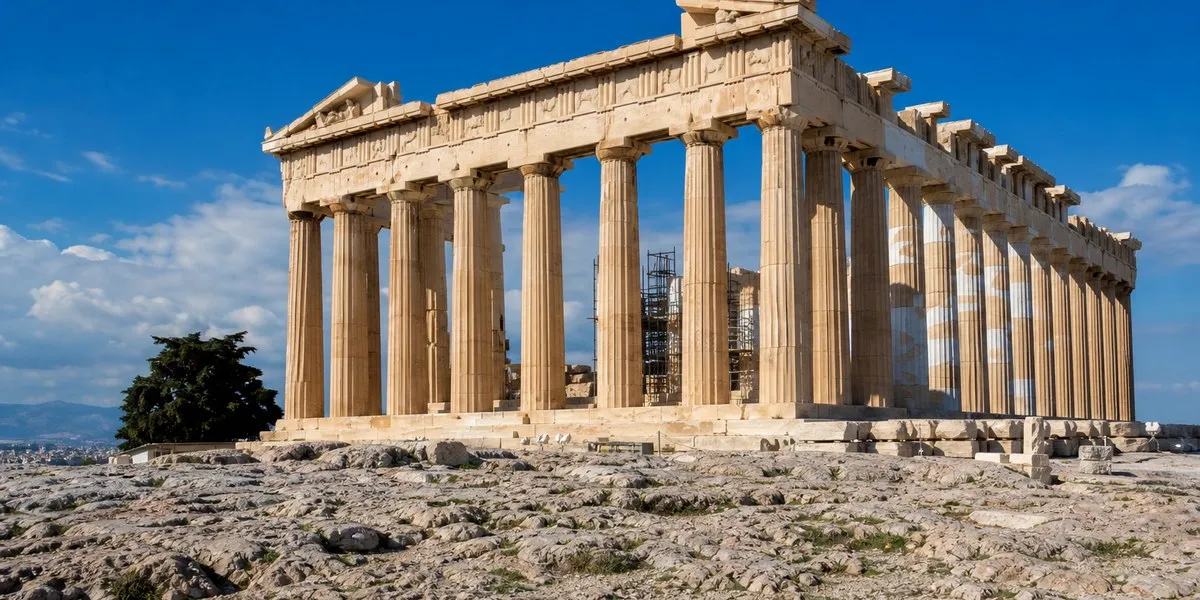
Professor Alain Goriely of the University of Oxford has challenged the widespread explanation that the curves of the Parthenon in Athens, Greece, were supposedly created to correct optical illusions. As The Guardian reports, mathematical modelling did not confirm the existence or visibility of the illusions that the temple's architectural features were meant to compensate for.
Curve of the temple’s base
One of the best-known examples concerns the stylobate, the base of the Parthenon. Its sides are not entirely horizontal: the arc rises by 6 centimetres in the central section. The Roman architect and engineer Vitruvius, who wrote about the temple around 400 years after it was built, believed that this curve was intended to eliminate the impression that a long horizontal line was sagging.
Goriely found no evidence that horizontal lines themselves appear to sag in the middle. He also analysed the assumption that the temple’s marble columns create this effect. It is associated with the Hering illusion, in which parallel lines on a two-dimensional plane can appear curved because they intersect with other lines. However, this effect is strongest at acute angles of intersection, while the Parthenon’s columns are too vertical. In addition, there is no evidence that such an illusion works in three-dimensional space.
More current news is available on the UA.News Telegram channel Telegram.
Barely noticeable thickening of the columns
The researcher also examined the claim concerning entasis, a slight thickening of columns. According to the traditional explanation, this curvature was meant to prevent the columns from appearing too thin in the middle. Goriely concluded that there is also no evidence for the existence of such a visual illusion. The thickening of the Parthenon’s columns is only 18 millimetres, so it is almost unnoticeable at a normal viewing distance.
In an article published in Royal Society Open Science, the mathematician suggested that the architects may have had other reasons for such decisions. The curved base, in particular, could have prevented puddles from forming after rain, while curved columns may have appeared more organic and aesthetically pleasing to the ancient Greeks. Frank Salmon, professor of the history of classical architecture at the University of Cambridge, noted that specialists have long treated Vitruvius’s explanations of Greek temple architecture, created several centuries before his time, with caution.




