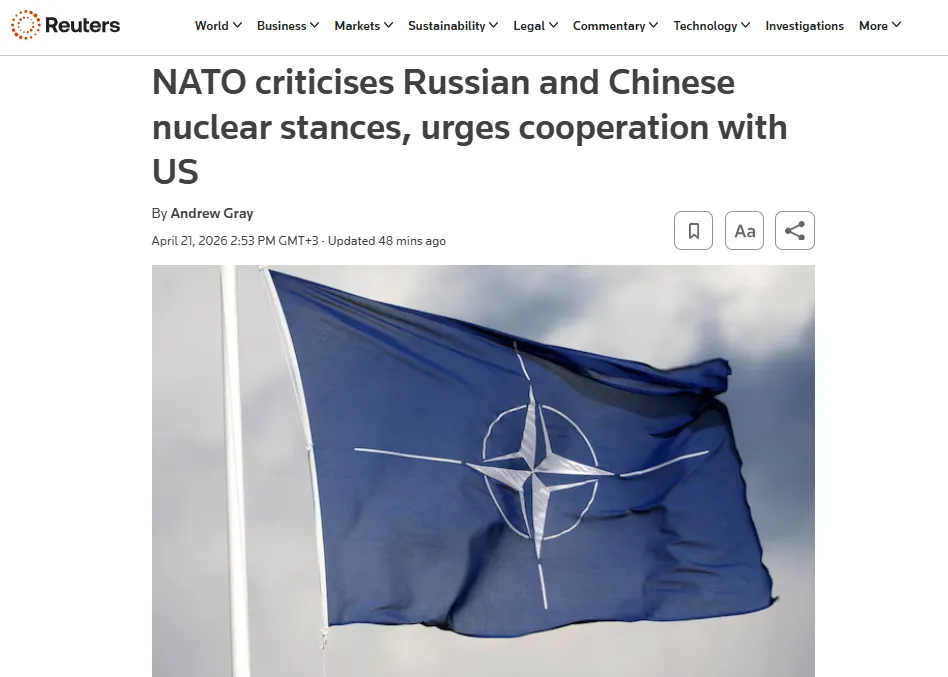
NATO countries expressed concern over the nuclear policies of Russia and China and called for greater transparency.
According to them, Russia is demonstrating its nuclear capabilities, specifically mentioning the "Oreshnik" missile, while China continues to expand its arsenal. The statement was made ahead of the UN Conference on Disarmament.
This was reported with reference to Reuters.
The North Atlantic Council’s statement emphasizes the Alliance’s “firm commitment” to the Nuclear Non-Proliferation Treaty, which has been the cornerstone of the global arms control system since 1970.
"Russia has violated key arms control obligations and engaged in irresponsible and threatening nuclear rhetoric. China continues to rapidly expand and diversify its nuclear arsenal without transparency," the statement reads.
"Oreshnik" and Signals from Moscow
NATO Deputy Secretary General Boris Ruge noted that Russia’s deployment of the “Oreshnik” medium-range ballistic missile, capable of carrying a nuclear warhead, is yet another signal of Moscow’s risky policy.
"Today we are dealing with a Russia that has withdrawn from all major arms control agreements, that... is developing all sorts of... nuclear delivery systems, and is waging the largest war in Europe since 1945," he emphasized.
NATO also stressed that the Alliance remains defensive and does not use such rhetoric, unlike the Russian leadership.
China’s Response
Meanwhile, China rejected the accusations, stating that it maintains its nuclear capabilities at the minimum level necessary for security.
"China always maintains its nuclear capabilities at the minimum level necessary for national security and will never participate in a nuclear arms race," said a spokesperson for China’s Ministry of Foreign Affairs.
Who Has the Largest Arsenals
According to estimates, Russia and the United States have the largest nuclear arsenals, followed by China, France, and the United Kingdom.
Ruge expressed hope that the upcoming conference would allow for the adoption of a joint document on transparency, risk reduction, and strategic stability, although previous attempts to reach a consensus have ended without results.
"Even if we fail to agree on a document, this, in our view, does not call into question the importance and validity of the NPT itself," he concluded.