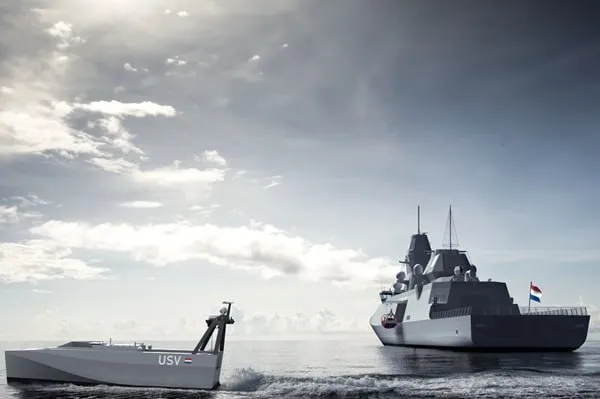
The Dutch Ministry of Defense has commissioned the Dutch Naval Design consortium to develop an autonomous surface vessel that will be used to detect and track submarines.
The new platform, approximately 12 meters long and with a displacement of about 9 metric tons, will be capable of speeds up to 20 knots (nearly 37 km/h), operating at sea for at least 96 hours, and carrying out missions even under challenging weather conditions.
The vessel is planned to be deployed alongside the next-generation ASWF frigates. It will help search for submarines at a considerable distance from the ship, expanding the area of control and allowing the frigate to remain more stealthy.
To detect targets, the system will use the Compact FLASH hydroacoustic suite from Thales, which was originally developed for anti-submarine helicopters. The drone will be able to deploy the sonar in designated areas, analyze different layers of water, and transmit the information to the ship.
The system will also be compatible with the frigates’ onboard sonars and acoustic buoys, allowing data from different platforms to be combined to create a more accurate picture of the underwater situation.
The Dutch Ministry of Defense explained under what conditions the war in Ukraine could end.
In May 2026, Ukraine sawa sharp increase in the number of civilian deaths and injuries—the highest figure in the last four years. According to the UN, the main casualtieswere caused by intense combat operations and strikes on urban areas.
Overall, the mission emphasizes that it is precisely the combination of massive strikes on cities and drone activity in frontline areas that has led to a sharp increase in civilian casualties. This is stated in the reportof the UN Monitoring Mission.