
The Shallowening of Rivers Poses a Threat to Germany's Chemical Industry — DPA
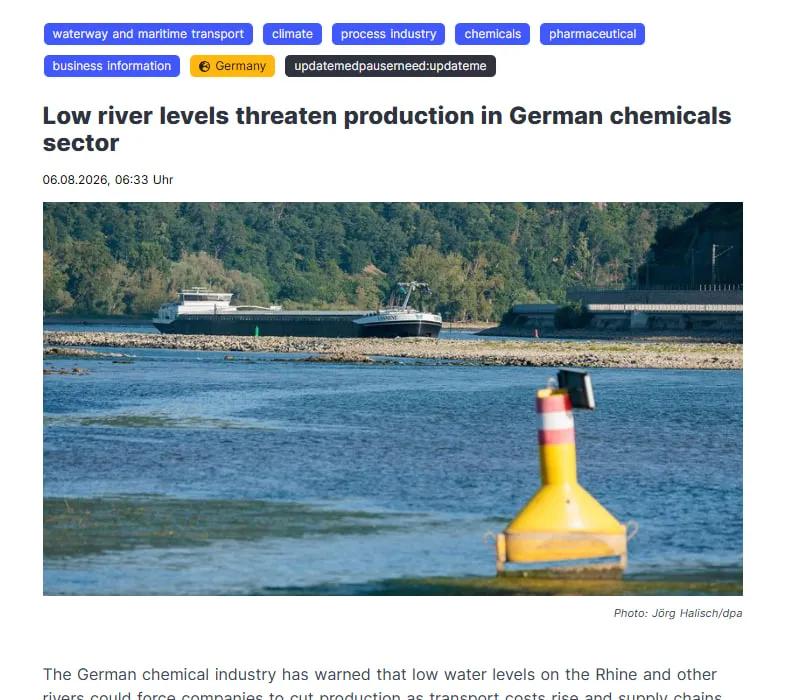
The German chemical industry has warned of the risk of reduced production due to low water levels in the Rhine and other rivers. This is due to rising transportation costs and logistical challenges.
The warning came on the eve of a conference on low water levels convened in Bonn by German Transport Minister Steffen Bilger.
According to Wolfgang Grosse-Entrup, executive director of the industry association VCI, when ships are forced to carry less cargo or cannot operate at all, this leads to higher transportation costs, disruptions in supply chains, and production constraints.
According to estimates by the Kiel Institute for the World Economy, Germany could lose between 1 and 2 billion euros in economic output in the third quarter due to the shallowing of rivers. This could also reduce the country’s gross domestic product by 0.1–0.2%.
The Rhine is one of Europe’s key transportation arteries. Major chemical companies, including BASF, Evonik, and Covestro, use it to transport methanol, butane, propane, ammonia, and other products. In 2024, approximately 20 million metric tons of chemical products were transported via Germany’s inland waterways.
Due to low water levels, BASF has already partially shifted its shipments from river transport to road and rail. At the same time, rail capacity is limited due to extensive repair work on the section along the eastern bank of the Rhine between Cologne and the Rhine-Main region.
This was reported by DPA.
As a reminder, water levels in France’s small rivers and streams had fallen to a historic low for this time of year as of the end of July, according to a report by the French Office for Biodiversity.
On August 3, Serbian President Aleksandar Vučić announced serious energy problems in the country due to low water levels in the Danube. Due to difficulties with the supply of raw materials, the oil refinery in Pančevo may temporarily suspend operations.


