
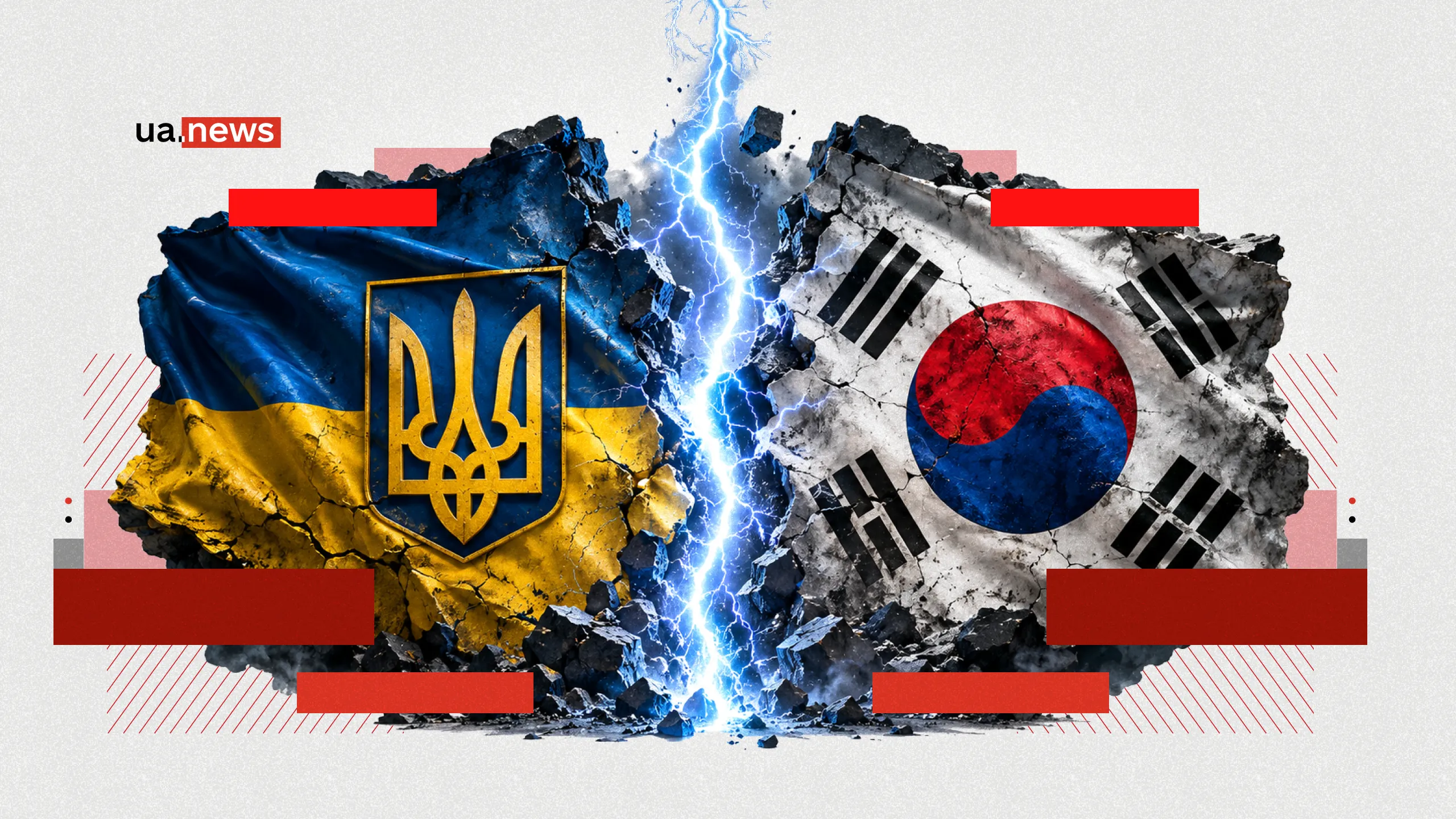
When President Zelenskyy took the podium at the UN General Assembly in September 2026, he could hardly have foreseen that a few words about the transfer of two North Korean prisoners of war to South Korea would set off a chain reaction that, within a month, would lead to a scandal at the head-of-state level and the recall of the Republic of Korea’s ambassador from Kyiv.
Just a month ago, Seoul was one of those partners that don’t make the headlines but quietly and consistently do their part: voting for pro-Ukrainian resolutions, allocating hundreds of millions of dollars for humanitarian programs and reconstruction, providing demining equipment, and so on. Now these relations are in serious jeopardy. And although formally this is a diplomatic dispute over a single incident, in reality much more is at stake: the trust that Ukraine built up over the years and lost in a single speech and subsequent ineffective communication.
What exactly happened between Kyiv and Seoul, why is it important, and is there still anything that can be salvaged in relations with South Korea? UA.News political analyst Mykyta Trachuk, together with experts, examined the issue.
What Happened Between Kyiv and Seoul: A Timeline of the Scandal
This story did not begin in September, but much earlier, in January 2025, when the Ukrainian military captured two North Korean soldiers in the Kursk region. Later, in the fall of 2026, they were handed over to South Korea—a country that is formally at war with North Korea, which formally claims the entire Korean Peninsula and does not recognize the division between the two states, and for which any information about its citizens (even enemy soldiers) is extremely sensitive.
According to Seoul, the handover took place under conditions of confidentiality. Moreover, as stated by South Korean Foreign Minister Cho Hyun, it was Ukraine that initially requested that this information not be disclosed. But in late September, during his speech at the UN General Assembly, Zelenskyy publicly mentioned the transfer of prisoners.
For Seoul, this constituted a breach of the agreement and came as a real shock. President Lee Jae-myung’s reaction was unprecedentedly harsh: he stated that “a person who, for the sake of their own petty gain, harms someone’s life, national interests, and security is called a murderer or a traitor,” clearly referring to Zelenskyy. South Korea made it clear that it considers Kyiv’s actions a violation of the agreements.
Events then unfolded rapidly. The South Korean presidential administration expressed “deep regret” over the “unilateral disclosure of information” and the “false claim that a non-disclosure agreement did not exist.” The country’s Foreign Ministry summoned the Ukrainian representative to lodge a protest. Seoul demanded official explanations and an apology—and a public one at that. Kyiv, however, insisted that no promises of non-disclosure had allegedly been made, and that Ukraine had “fulfilled all its obligations”—it was simply that a “misunderstanding” had arisen between the parties for no apparent reason.
No compromise was ultimately reached. On October 8, Seoul recalled its ambassador to Kyiv. And on October 20, South Korea’s Ministry of Foreign Affairs announced a reduction in its diplomatic mission in Ukraine. As a result, South Korea’s diplomatic presence in Ukraine has been significantly reduced, and relations between the two countries are at their worst since the start of the full-scale war.

South Korea—a partner that is easy to underestimate
Compared to the massive (in the past) U.S. military aid packages, French billions, or German armored vehicles and air defense systems, South Korea does not appear to be a “giant” in terms of aid to Ukraine. It has not provided Kyiv with lethal weapons: this is Seoul’s principled stance, driven by the complex security situation on the Korean Peninsula and a reluctance to provoke Russia, which wields significant influence over Pyongyang. But to reduce Seoul’s role solely to the absence of weapons would be a huge mistake and an underestimation.
First, the total amount of aid provided by the South Korean government from 2022 to 2025 exceeds $550 million. Another $100 million package was provided to Kyiv as early as July 2026. And starting in 2025–2026, the countries moved on to implementing more extensive long-term preferential lending programs (EDCF) totaling up to $2.1 billion.
Second, there is another form of critically important aid. In January 2024, South Korea delivered 200 pickup trucks to Ukraine for the State Emergency Service. In May 2025, it provided 16 underwater drones for mine clearance. This equipment saves lives. In addition, Seoul has repeatedly supplied equipment for humanitarian demining, engineering and medical equipment, and more.
Third, there is also very important political support. South Korea has consistently voted in favor of all key UN resolutions regarding Ukraine, including the resolution condemning Russian aggression.
Fourth, we must not forget the strategic importance of this country. South Korea is not just another “wallet” for Kyiv’s endless requests. It is a key U.S. ally in Asia, a country with a powerhouse economy and cutting-edge technology, which also shares a common enemy with Ukraine in the form of North Korea, whose soldiers are fighting on Russia’s side.
In other words, Kyiv and Seoul have an objective common interest. To lose this channel of understanding due to a series of communication errors would be the height of absurdity.
Diplomacy as the Only Way Out
As of October 21, the situation appears to be at an impasse. Seoul is demanding an official apology and an explanation. Kyiv insists that there is “nothing to apologize for,” and that the dispute has allegedly already been resolved—at least according to Foreign Minister Andriy Sibiga. For Kyiv, publicly confirming the existence of a confidentiality agreement would mean admitting that Zelenskyy violated it. For Seoul, however, a public apology is a matter of President Lee Jae-myung’s reputation, as he has already made this issue a personal one, employing highly aggressive and personal public rhetoric.
But there is also a broader context. Political forces in Seoul, which had previously opposed any aid to Ukraine in order to avoid straining relations with Russia and North Korea, have been given a powerful argument—and one that comes directly from Kyiv, no less. Now, any decision to expand support will be more complicated, as it will have to pass through a domestic political filter. In other words, even after a formal reconciliation, “resentment” may linger.
It’s important to understand that Ukraine is in the weaker position. It is Ukraine that is at war; it is Ukraine that is chronically dependent on any form of aid. Under such conditions, diplomacy is not a matter of “who is to blame,” as if in a children’s sandbox, but a matter of “how to retain an important partner.”
What has happened is not yet a catastrophe, overall. But it is already a warning sign. A country that for years has been an unassuming but reliable partner is now officially expressing “deep disappointment,” using very harsh rhetoric, and demonstratively scaling back its political and diplomatic presence. Regaining trust will be far more difficult than losing it. And Ukraine’s standing in Asian politics—a region where it doesn’t have many friends to begin with—depends on how quickly Kyiv comes to realize this.

Expert
Opinions
Political scientist Viktor Nebozhenko, head of the “Ukrainian Barometer” polling service, points out: South Korea is a powerful nation. And its main enemy, North Korea, supplies Russia with weapons and soldiers. Therefore, of course, we urgently need to make peace with South Korea, rather than pretending that this does not concern us.
“The conflict with North Korea is just as much a mistake on the part of the Presidential Office, Zelenskyy, and diplomacy as a whole as the conflict with Poland over the Order of the White Eagle and everything else. This conflict is a huge mistake. South Korea has a powerful military-technical base and has helped Ukraine a great deal. This is our fault. Another matter is that local politicians are exploiting Ukraine’s diplomatic blunders and tactlessness, turning them into a political campaign. That’s how it works in Poland, and that’s how it works in South Korea. South Korea has already reduced the embassy’s staff, and the country’s president is making it clear that he intends to continue having serious disagreements with Kyiv.
So in this situation, we’ve clearly struck a very sensitive nerve. It doesn’t really matter who’s right or who’s to blame. The fact is that Ukraine is at a disadvantage in this situation. North Korean soldiers are fighting for Russia against Ukraine, while Ukraine is at the same time quarreling with South Korea! Well, that’s just impossible to imagine!” exclaims Viktor Nebozhenko.
Serhiy Tolstov, a political analyst at the UIP and a candidate of historical sciences, is convinced that, when it comes to shaping Ukraine’s position, it is necessary, first of all, to adhere to agreements with partners. Second, one must take into account not only the interests of one’s own public relations but also the interests of the partner, on whose position this or that form of assistance and support depends, including within international organizations.
“This is the ABCs of diplomacy and responsible international conduct. Partnerships cannot be built on any other basis. If South Korea is an important country—a member of the G20 and a leader in technology and industry—then we must maintain a relationship of mutually responsible cooperation with its government circles. All the more so because North Korea is an ally of Russia and is in the hostile camp. As for what the Ukrainian leadership did—we do not know whether South Korea demanded that this information be kept secret. But we can assume that this agreement was reached, given Sesul’s reaction. Zelenskyy violated the agreement—and did so demonstratively—from the UN podium. This is not merely a mistake, but a display of contempt for the country with which the agreement was reached.
For South Korean politicians, the question of whether or not to return North Korean soldiers is a very sensitive issue. Relations between Seoul and Pyongyang are strained. For a long time, both capitals assumed that reunification was inevitable, although this issue has now been removed from the agenda. But as far back as 1953, the issue of repatriating North Korean prisoners of war was so contentious that it even delayed the signing of the armistice for several months. The question of where, how, and to whom North Korean prisoners of war are handed over is an extremely sensitive issue for the government in Seoul. And if the reaction was so harsh, then one can only say that the Ukrainian side violated very important principles and broke its promises,” noted Serhiy Tolstov.

To sum up, the main lesson of this story is very simple: in diplomacy, sometimes what matters most is not what you say, but what you leave unsaid. Sometimes it’s better to simply remain silent, and if you’ve already said something you shouldn’t have—it’s definitely better to remain silent afterward rather than start a public diplomatic spat that no one needs.




