
Trump's approach to borders undermines global stability — NYT
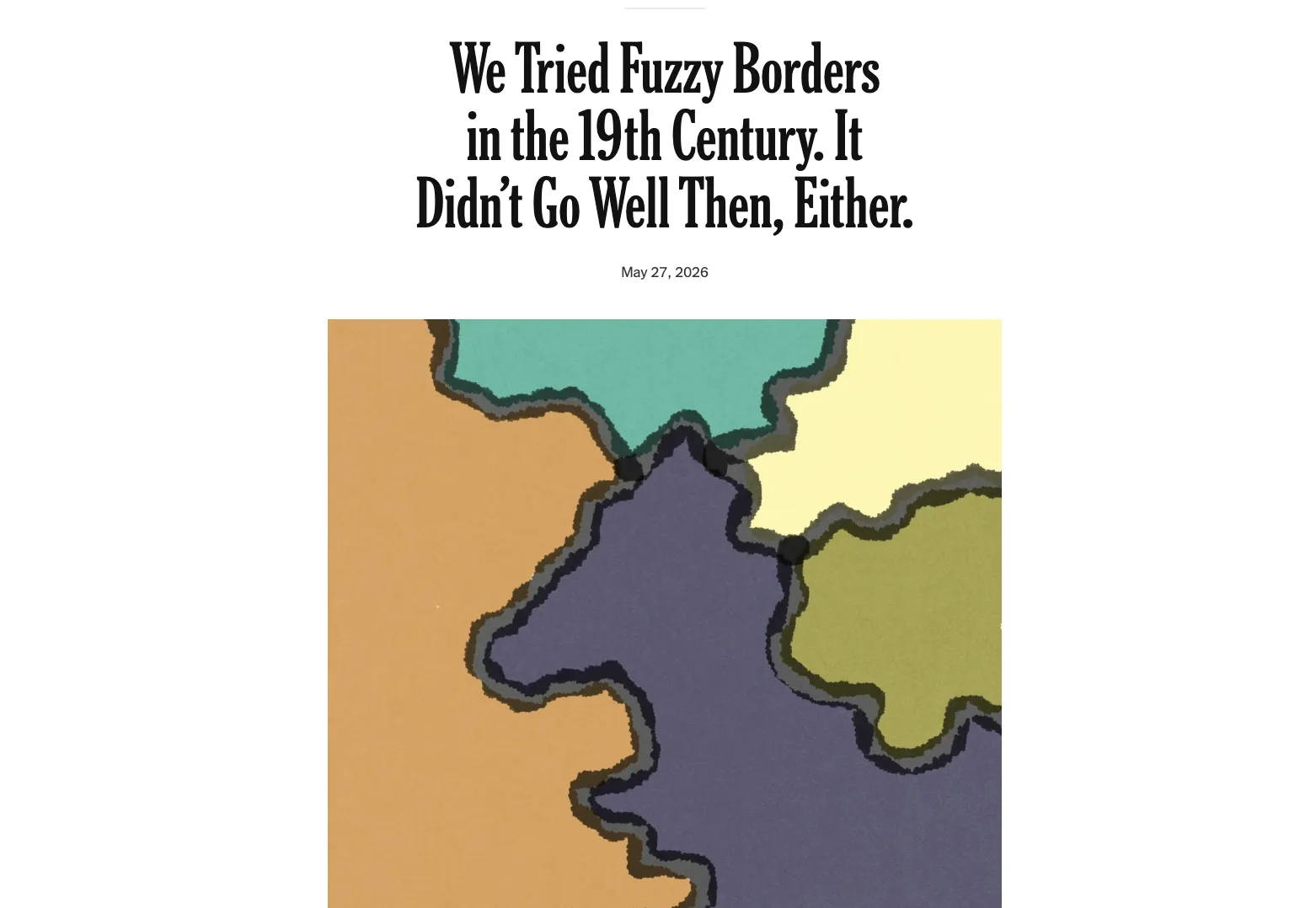
The New York Times has criticized Donald Trump’s statements regarding possible changes to Iran’s borders. According to the newspaper, such rhetoric reflects an imperial approach to international politics and poses risks to global stability amid the conflict in the Middle East.
For the White House administration, which regularly confuses political bluster with a well-thought-out strategy, this remark set an extraordinary precedent. Iran is one of the world’s largest countries, and any attempt to redraw its borders could unleash a protracted ethnic, religious, and political conflict that would destabilize the entire Middle East. However, this incident is merely part of a broader pattern indicating that Trump’s understanding of international borders is decidedly blurred.
The American president has repeatedly threatened to deploy the U.S. military in Colombia and Mexico, and has also promised to bring the Panama Canal back under U.S. control. His administration has declared an armed conflict with drug cartels, in which U.S. troops attack boats in the Caribbean Sea and the Pacific Ocean, a campaign that has already resulted in the deaths of nearly two hundred people. Trump’s obsessive desire to seize Greenland, backed by constant diplomatic, economic, and military pressure on Denmark and other NATO allies, has nearly destroyed the already fragile Western alliance. After publicly musing about turning Canada into the fifty-first state, Trump now approves of social media posts depicting Venezuela draped in the American flag.
All of this indicates that the U.S. leader has adopted an openly imperial approach to foreign policy. In such a framework, any international treaties are viewed as temporary, allies are perceived as obstacles, and military force becomes an instrument of personal rule. Although analysts often describe Trump’s worldview as neo-royalist, his traditional understanding of geopolitics threatens the fundamental basis of the modern world—clearly defined international borders that ensure state sovereignty. For a man who constantly talks about borders, Trump has a very specific view of them, the result of which will be a world of blurred boundaries and a cacophony of territorial claims across the globe.
Today, the clear lines on the map seem natural and inevitable to us, and the planet appears neatly divided, with each country ending where the next one begins. Even the ongoing disputes over Taiwan, Israel, or Kashmir force cartographers and corporations to make awkward compromises, as a poorly drawn line can trigger an immediate diplomatic or regulatory response. Russian dictator Vladimir Putin’s attempts to unilaterally redraw the map and erase Ukraine’s sovereignty over its legitimate territories are shocking precisely because they shatter these widely accepted conventions.
However, the current stability is a historical anomaly, as international borders were vague and constantly contested until the 21st century, and the very idea of a clear line is a modern invention. In the past, empires constantly changed in size due to wars, marriages, or the purchase of lands, and sovereignty was tied to dynasties rather than to a specific territory. Imperial frontiers always remained zones of uncertainty and friction, which, instead of being romantic spaces of freedom, became engines of brutal conflicts. Europe learned this lesson in 1914, when the assassination in Sarajevo triggered a chain reaction of territorial claims in the Balkans, leading to four years of industrial slaughter and claiming over 14 million lives. The Allies’ attempts to resolve the problem of blurred lines after World War I ended in failure, as the Treaty of Versailles left a humiliated Germany territorially dismembered, undermining its democracy and fueling a desire for revenge that Adolf Hitler would later exploit. The Treaty of Trianon similarly diminished Hungary, creating a lasting grievance by placing millions of ethnic Hungarians under the rule of neighboring states.
World War II began with the same pattern of border disputes, as the annexation of Austria met only symbolic resistance and was justified by elites as a natural unification of peoples, making every European border a matter of debate. The Munich Agreement destroyed Czechoslovakia, and the Nazi-Soviet Pact divided Poland’s territories, triggering a global war and the deaths of fifty million people. The new world order created thereafter proved extremely successful in resolving this problem, not only thanks to the emergence of the UN or NATO, but through the invention of a system where the linear borders of each state are demarcated and recognized by all. Although this principle has often been violated by Western states themselves, and former colonies required decades of bloody struggle for sovereignty, this model is far more precise than in any previous era.
Trump’s reckless disregard for the sanctity of national borders threatens to return humanity to a dangerous world of endless geopolitical wars over disputed territories. The current standoff over who exactly holds sovereignty over the Strait of Hormuz is merely the first harbinger. In his second inaugural address, the American president called for the expansion of U.S. territory, but if Washington can lay claim to Canada, Panama, Venezuela, Greenland, or Cuba, then powerful states on other continents will lose any incentive to abide by international law in their relations with neighbors. A world in which powerful states treat sovereignty as a mere formality would mark a return to the old logic, where the boundaries of the political community are defined by force, not by law. The great powers of the twenty-first century—namely the United States, China, and Russia—may be tempted by this vision, but the price of returning to such chaos will be paid in millions of human lives.
You might be interested in:
France and Britain have recordedrecord-breaking heat waves.
Francehas called on China to influence Russia to end the war against Ukraine.
Russian dictator Vladimir Putin stated that Russia is ready to provide China with “uninterrupted” supplies of oil, gas, and liquefied natural gas (LNG).
Following U.S. President Donald Trump, Vladimir Putin arrived in China for a meeting with Chinese President Xi Jinping.
During his visit to China, Vladimir Putin had hoped to secure Beijing’s approval for the construction of a new large-scale gas pipeline, but the negotiations ended without a result.


