
Suspect in the drone attack on Leipzig Airport has ties to Russian intelligence — WELT
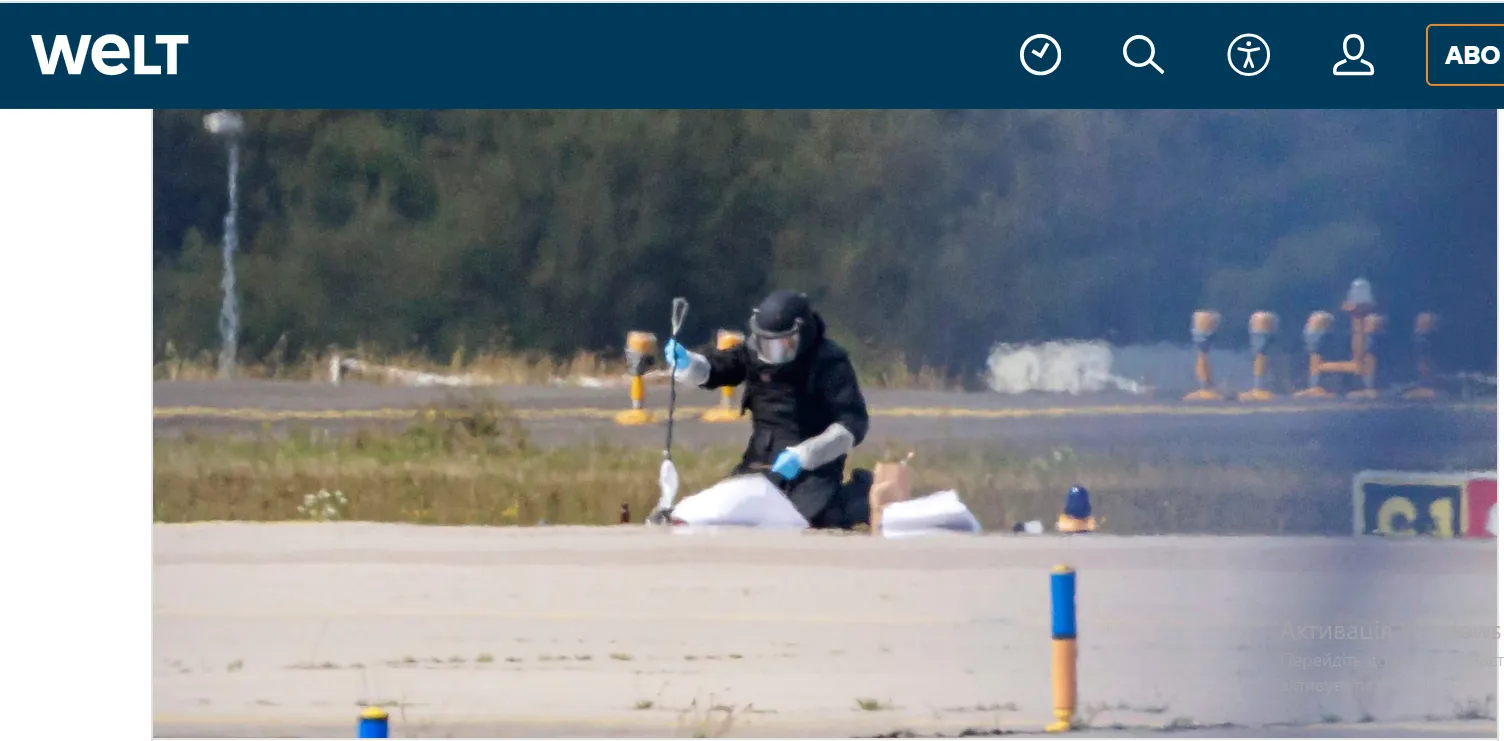
German investigators have identified two individuals who may have been involved in the drone attack on Leipzig Airport, which occurred while an aircraft carrying cargo for Ukraine was parked there. One of them is linked to Russian military intelligence—the GRU.
Journalists from the German newspaper *Welt* gained access to classified investigation materials and spoke with high-ranking representatives of German security agencies.
The publication claims to have obtained the suspects’ full names, as well as details about their entry into and subsequent departure from Germany. According to Welt, the evidence gathered by investigators formed the basis for statements by German ministers regarding Russia’s possible involvement in the attack. Moscow denies these allegations.
The main suspects in the case are Andrei Ka., a Belarusian citizen, and Oleg Le., a Russian citizen. According to investigators, Le. was responsible for planning and logistics for the operation. German security agencies link him to Russia’s GRU. He entered Germany via Turkey and later left the country through Berlin-Brandenburg Airport, flying to Serbia. Le. is currently in Russia.
According to investigators, the plan was to use three drones for the attack. Two of them were likely destroyed during takeoff, while the third reached the Antonov aircraft, but the explosion did not occur. Investigators believe that the plan was to use approximately 1.8 kg of Semtex explosives, which could have been hidden in a tin can. German law enforcement officials suggest that, had it detonated, a powerful explosion could have occurred, capable of damaging part of the airport.
DNA traces have become crucial evidence for the investigation. Forensic experts discovered them on fragments of a device that, according to law enforcement, was used to control the drone. These traces are linked to K., who has previously been involved in criminal cases in Finland and Lithuania. Polish law enforcement also links him to the arson of a hardware store in Łódź in 2024, which the prosecutor’s office is investigating as an act of sabotage with a possible Russian connection.
According to German authorities, the explosives may have been transported to Germany via Bulgaria and Serbia. Investigators suspect they were transported in hidden compartments in trucks and then stashed near Leipzig Airport. Police discovered several possible hiding places, and an analysis of data on a rental car used by one of the suspects helped them locate them.
As a reminder, the Estonian Ministry of Foreign Affairs summoned the chargé d’affaires of the Russian Federation—an aggressor state—to express its strong condemnation of the August incidents involving drones at the Leipzig/Halle Airport in Germany. German authorities link these incidents to Russia.
In total, the United Kingdom, Lithuania, Latvia, and Estonia summoned representatives of the Russian embassies over the incident at Leipzig Airport. In doing so, these countries expressed solidarity with Germany, which has accused Russia of involvement in the attack.
German investigators have identified two suspects in the planning of an attack on a Ukrainian passenger plane at Leipzig Airport, uncovering a connection to Russia in their actions.
Berlin is prepared to officially hold Russia responsible for the attempted drone attack in Leipzig. Germany is also considering the possibility of imposing direct sanctions against Russian entities.


