
Russia's record oil revenues soared amid the crisis in the Middle East

Last week, Russia recorded its highest estimated revenue from seaborne crude oil exports since the start of the full-scale invasion. According to Bloomberg, this was driven by high global oil prices and rising prices for Russian crude grades, some of which sold for $110–120 per barrel. At the same time, attacks on Russian oil refineries and the ban on fuel exports are forcing Moscow to export more crude oil.
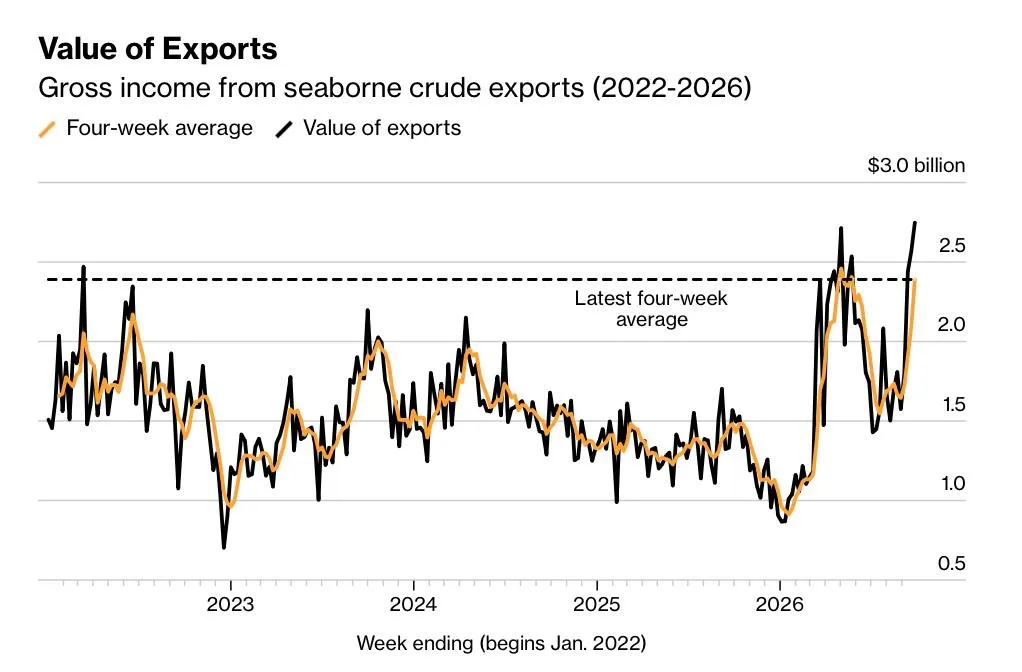
Russia has earned record weekly revenue from seaborne crude oil exports since the start of the full-scale war against Ukraine. In the week ending September 27, Russia shipped approximately 3.99 million barrels of crude oil per day to foreign markets. Against the backdrop of high prices, this has significantly increased the value of Russian exports. Bloomberg estimates that the total value of oil shipped from Russian ports last week was approximately $2.75 billion. This is approximately $180 million more than the previous week and the highest weekly figure since the start of Russia’s full-scale invasion of Ukraine.
The reason for this surge is not solely due to export volumes. Russian oil is now significantly more expensive than in previous months. This has been influenced by the situation on the global oil market, particularly instability in the Middle East. The price of Brent crude has remained above $100 per barrel in September. At the end of September, the price of this grade exceeded $103 per barrel. Earlier, prices had risen even higher amid fears of disruptions to oil supplies from the Middle East.
Against this backdrop, Russian crude is also becoming more expensive. Specifically, in mid-September, the Russian ESPO grade exceeded $120 per barrel, while the price of Urals rose to $110. Reuters noted that the ESPO premium over Brent reached a record $20–30 per barrel at that time. This is significant for Russia, as its oil is typically sold at a discount to global benchmark grades. Now, however, strong demand from buyers for alternative supplies is allowing Russian sellers to command significantly higher prices for certain shipments.
The main factor driving this demand is the situation in the Middle East. Due to supply issues, buyers are seeking additional sources of crude. In particular, Chinese oil refiners have begun purchasing Russian oil more actively, fearing a shortage of crude ahead of the winter season. At the same time, the Russian oil industry is under pressure from Ukrainian strikes on oil refineries. Due to damage to refineries, Russia has fewer opportunities to process its own oil domestically. As a result, some of the crude must be directed directly for export.
For example, on September 25, the Perm Oil Refinery halted operations following a drone attack. Reuters reported a fire and damage to the facility’s pipelines, storage tanks, and processing units. The plant is one of the largest in Russia and, prior to the attack, processed approximately 252,000 barrels of oil per day. Other Russian oil refineries have also been targeted. As a result, gasoline and diesel production has declined, and fuel supply issues have arisen in the domestic market. Reuters reported in September that the gasoline shortage in Russia had spread to many regions, and some gas station chains were forced to limit sales.
To support the domestic market, Russian authorities have restricted fuel exports. The ban on diesel exports by Russian producers has been extended until September 30, while restrictions on gasoline and some diesel fuel exports by other exporters remain in place for a longer period. As a result, a unique situation has arisen: Russia cannot export as many petroleum products as before, but it has a surplus of crude oil that it cannot fully process domestically. Therefore, the excess crude is being directed to the foreign market.
This is increasing the volume of maritime exports. According to Bloomberg, approximately 3.99 million barrels of crude oil per day were shipped from Russian ports last week. At the same time, current revenue significantly exceeded the previous week’s figure. Bloomberg estimates the difference at about $180 million. To avoid drawing conclusions based on just one week, Bloomberg also calculated the average revenue over four weeks. This metric is less susceptible to sharp short-term fluctuations in prices and volumes.
Over the past four weeks, the estimated average value of Russian oil exported by sea was approximately $2.39 billion per week. This is about $290 million more than in the previous four-week period and the highest figure since the second half of May.
Thus, Russia is currently earning more money from oil sales not only because of increased exports. The price of crude oil itself also plays an important role. As long as Brent remains above $100 per barrel and Russian crude grades are in demand among buyers in Asia, Moscow can generate additional revenue even despite operational issues at its own oil refineries.
At the same time, this situation may change along with prices on the global market. Oil supplies from the Middle East are gradually resuming: Reuters reported that exports from Saudi Arabia and the UAE rose in September, and some infrastructure began to recover following the attacks. This could ease pressure on the global market and affect the price of Russian oil. This is evidenced by an analysis of tanker movement data conducted by Bloomberg.
In Russia, the aggressor state, restrictions on the public disclosure of data regarding refinery operations, contracts, and tanker routes have taken effect. Putin signed the corresponding decree on September 28, according to OilPrice, citing Reuters.




