
Russia has established priorities for fuel distribution
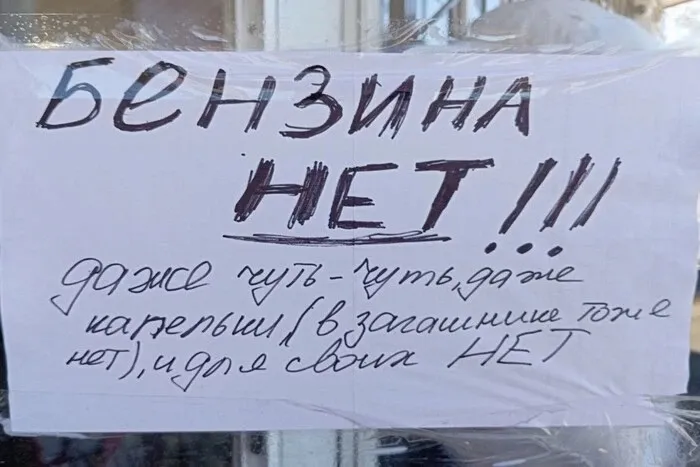
Russia has approved a new distribution plan for gasoline and diesel fuel amid supply issues. State agencies, law enforcement agencies, and the temporarily occupied Crimea will be given priority, while independent gas stations and ordinary drivers will be at the bottom of the list.
According to the minutes of meetings held by Deputy Prime Minister Alexander Novak, which were reviewed by the publication “Kommersant,” petroleum products will first be allocated to government contractors, municipal services, state defense contractors, Russian Railways, the civilian fleet, and farmers. Next in line are occupied Crimea, other occupied territories of Ukraine, and the Kaliningrad Oblast. Only after that will fuel be allocated to oil companies’ gas stations, independent gas stations, and for export under intergovernmental agreements.
The government itself acknowledges that the market situation remains tense, especially in Siberia and the Far East. The Ministry of Energy has been tasked with finding contractors to import fuel, developing supply schemes for problem regions, and assessing the feasibility of building mini-refineries there. Regional authorities have been required to report daily on fuel stocks at oil depots, refineries, and gas stations.
The fuel crisis resulted from attacks on Russian oil refineries. According to EA Analytics, oil refining volumes in July fell to 3.91 million barrels per day—the lowest level since 2005— while analysts at Energy Intelligence put the figure even lower at 3.58 million barrels, which could be the lowest level since 2002. To mitigate the shortage, the government restricted gasoline and diesel exports through the end of July and is considering subsidizing imports.
According to Reuters estimates, Russia has lost about 40% of its refinery capacity due to attacks by Ukrainian drones. In the second week of July, gasoline production fell to 75,000–80,000 metric tons per day, compared with summer demand of 115,000–120,000 metric tons. Formally, restrictions on fuel sales are in effect in more than 40 regions, but in reality, limits and bans cover almost the entire country, including the occupied territories of Ukraine.
Analysts surveyed by “Kommersant” doubt that the new scheme will truly solve the problem. Dmytro Prokofiev, Director of External Communications at NEFT Research, believes that the introduction of priority access effectively creates a two-tier supply system, under which independent gas stations and ordinary motorists will receive fuel on a residual basis. According to him, large consumers and priority regions may indeed see improvements in the coming weeks, while the retail segment will continue to face shortages. The publication’s industry sources warn that shifting supplies to the over-the-counter segment could only exacerbate the shortage and lead to the formation of a parallel market with higher prices.
For the first time in history, Russia plans to begin importing diesel fuel due to a sharp decline in its own production and a shortage in the domestic market.
The Russian Red Cross has begun building up additional humanitarian aid reserves for the temporarily occupied Crimea and Sevastopol following the declaration of a state of emergency on the peninsula.
On the temporarily occupied Crimean Peninsula, local residents report prolonged power outages, fuel shortages, rising prices, and problems with social infrastructure. According to them, the situation is particularly dire in the northern regions of the peninsula.
As a reminder, Ukraine has claimed to have struck 19 Russian tankers carrying fuel for Crimea.




