
Investigators name causes of train collision in Bekasi — Channel NewsAsia
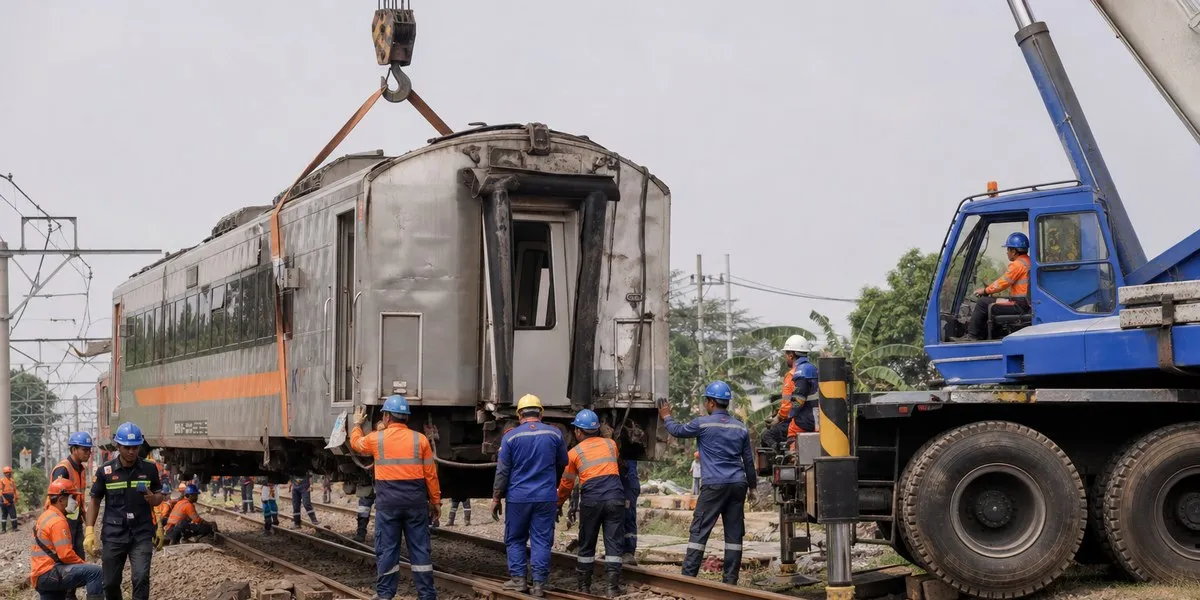
Indonesian investigators have found that signal failures and communication problems were the main causes of the collision between a commuter train and an intercity train in Bekasi, near Jakarta. The April 27 crash killed 16 people and injured another 107, Channel NewsAsia reports, citing a report by the Transportation Safety Committee.
Sequence of the accident
According to the report, the events began after an electric taxi reportedly stopped at an unattended railway crossing near East Bekasi station. At around 8:48 p.m., a commuter train traveling from east to west collided with the car.
Another commuter train traveling in the opposite direction was instructed to remain at East Bekasi station. An express train traveling from Jakarta to Surabaya in East Java province then crashed into the stationary commuter train. Passengers in the overcrowded women’s carriage at the rear of the train were injured in the impact.
Faulty signals and communication delay
Investigators found a signaling malfunction on the section between Bekasi and East Bekasi stations. The intercity train driver received a green signal to depart but did not receive an additional warning that he needed to reduce speed.
More current news is available on the UA.News Telegram channel Telegram.
The report states that the driver “did not receive a yellow signal informing him that the next signal was red.” The operations control center also took three minutes and 20 seconds to receive a report from the commuter train driver about the taxi incident. Center staff could not hear the driver clearly.
Driver training
The report’s authors also found that the long-distance train driver had not undergone training on how to act in situations requiring emergency braking. Other factors noted by investigators included poor signal visibility due to light pollution and damaged windshields.
After the crash, experts and civic organizations called for stronger railway safety measures. In particular, there were proposals to build separate tracks for express and commuter trains, as well as to fund the construction of overpasses instead of railway crossings.




