
The U.S. Will Shorten the Validity Period of Visas for Chinese Journalists — Bloomberg
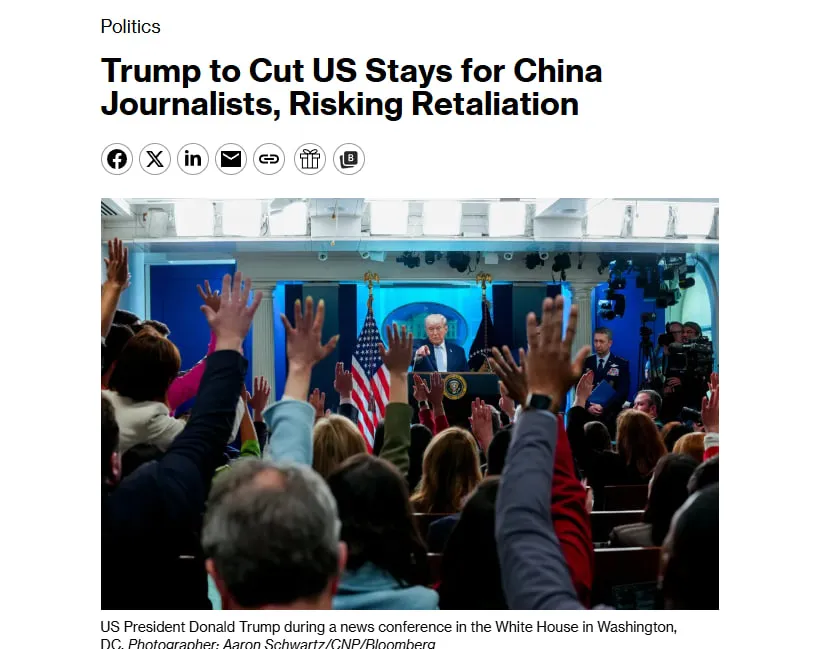
The administration of U.S. President Donald Trump has decided to shorten the validity period of U.S. visas for foreign journalists, particularly those from Chinese media outlets. Officials in Washington stated that this will allow for stricter monitoring of compliance with residency requirements, while Beijing has already threatened retaliatory measures.
Under new rules from the U.S. Department of Homeland Security, the validity period of journalist visas for foreign nationals will be reduced to 240 days, and for journalists from mainland China, to 90 days. This is precisely the restriction that Donald Trump proposed to implement toward the end of his first presidential term, but it was later rescinded by the Joe Biden administration.
The White House explained that the new measures will allow for closer monitoring of visa holders and verification that their activities align with the stated purpose of their entry into the U.S. At the same time, the option to extend visas will remain available.
In response, Chinese Foreign Ministry spokesperson Lin Jian condemned Washington’s decision, calling it discriminatory, and urged the U.S. to abandon the changes. According to him, Beijing reserves the right to take appropriate countermeasures.
In addition, the U.S. has introduced a new four-year validity period for student visas, abandoning the previous practice that allowed international students and exchange program participants to remain in the country for the entire duration of their studies.
The effective date of the new rules has not yet been announced.
The decision was made against the backdrop of a fragile trade truce between the U.S. and China. It is expected that in September, the leaders of the two countries may meet to discuss further steps in the areas of trade and investment.
U.S. authorities have repeatedly stated that there are significantly more Chinese journalists working in the United States than there are American journalists working in China. During Trump’s first term, Washington had already scaled back the presence of Chinese state-run media in response to restrictions imposed by Beijing on American journalists.
This was reported by Bloomberg.
As a reminder, U.S. President Donald Trump intends to announce previously unknown possible Chinese interference in the U.S. elections during a scheduled prime-time address.
China has rejected Trump’s claims of interference in the U.S. presidential election.


