
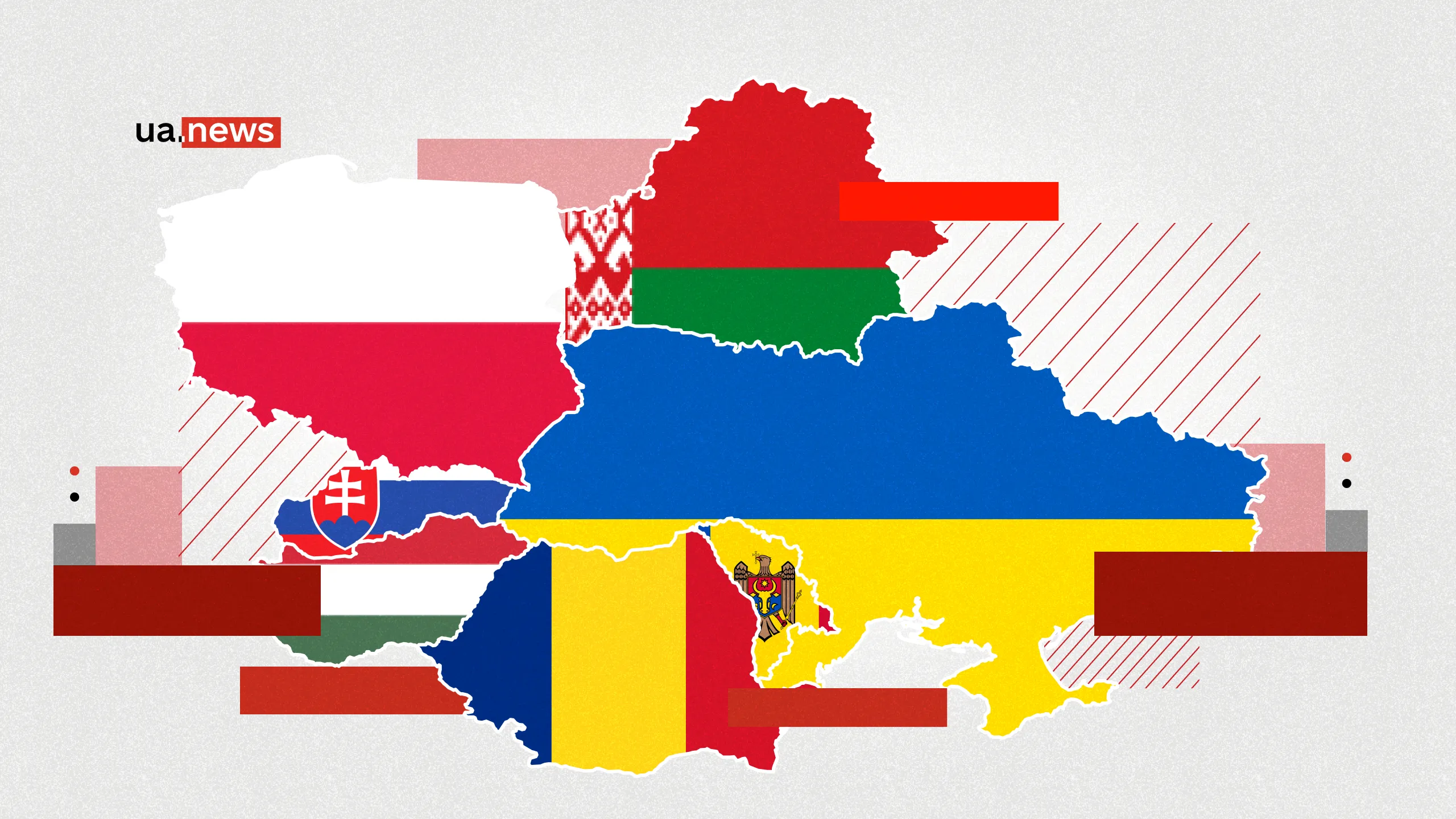
The world today is in a state of constant turmoil. One crisis follows another; old security paradigms are crumbling, while new ones have not yet had time to take shape. In this whirlwind of events, one thing that often finds itself on the periphery of global news agendas remains extremely important: relations with our closest neighbors. Because neighboring states are not like neighbors in an apartment building. You can move out of a building, find a new place, and have different neighbors.
It doesn’t work that way with countries. Geography is an inexorable force. It determines not only where you are located, but also who you are forced to deal with every day, regardless of your likes or dislikes.
UA.News decided to examine the current state of Ukraine’s relations with all its key neighbors. Not with Russia—everything is clear there. We’re looking at six countries: Moldova, Romania, Poland, Hungary, Slovakia, and Belarus. Each has its own history of relations with Kyiv, its own sore spots, and its own interests. In some cases, things are going well; in others, with mixed results; and in still others, unfortunately, they’re frankly going badly. Read more in our article.
Moldova: A Strategic Partnership and Complete Mutual Understanding
If one were to look among Ukraine’s neighbors for a country with which relations today can be described as nearly flawless, it would undoubtedly be Moldova. Chisinau and Kyiv demonstrate a high level of mutual understanding, based not only on the good personal relations between their leaders (Volodymyr Zelenskyy and Maia Sandu) but also on a shared vision of the future.
Both countries understand that their security is inextricably linked. During a meeting with his Moldovan counterpart in April 2026, President Zelenskyy stated that Ukraine would continue to support Moldova on security issues. This is a strategic approach that works for both sides. Chisinau, for its part, has repeatedly emphasized that Moldova’s security is closely linked to Ukraine’s security and that Moldova supports Ukraine in its struggle for sovereignty. In addition, Moldova is a reliable economic and energy partner.
It is particularly telling that both countries are moving in tandem toward EU membership. They even expect to open negotiation chapters in the near future.
Of course, there are certain points of tension in the relationship. But for now, both sides are demonstrating the political will to coordinate their actions. Moldova is a rather rare case where proximity turns into an advantage rather than a burden.

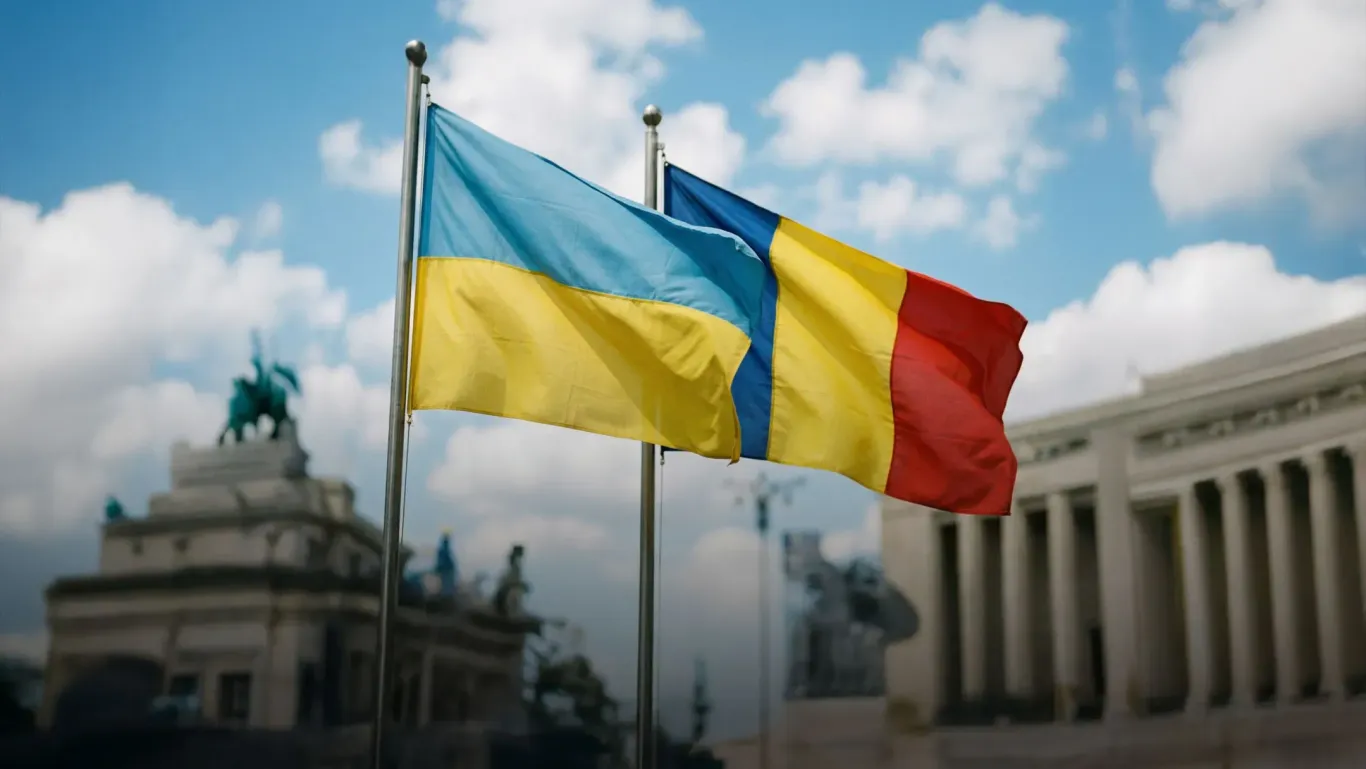
Romania: A Pragmatic Partnership with Nuances
Romania is another neighbor with which Ukraine has developed fairly constructive relations. Bucharest plays an important role in regional security, and Kyiv appreciates this.
Defense remains the key area of cooperation. Romania also supports Ukraine’s European integration aspirations. This is important because, as a member of the EU and NATO, Romania carries significant weight on these issues.
At the same time, there are also cause for concern: UAVs regularly enter Romanian airspace from Ukrainian territory. Such incidents serve as a reminder that the war poses risks to neighboring countries as well. Romania is forced to respond, and this creates some tension, though it does not escalate into any political conflicts.
The issue of national minorities is also present, but it has not become as acute as it is with Hungary. The Romanian minority in Ukraine, particularly in the Odesa region, occasionally draws the attention of Bucharest, but the parties try to resolve these issues in the European spirit and without any significant public conflicts. The Ukrainian minority in Romania, for its part, is represented in parliament by the Union of Ukrainians in Romania, which indicates a certain level of institutional recognition.
Overall, Romania is a fairly reliable partner with whom it is both possible and necessary to work. Relations between Kyiv and Bucharest are not without their challenges, but both sides demonstrate a willingness to engage in dialogue and seek compromises, which is key.
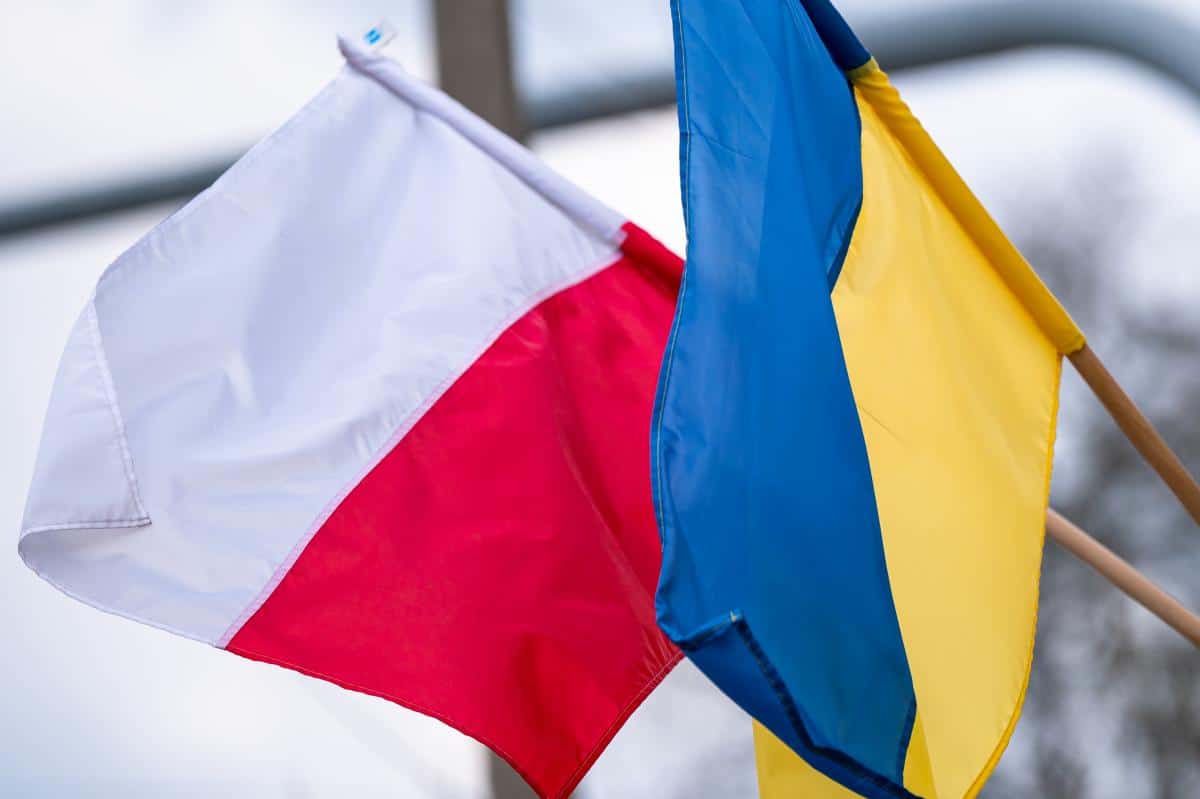
Poland: From Strategic Partnership to Deep Crisis
While Moldova and Romania are examples of successful “neighborly diplomacy,” Poland is perhaps the most sensitive issue among all of Ukraine’s neighbors (of course, excluding Russia and Belarus). Just a few years ago, Warsaw was one of Kyiv’s most reliable allies, but today relations are in a state of deep and protracted crisis.
The problems have built up gradually, and now they are piling up on top of one another. Formally, the most acute issue is historical disputes. Polish President Karol Nawrocki has openly stated that he will use historical disputes as a condition for blocking Ukraine’s path to the EU. This refers to the Volhynia tragedy and the role played in it by UPA fighters, who are officially considered heroes in modern Ukraine. The leader of the Law and Justice Party, Jarosław Kaczyński, has also called on Warsaw to block new rounds of negotiations on Ukraine’s accession to the EU. Polish Defense Minister Władysław Kosiniak-Kamysz even stated that his country would not agree to Ukraine’s accession to the EU unless Kyiv stopped honoring nationalists from the past. The situation has escalated to such an extent that President Navrotsky stripped Zelenskyy of the Order of the White Eagle, after which both sides began reciprocally revoking each other’s awards. This is a level of diplomatic warfare that would have been frankly hard to imagine just a few years ago.
But it’s not just about history. On the economic front, Poland and Ukraine are competitors—something that is not usually spoken of openly, but which actually lies at the root of many conflicts. Poland receives over 80 billion euros from the EU budget in the current cycle, and Ukraine is also seeking European funds. The Common Agricultural Policy is one of the EU’s largest expenditure items, and Ukrainian grain, which has access to the European market, poses direct competition to Polish farmers. Recall the border blockade in 2023 and the dumping of Ukrainian grain onto the ground: even then, we saw signs of a deep-seated economic conflict of interests.
And finally, perhaps the worst of all—the attacks on Ukrainians. In the first half of 2026, Polish police received over 180 reports from Ukrainian citizens regarding attacks—30% more than during the same period the previous year. These are no longer isolated incidents, but a systemic problem: some aggressive Poles are even attacking Ukrainian children.
Poland and Ukraine are two nations that share not only common enemies but also many mutual grievances and complaints—both old and new. And as long as politicians on both sides continue to exploit these grievances for domestic electoral purposes, unfortunately, we should not expect a genuine breakthrough or a reset in relations.
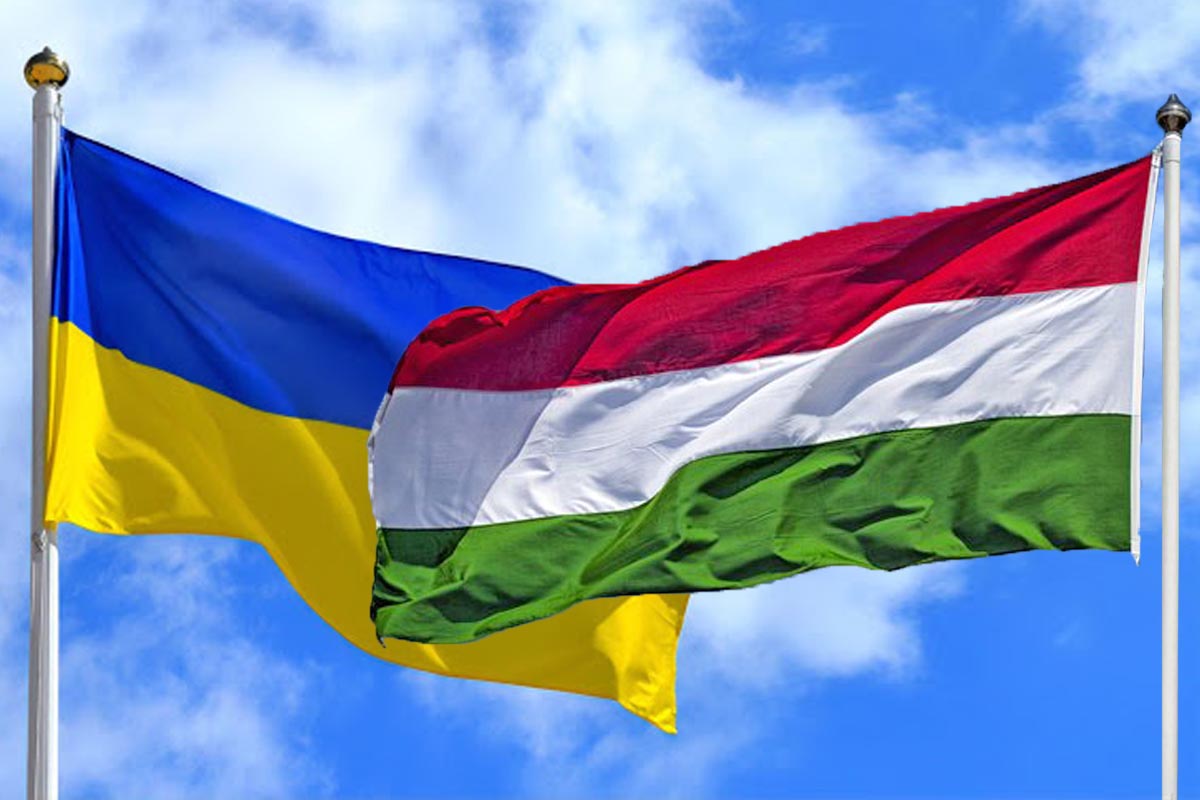
Hungary: Things Have Improved Without Orbán, but Key Problems Remain Unresolved
For many years, Hungary was a real headache for Ukrainian diplomacy. The country’s former leader, Viktor Orbán, consistently blocked Ukraine’s European integration aspirations, issued ultimatums regarding the rights of the Hungarian minority in Zakarpattia, and openly played into the Kremlin’s hands.
The situation changed in April 2026, when the opposition party “Tisa,” led by Péter Magyar, won the election. This came as a real sensation. Magyar truly demonstrated a willingness to reset relations. He stated that the Ukrainian-Hungarian conflict of the Orbán era must come to an end. In June 2026, Hungary lifted its veto on the negotiation clusters regarding Ukraine’s accession to the EU—a decision that Orbán had blocked for nearly two years.
Moreover, in June 2026, Kyiv and Budapest signed an agreement on the rights of the Hungarian community in Zakarpattia. This is an unprecedented document that demonstrates that the parties are ready to seek practical solutions and resolve long-standing (or rather, long overdue) issues. Magyar also initiated technical negotiations on the protection of the linguistic, educational, and cultural rights of the Hungarian minority.
However, it is not that simple. The Hungarian minority in Transcarpathia numbers over 100,000 people, and the issue of their rights remains complex and mutually sensitive. Despite his willingness to engage in dialogue, Magyar still raises claims regarding the rights of Hungarians in Ukraine. And although the tone has shifted from openly confrontational to more constructive, the problems themselves have not disappeared.
In addition, there are a number of other economic and political issues that need to be resolved. De-escalation has occurred—that much is clear. But there is still a great deal of painstaking diplomatic work ahead.
Slovakia: A Complex Dialogue in Pragmatic Terms
Slovakia is another neighbor with whom relations are far from simple. Slovak Prime Minister Robert Fico is known for his controversial statements regarding Ukraine and the war, which creates an additional backdrop of tension. Recently, however, there have been signs that Bratislava is ready for more constructive cooperation.
In May, Zelenskyy and Fico spoke in person. The head of state emphasized that Kyiv is ready for constructive dialogue with Slovakia and is interested in developing strong relations. Fico, for his part, assured that Slovakia supports Ukraine’s accession to the EU. This is a very important statement.
Fico also expressed his intention to intensify the Slovak-Ukrainian dialogue as a whole and noted that Slovakia would not object to projects aimed at strengthening ties between Ukraine and the EU, as it stands to benefit from this itself. This is a pragmatic approach that demonstrates that, even amid mixed rhetoric, Bratislava is mindful of its economic interests.
Economic cooperation remains an important element of bilateral relations. Slovakia is prepared to transport Ukrainian grain through the port of Bratislava—by rail to a river port, and then down the Danube to Constanta, Romania. This creates alternative logistics routes, which are particularly important given the blockade of seaports.
The main problem in relations with Slovakia is Fico’s rhetoric, which at times borders on outright sympathy for Russia. But on a practical level, Bratislava demonstrates a willingness to cooperate where it serves its interests. This is a complex but necessary and important dialogue.

Belarus: From Friendship to Complicity in Aggression
If one were to look among all of Ukraine’s neighbors for the country with which relations are in the worst state—apart from Russia, of course—it would undoubtedly be Belarus. Belarus has not merely lost its status as a neutral party; it has become an accomplice in Russia’s aggression against Ukraine. Fortunately, there is no open war between Kyiv and Minsk yet. But Belarus’s stance and Alexander Lukashenko’s political regime continue to pose a serious threat to Ukrainian and European security.
At the same time, diplomatic relations between the two countries have not yet been officially severed. For example, the Ukrainian embassy in Minsk is still operating—albeit on a limited basis. At the same time, Ukraine maintains contacts with democratic forces in Belarus who oppose Alexander Lukashenko’s regime. For example, Sviatlana Tsikhanouskaya is officially received in Kyiv.
Relations with Belarus are perhaps the most complex among all of Ukraine’s neighbors. There is no room for compromise on security issues, and there can be no doubt regarding the republic’s complicity in the aggression against Ukraine in 2022. At the same time, there must be an understanding that we do not need a second full-scale war with yet another neighboring state. Consequently, relations with Belarus remain a priority, and no matter how poor they may be, they must still have a chance to improve—solely in the interests of peace and security from the north.

To sum up, there is currently no neighboring country with which relations are 100% ideal. A common feature of most of these relationships is the tension between pragmatic interests and historical grievances, between economic benefits and political ambitions. Poland and Ukraine could be reliable allies, but historical disputes and economic competition are pulling them in different directions. Since the change in government, Hungary has shown a willingness to engage in dialogue, but old problems remain. Slovakia balances between strange rhetoric and practical interests. Belarus, once perhaps the closest partner, has turned into an adversary and a de facto accomplice in a hostile attack.
The main conclusion is simple: neighborliness is not a choice, but a given. And Ukraine’s ability to manage these relationships effectively will determine not only its foreign policy position, but also the security and well-being of millions of citizens. Geography is inexorable, but politics—including foreign policy—is not without reason called the art of the possible.




