
Holiday on September 8, 2026 — Ig Nobel Prize Day: Science You Can Laugh At

September 8 marks Ig Nobel Prize Day—an unofficial holiday dedicated to one of the strangest and funniest phenomena in the world of science. The Ig Nobel Prize honors researchers for work that first makes people laugh and then makes them wonder why anyone would study this in the first place and what useful insights can be gained from it. In 2026, the main award ceremony took place earlier—on September 3 in Zurich, where ten new laureates were announced.
The Ig Nobel Prize is a tongue-in-cheek scientific award that honors unusual, strange, and—at first glance—absurd research. But it would not be entirely accurate to call it simply a parody of the Nobel Prize. The organizers emphasize that the purpose of the prize is not to mock science, but to reveal its unexpected side. The official motto of the Ig Nobel Prize is: research should first “make people laugh, and then make them think.” It is this phrase that best explains why the list of laureates includes studies on animal behavior, strange human habits, unusual physical phenomena, or very specific medical problems.

At the same time, the studies are usually genuine. The award organizers explicitly state that almost all the works that have won Ig Nobel Prizes actually exist and have been published in scientific journals. In other words, a completely serious experiment may lie behind a humorous title. That is precisely why the prize has such a unique reputation. A person reads the title of a study, laughs, and then suddenly realizes that the authors were genuinely trying to find an answer to an interesting question.

In this way, the organizers remind us that science doesn’t always start with a grand problem. Sometimes a researcher simply becomes curious about why something strange is happening and decides to test it through an experiment.
When the Ig Nobel Prize Was Established
The first Ig Nobel ceremony was held in 1991. The prize was founded by American writer, editor, and science communicator Mark Abrahams, who had spent many years working on the topic of unusual research. He was also one of the founders of the journal *Annals of Improbable Research*. This journal continues to organize the awards to this day. Each year, ten new laureates are selected in various categories. The awards can cover medicine, biology, physics, chemistry, literature, economics, peace, and other fields.
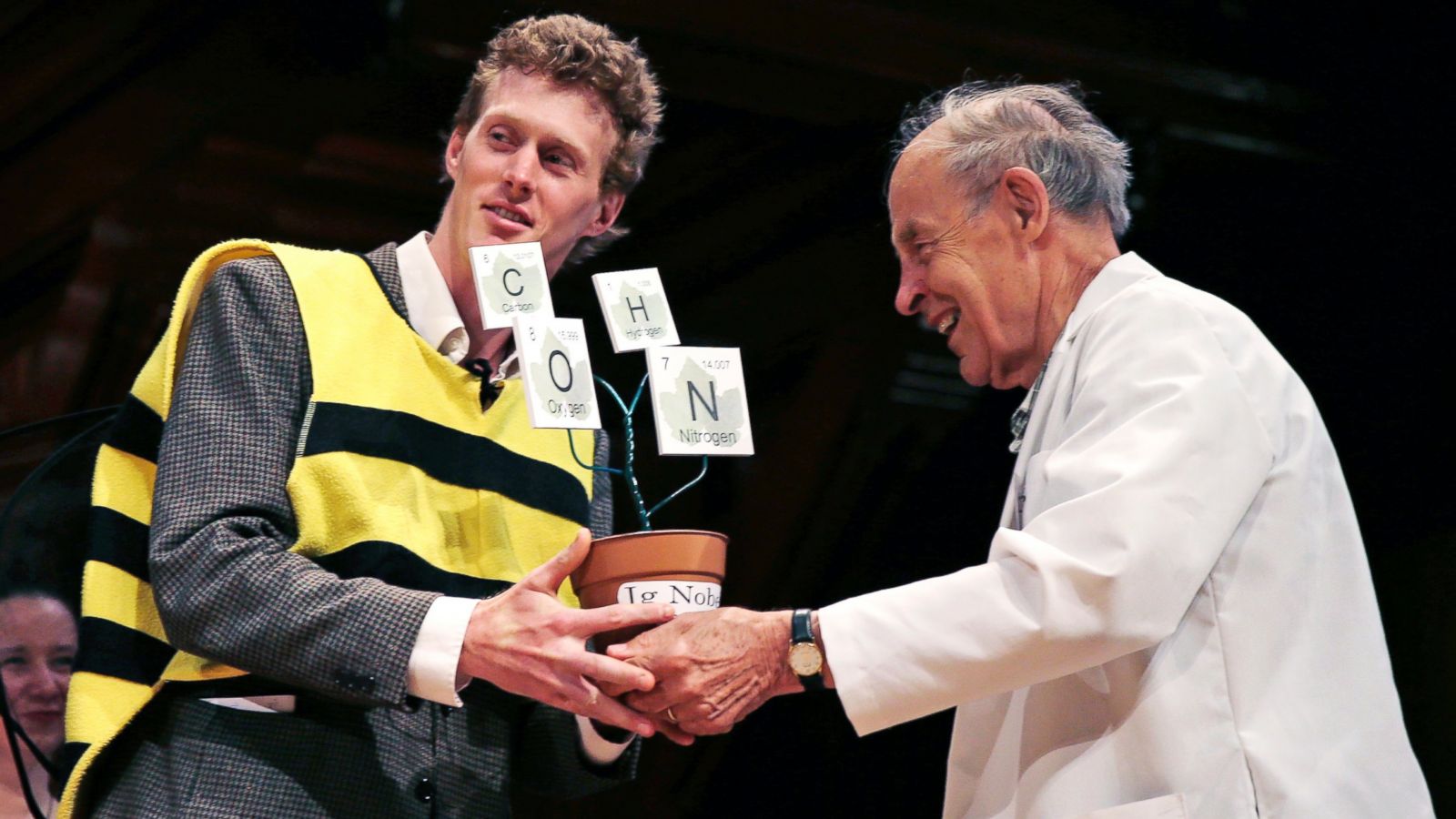
The first ceremonies were held in Massachusetts. In 1991, the event took place at the Massachusetts Institute of Technology Museum, and later the ceremony moved to other venues in the Boston area. For many years, it was held at Harvard University, then returned to MIT, and in 2025 took place at Boston University.

The COVID-19 pandemic also changed the tradition. From 2020 to 2023, the ceremonies were held online, without the usual large hall or live audience. In 2024, the organizers returned to an in-person format. And in 2026, the awards ceremony moved to Europe altogether. On September 3, the ceremony was held at the Congress House in Zurich, Switzerland. The organizers plan to return to Zurich in 2028 as well, and to hold the ceremony in other cities in the intervening years.
Why the Prize Is Called the Ig Nobel
The name “Ig Nobel” is a play on words. It resembles the word “ignoble,” which in English means “unworthy,” “base,” or “lowly.” At the same time, the name clearly echoes the surname of Alfred Nobel and the Nobel Prize. In Ukrainian, it is often called the “Shnobel Prize” or the “Anti-Nobel Prize.” However, the term “Anti-Nobel” may slightly distort the original intent. The organizers are not trying to create a counterpart to the Nobel Prize.

On the contrary, genuine Nobel laureates are regularly seen among the ceremony’s participants. They are often the ones who take the stage to present the awards to the Ig Nobel winners. Therefore, the joke here isn’t that scientists are receiving a “bad” award. The joke lies in the very idea of solemnly honoring people for research that sounds so bizarre that it’s hard to read the titles without smiling.
Who Receives the Ig Nobel Prize
Researchers from any country can become laureates. They may work at universities, research centers, hospitals, or other institutions. The main requirement is that the research must be unusual and spark curiosity. It’s important to the organizers that the work not only seem strange but actually provide a reason to reflect on a particular phenomenon.

Some studies seem completely nonsensical until you find out why they were conducted. For example, researchers might study animal behavior in very specific situations. But the results of such experiments sometimes help us better understand behavior, evolution, or physiology. Other studies can be useful in everyday life. For example, awards have been given for research on why shower curtains blow inward, the best way to dip cookies into a drink, or why certain things emit an unpleasant odor.

So the principle behind the prize can be summed up simply: if a question seems too strange to be taken seriously, some scientist has probably already studied it.
The Strangest Studies in the History of the Prize
Over more than three decades of existence, the Ig Nobel has amassed a huge collection of studies with titles that are hard to forget. For example, in 2001, the Medicine Prize was awarded to Canadian physician Peter Bars for his study of injuries caused by falling coconuts. It sounds like a joke, but falling coconuts can indeed pose a danger to people standing under palm trees.

That same year, the Physics Prize was awarded to David Schmidt for explaining why shower curtains tend to blow into the bathtub. An ordinary household problem thus became the subject of serious physical analysis. In 1999, Len Fisher received the physics prize for calculating the optimal way to dip a cookie into a drink. At first glance, this seems like a perfect example of completely useless science. But it is precisely this kind of research that demonstrates just how many fascinating physical processes are hidden in everyday objects.

Another well-known example is a study of Canadian society through donut shops, which won a prize in sociology. In 1997, researcher Mark Hostetter received an entomology prize for a book on how to identify which insects crashed into a car’s windshield by examining the traces they left behind. Examples like these are what made the Ig Nobel Prize famous. The prize shows that even the most mundane or bizarre things can become the subject of scientific research.
How the Ceremony Unfolds
The Ig Nobel ceremony is a unique part of this story. It is deliberately unlike formal academic award ceremonies. Scientists, hosts, musicians, and Nobel laureates take the stage. Winners receive their awards in person, if they are able to attend the ceremony. In 2025, for example, the awards were presented by actual Nobel laureates, including Esther Duflo, Eric Maskin, Svante Pääbo, Mungi Bawendi, William Kelyin, and Robert Merton.

One of the ceremony’s most famous traditions is the paper airplanes. The audience launches them toward the stage, and the organizers even have special moments when the hall is literally showered with paper airplanes. In 2025, the organizers described two separate 30-second “showers” of paper airplanes. A special team was even on hand to clean up the paper so that the stage would not become hazardous for the participants.
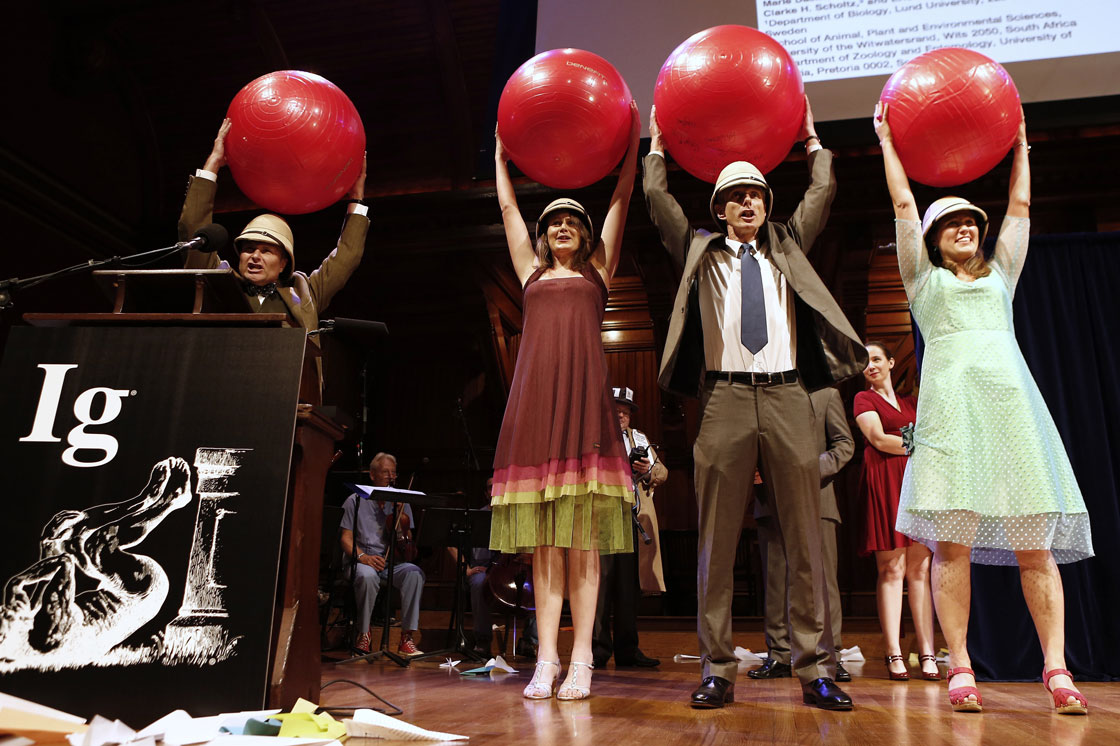
Another distinctive feature is the laureates’ extremely short presentations. During the ceremony, they have only 60 seconds to explain their work. After that, they may be asked to leave the stage. But for those interested in learning more, there’s the Ig Nobel Face-to-Face format and special lectures. For example, the “24/7 Lectures” format involves first giving a technical explanation of a topic in 24 seconds, followed by a simple explanation in just seven words.
Paper Airplanes and Other Traditions
Paper airplanes have become one of the ceremony’s main symbols. They create the feeling that this isn’t a dry scientific conference, but a big show. Another tradition is humor during the presentations. The organizers don’t try to make the ceremony as serious as possible. On the contrary, they emphasize that science can be interesting, strange, and fun. Yet behind this apparent lightheartedness lies real work. Participants often spend years conducting experiments, collecting data, and publishing their results in scientific journals.
It is precisely this contrast that is part of the concept. An audience member might laugh at the title of a study, only to learn that its author spent years searching for the answer. As a result, the ceremony becomes a unique bridge between the scientific community and the general public. People who would never open a scientific article about the physics of a shower curtain or the behavior of insects might become interested in it precisely because of the joke.
Are these studies real?
Yes. And this is one of the most important features of the Ig Nobel Prize. The organizers explicitly state that the studies receiving awards are almost always real. They have authors, publications, and scientific sources that can be verified. According to the organizers, the only exceptions were a few isolated cases at the very beginning of the prize’s existence. Therefore, the prize does not operate on the principle of “let’s find the funniest made-up story.” On the contrary, the jury looks for genuine scientific papers that have an unusual subject of study.

This is an important distinction. If someone has simply come up with a funny experiment without actually conducting it, they won’t win the prize just because of a humorous title. But if scientists have actually spent time researching a very specific phenomenon, they have a chance to win an Ig Nobel. That’s why the prize is interesting not just as entertainment. It shows just how broad science can be.
What the Winners Receive
The award is symbolic in nature. The organizers traditionally try to design the prize to match the overall mood of the ceremony. At the same time, the financial reward is not the main part of the prize. Its value lies primarily in the public recognition of the research and the attention given to the scientists’ work. Over the years, the prizes and their design have changed. What remains most important is the very fact of receiving the award and the opportunity to present one’s work to a vast international audience.

For some scientists, this can even be a useful way to draw attention to a topic that no one would have noticed without a touch of humor. A quirky headline grabs attention, and only then do people begin to read about the research itself. This provides scientific communication with an unusual but effective tool.
The Ig Nobel Prize in 2026
In 2026, the Ig Nobel Prize celebrated its 36th ceremony. It took place on September 3 in Zurich, and the organizers announced ten new winners. Among this year’s studies are projects that perfectly illustrate the nature of the prize. For example, the prize in physics was awarded to researchers who worked on creating a splash-free urinal. The study combined experimental physics, mathematics, and a very everyday problem.
The prize in chemistry was awarded to researchers who studied the milk proteins of the viviparous cockroach. It turned out that crystals of these proteins can contain about three times more energy than proteins found in cow’s milk. The Soil Science Prize was awarded for a large-scale experiment involving underwear. Researchers buried 1,000 identical pairs of underwear in more than 25 countries and dug them up two months later to assess the condition of the soil.

And the Olfaction Prize went to scientists who studied the smell of children. Their work had an eloquent title: that infants smell wonderful to their parents, while teenagers do not. Another example is the technology prize for using mosquito proboscises as extremely small nozzles for 3D printing. The process was dubbed “Necroprinting.”
Why the Ig Nobel Prize Matters
At first glance, it might seem like this whole thing is just a big science party. But the prize has a very specific goal. The organizers want to show people that science isn’t limited to complex formulas, laboratories, and multi-volume textbooks. It starts with a question—and questions can sometimes be very strange.

Why does a shower curtain move in a certain direction? Why do people perceive the smell of children of different ages differently? How can you design a urinal that doesn’t splash? And can you learn anything about the soil from the condition of old underwear? All these questions sound funny until you start looking for the exact answer. And when the answer emerges, it becomes clear that physics, biology, medicine, psychology, or engineering can lie behind even the most amusing topics. That’s exactly why the motto “laugh first, think later” is more than just a catchy phrase. It’s actually the entire philosophy behind the Ig Nobel Prize.
Interesting Facts About the Ig Nobel Prize
The prize has been awarded since 1991. Since then, dozens of ceremonies have been held, and the number of honored studies runs into the hundreds. Each year, the organizers typically select ten new winners.
Among those presenting the awards are actual Nobel laureates. This is one of the Ig Nobel’s most unusual traditions. It simultaneously highlights the award’s connection to serious science and maintains the ceremony’s lighthearted format.
The ceremony was one of the earliest scientific events to be broadcast online. The organizers note that the 1995 ceremony was one of the first events to be streamed online.
In 2022, the Ig Nobel Prize itself received an award. It was honored with the Heinz Oberhummer Award for outstanding science communication. In other words, the prize for unusual research itself became the recipient of a science communication award.
Not all laureates are able to attend the ceremony. In 2025, some of the winners were unable to attend in person, so their speeches were read on stage by Nobel laureates.
The prize is not intended to belittle scientists. On the contrary, the organizers speak of celebrating the unusual, honoring imagination, and stimulating interest in science, medicine, and technology.
How to Celebrate Ig Nobel Prize Day
Since September 8 is an unofficial date, there are no specific rules for celebrating. You don’t need to attend an official ceremony or buy a special ticket. The simplest option is to read about the strangest studies that have won Ig Nobel Prizes. This can be more interesting than a typical list of scientific achievements, especially if you choose topics related to everyday life.

You can also host your own little “ceremony.” For example, get together with friends or coworkers and pick the most absurd—yet real—scientific study you can find. Another option is to watch recordings of past ceremonies. The official Ig Nobel archive contains videos, photos, programs, and other materials dating back to the award’s early years. And if you’re in the mood for something more serious, you can read the original scientific paper after enjoying a bit of lighthearted research. That’s exactly how the main idea behind the prize works: first, have a laugh at the topic, and then try to understand what the scientists were actually studying.
Science can be fun, too
Ig Nobel Prize Day reminds us that science isn’t always solemn and serious. Sometimes it starts with a very simple question that other people didn’t even think to ask. On September 8 in Ukraine, this unofficial date can be seen as an opportunity to recall the funniest scientific discoveries and look at research from a slightly different angle. Meanwhile, the 2026 Ig Nobel ceremony itself took place on September 3 in Zurich, where ten new laureates were announced.

The main lesson of this award is simple: a strange question isn’t necessarily a silly one. Sometimes it’s precisely that question that leads to an interesting discovery. And if, after reading about research on urine splashes, the smell of teenagers, cockroach milk, or underwear in the soil, you’ve become curious to learn more—then the Ig Nobel Prize has done its job. First, it made you smile. And then—it made you think.


