
Star formation rates fell much faster than hydrogen reserves
An international group of astronomers has found that over the past 4.5 billion years, the rate of new star formation in the Universe has decreased by approximately 2.5 times. At the same time, the density of neutral atomic hydrogen was only about 1.4 times higher than its current level. The results of the study, published online in Nature Astronomy, are reported by ScienceDaily.
Observations of millions of galaxies
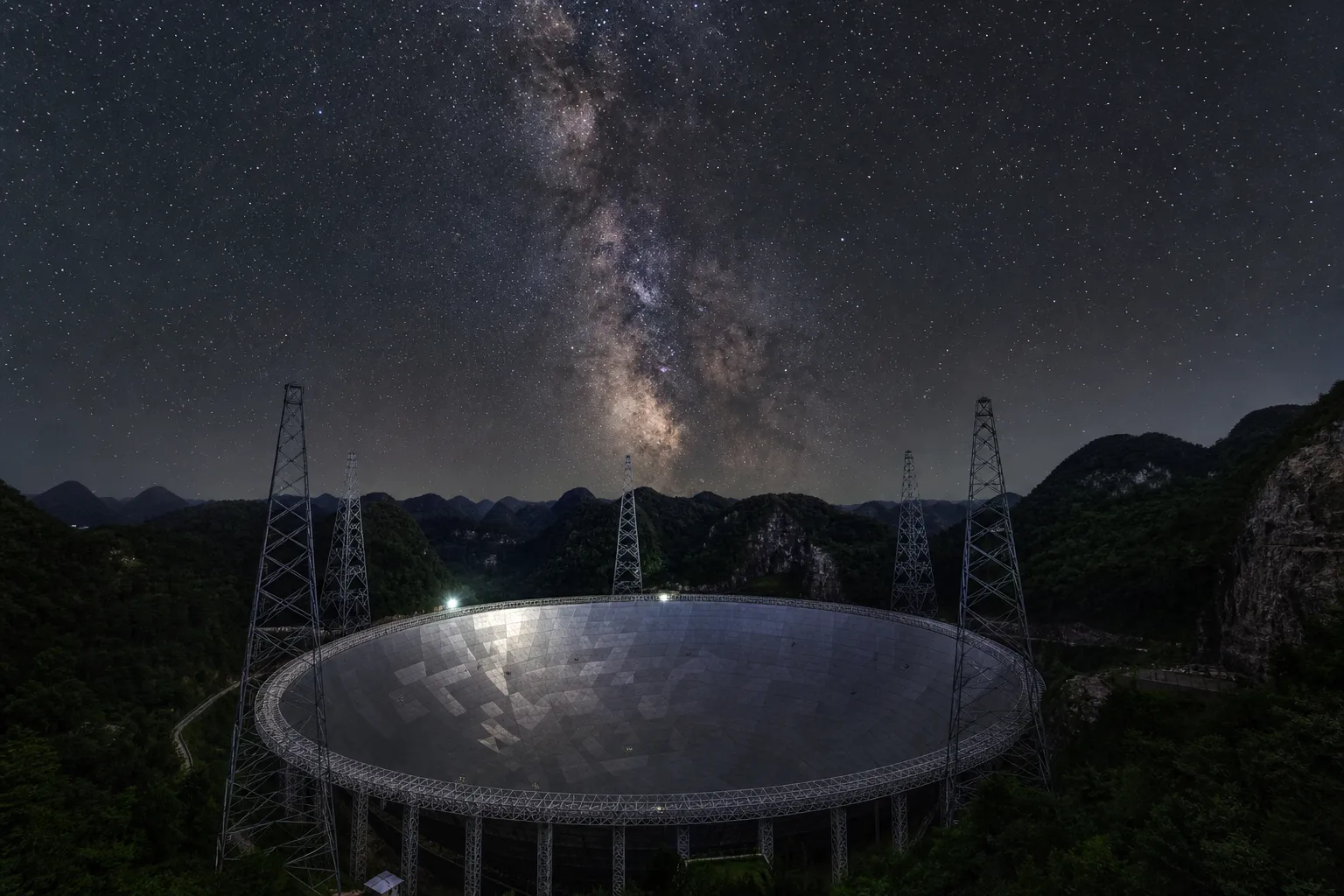
Researchers led by specialists from the Chinese Academy of Sciences combined data from China’s FAST radio telescope with a large array of optical spectroscopic data from the DESI project. They studied about 2.5 million galaxies located across nearly one-third of the sky.
Neutral atomic hydrogen, or HI, is an important reservoir of cold gas inside galaxies. It links the overall cosmic gas supply with molecular hydrogen, in whose dense clouds stars are predominantly born. HI is detected through an extremely faint radio line with a wavelength of 21 centimeters, the signal of which is often lost against background noise.
More current news is available on the UA.News Telegram channel Telegram.
To measure signals too weak for individual detection, the scientists used the spectral stacking method. They aligned radio signals according to the precisely measured redshifts of galaxies and combined them. This made it possible to isolate the average neutral hydrogen signal and trace changes in its cosmic density with high statistical precision.
HI reserves do not explain the decline in star formation
One explanation for the decrease in star-formation activity was the gradual depletion of cold gas in galaxies. However, the new measurements showed that the sharp decline in star birth rates was not accompanied by an equally large reduction in neutral atomic hydrogen reservoirs.
The authors of the study note that the rapid depletion of HI alone does not explain the decline in star formation. In their view, changes in gas movement within the baryon cycle may be important: due to a weaker inflow of gas from the cosmic web and lower gas density, galaxies may convert HI into molecular hydrogen less efficiently. Under this scenario, the overall HI reservoir may remain relatively stable, while molecular gas reserves, which are directly linked to star formation, gradually decrease.


