
Egypt describes new species of ancient crocodile from the Mokattam Formation — The National
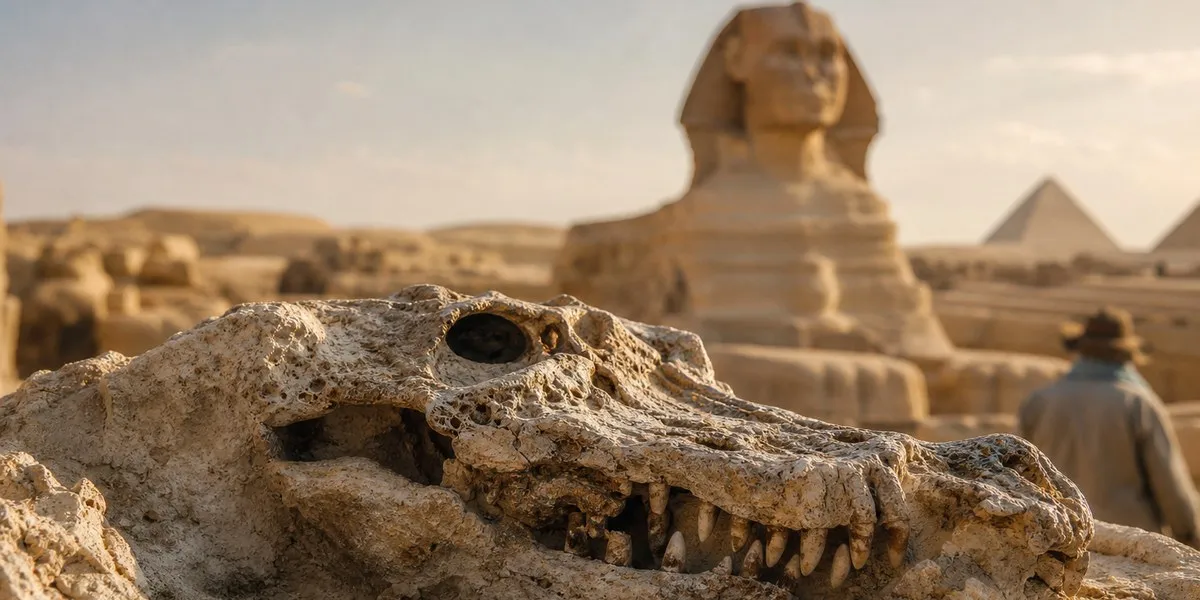
In Egypt, scientists have described a previously unknown species of ancient crocodile, Herugavialis cairensis. It was identified from a skull found nearly a century ago in rocks of the 45-million-year-old Mokattam Formation. Stone from this formation was used to build the Great Sphinx of Giza.
As The National reports, only the tip of the snout is missing from the skull. The fossil was previously assigned to the species Tomistoma schlegelii, but an international team of researchers revised the classification using computed tomography. The scans made it possible to study the skull's internal structure and identify several differences from Tomistoma.
Named after the god Heru
University College London professor Philip Mannion, who co-led the study, said that the new species was named after the Egyptian god Heru. According to him, the choice of name is linked to a coincidence: the skull lacks the tip of its snout, while the Great Sphinx has no nose. The study was published in the journal Royal Society Open Science.
More current news is available on the UA.News Telegram channel Telegram.
Gharials of ancient Egypt
Herugavialis belonged to the gharials, a group of crocodiles whose fossil record spans more than 100 million years and indicates their nearly global distribution in the past. Today, gharials are found only on the Indian subcontinent and in Southeast Asia.
The study's lead author, Paul Burke, a researcher at the Swedish Museum of Natural History in Stockholm, noted that the shallow marine environment that then covered much of the region was home to at least three species of gharials. According to him, crocodile diversity in the Mediterranean changed along with global temperatures and sea levels, and about six million years ago crocodiles disappeared from the region as a result of the Mediterranean Sea drying up.




