
In Japan, an earthquake caused a shopping mall to collapse; people remain trapped under the rubble
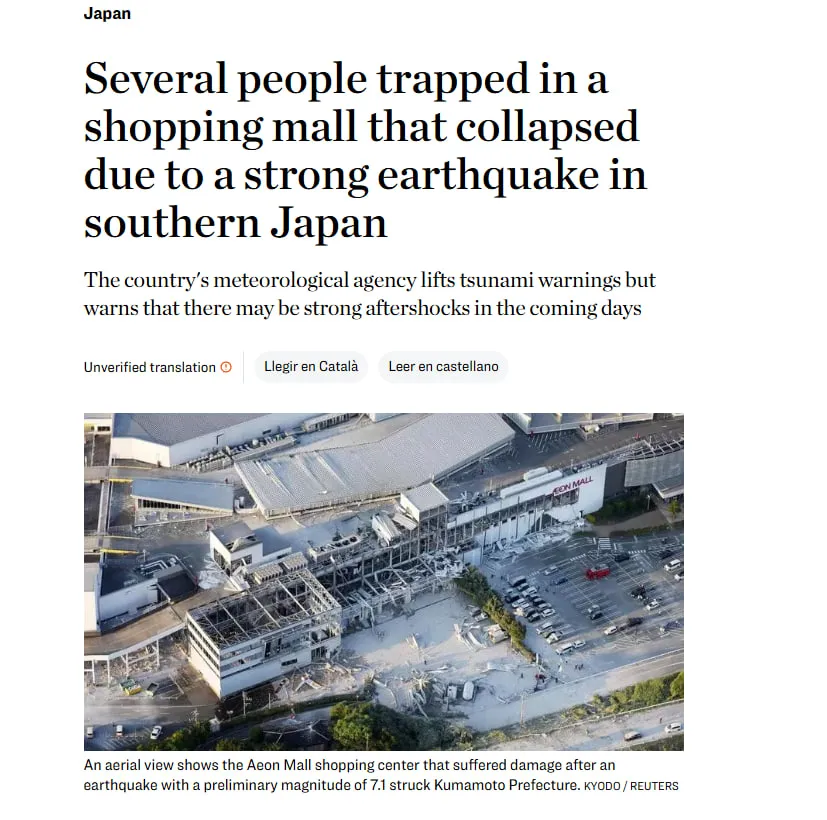
In southern Japan, a shopping center partially collapsed following a powerful 7.1-magnitude earthquake, and people may be trapped under the rubble. At least 50 people were injured as a result of the disaster, and more than 300,000 residents were advised to evacuate, according to Japanese emergency services.
The earthquake struck on July 28 at 4:27 p.m. local time. The epicenter was located at a depth of about 10 kilometers near the city of Uki in Kumamoto Prefecture on the island of Kyushu. In a number of areas, the maximum seismic intensity on the Japanese scale was recorded.
Immediately after the tremors, the Japan Meteorological Agency issued a tsunami warning for several coastal areas. However, approximately two hours later, all warnings were lifted.
The most serious situation occurred in the city of Kashima, where the Aeon Mall partially collapsed. According to rescue workers, an explosion also occurred inside the building. After the earthquake, visitors and employees were evacuated, but some people remained trapped under the rubble.
The Japanese broadcaster NHK reports that at least 50 injured people were taken to hospitals. Police are also searching for nine people whose whereabouts are currently unknown. Some local media outlets speculate that there may have been fatalities as a result of the collapse, but there is no official confirmation of this information at this time.
Japanese Prime Minister Sanae Takaichi stated that authorities are continuing to assess the extent of the damage and the consequences of the earthquake. She confirmed reports of injuries, fires, power outages, damage to roads and bridges, and the collapse of buildings.
Approximately 3,600 military personnel have been deployed to the affected areas to respond to the disaster.
The Japan Meteorological Agency has warned that strong aftershocks are possible over the coming week. In addition, there is a risk of landslides due to soil damage. According to the Disaster Management Agency, more than 300,000 people have been advised to evacuate to specially designated shelters.
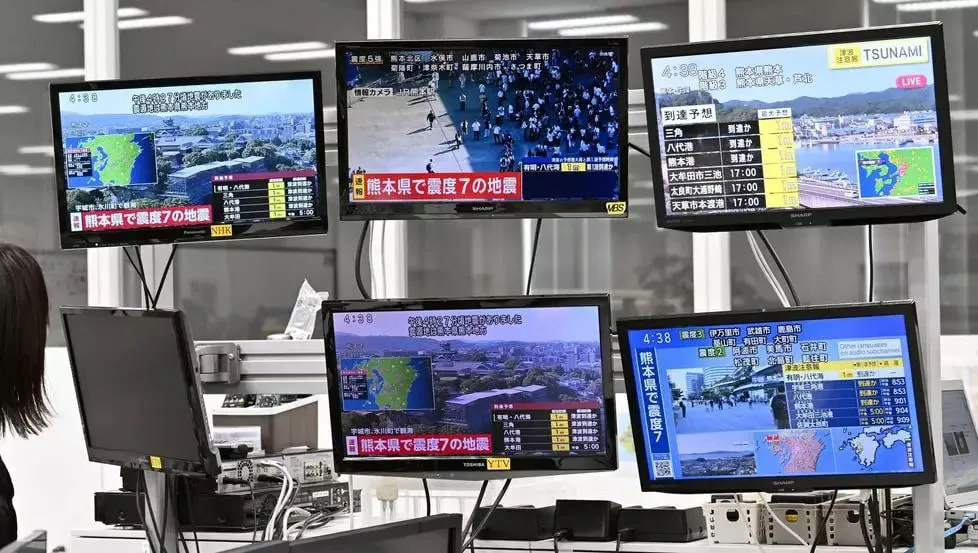
About 45,000 households were left without power due to the earthquake. The railway operator JR Kyushu has temporarily suspended train service, including the Shinkansen high-speed trains. At the same time, Japan’s nuclear regulator reported that no abnormalities were detected at the region’s nuclear power plants.
Japan is part of the so-called Pacific Ring of Fire—one of the world’s most seismically active zones. Powerful earthquakes occur regularly in this region. In April 2016, two strong earthquakes in Kumamoto Prefecture claimed the lives of 278 people, and another 2,800 were injured. The most devastating earthquake in the country’s modern history remains the magnitude 9.1 quake in March 2011, which triggered a massive tsunami and an accident at the Fukushima nuclear power plant.
Source: Ara.
As a reminder, a powerful 7.1-magnitude earthquake struck southwestern Japan on July 28. Following the tremors, authorities issued a tsunami warning and implemented emergency measures in seven prefectures on the island of Kyushu.
An earthquake with a magnitude of 2.8 was recorded near Lviv.
The death toll from the earthquakes in Venezuela has exceeded 5,000.


