
Rice harvested in the Netherlands for the first time, potentially helping peatlands — Dawn
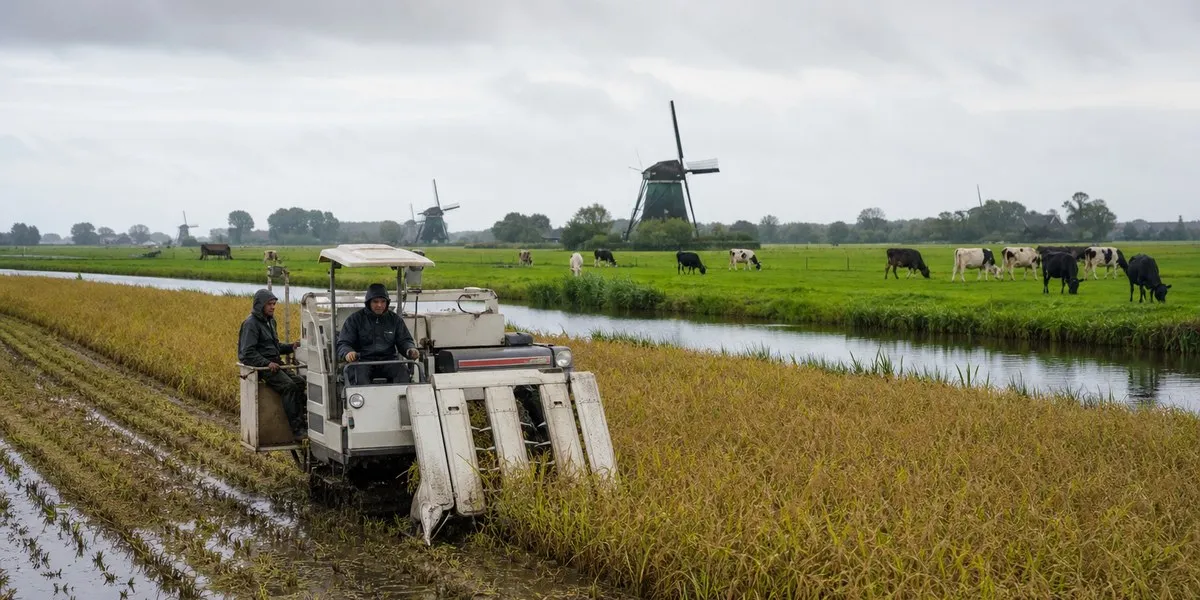
In the Netherlands, farmer Sander Roeleveld has harvested rice for the first time in the country’s history, on a field between Amsterdam and The Hague. Experimental rice cultivation is intended not only to expand opportunities for farmers but could also help address the problem of peat soils, which subside because of drainage, Dawn reports.
The pilot field covers 0.6 hectares. The organizers expect to obtain about three tonnes of short-grain rice suitable for sushi or risotto. Researchers are testing about 30 rice varieties from Russia, China, Japan and Uzbekistan to identify those that grow best in Dutch conditions.
Rice on wet land
Roeleveld calls himself a pioneer and seeks to demonstrate to other farmers that waterlogged land can be used to grow more than just grass for livestock. According to him, after about 600 years of livestock farming, it is not easy for farmers to imagine another way of using such land.
The Land van Ons association provided the fields for the rice harvest. Researchers from Wageningen University & Research are working on the pilot project together with colleagues from Leiden University. Land van Ons chairman Philip Terheggen said that just 20 years ago, the possibility of growing rice in the Netherlands seemed unthinkable, but it also indicates climate change.
More current news is available on the UA.News Telegram channel Telegram.
Drained peatlands
About one-tenth of the Netherlands’ territory consists of peatlands, which farmers drain to grow grass for livestock feed. As peat dries out, it releases millions of tonnes of carbon dioxide and causes land subsidence — by several centimetres annually in the most affected areas.
According to Wageningen University’s estimate, greenhouse gas emissions from Dutch peat soils account for about 2–3% of the country’s total emissions. Researcher Julian Helfenstein explained that keeping fields wet can stop peat degradation and the associated CO2 emissions. At the same time, the team is comparing carbon dioxide and methane emissions from rice cultivation and grassland management to ensure that the new approach does not create greater environmental problems.
Japanese variety
Wij Land association representative Gousje van der Vossen said that the rice being harvested now comes from northern Japan and, according to her, has adapted best to local conditions. Local restaurants have already shown interest in premium Dutch rice. Last year, van der Vossen tasted rice from an experimental batch and said it was somewhat chewy but tasty.




