
In Australia, autonomous Ghost Bat hit a target with an air-to-air missile — ABC News Australia
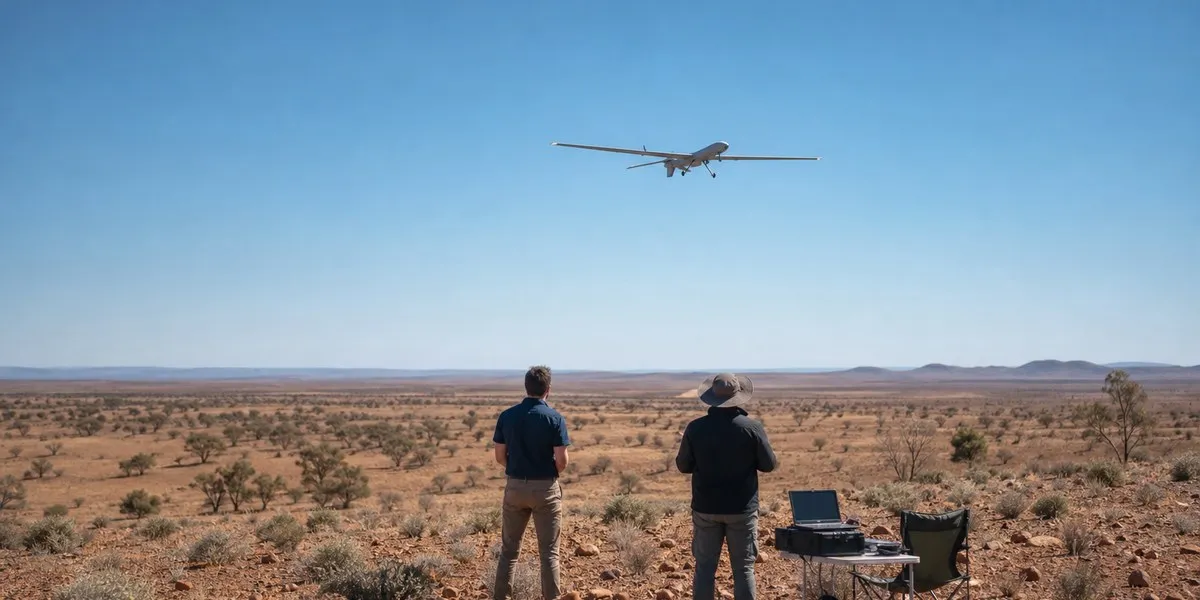
In Australia, the Ghost Bat unmanned aircraft hit a target with an air-to-air missile during a test over the remote desert of South Australia. The final authorization to launch the missile was given by an operator aboard an E-7 Wedgetail aircraft, although the Ghost Bat system calculated the attack plan, ABC News Australia reports.
Autonomy with limitations
The Australian-made Ghost Bat, an aircraft approximately two-thirds the size of a fighter jet, is autonomous and is not controlled by a pilot in a cockpit or an operator on the ground. At the same time, Royal Australian Air Force chief Air Marshal Stephen Chappell said that the aircraft does not operate on the basis of artificial intelligence but uses deterministic programming.
According to him, thousands of possible courses of action were developed for Ghost Bat during digital twin testing supported by AI. The system selects one of them, while the military understands exactly how it will be implemented. As Chappell explained, this is important from legal and ethical perspectives.
The Royal Australian Air Force describes Ghost Bat as a platform for integrating autonomous systems and artificial intelligence to create human-machine teams. A similar approach is also being applied to Ghost Shark, an autonomous underwater vehicle.
More current news is available on the UA.News Telegram channel Telegram.
AI for battlefield analysis
The Australian Defence Force is also studying the use of AI for faster intelligence analysis and support for command decisions. Australian National University researcher Aina Turillazzi noted that the main use of such systems in the military sphere often occurs before the direct use of weapons: they form a situational picture on the basis of which a human makes a decision.
The Australian Defence Force told parliament that Palantir's Maven Smart system is currently being used in a closed environment, without connection to broader defence networks. Malcolm Davis, a senior analyst at the Australian Strategic Policy Institute, called such technologies a “silicon commander” capable of rapidly assessing the battlefield situation and reducing the time needed to prepare orders and analysis.
Humans must remain responsible
Australian defence policy stipulates that a designated defence representative is always responsible for the actions, decisions, and consequences of using AI. This means human oversight of the system and human intervention at critical stages, including before the use of lethal force.
Experts, however, warn against “automation bias” — a situation in which a person under pressure relies excessively on the system's recommendations. Turillazzi cited the example of Soviet officer Stanislav Petrov, who in 1983 did not accept an automated warning of an alleged US missile attack as indisputable fact. She believes that decision-support systems in crises should display uncertainty and provide for mandatory pauses to verify data.




