
Large Hadron Collider finds no quantum black holes — ScienceDaily
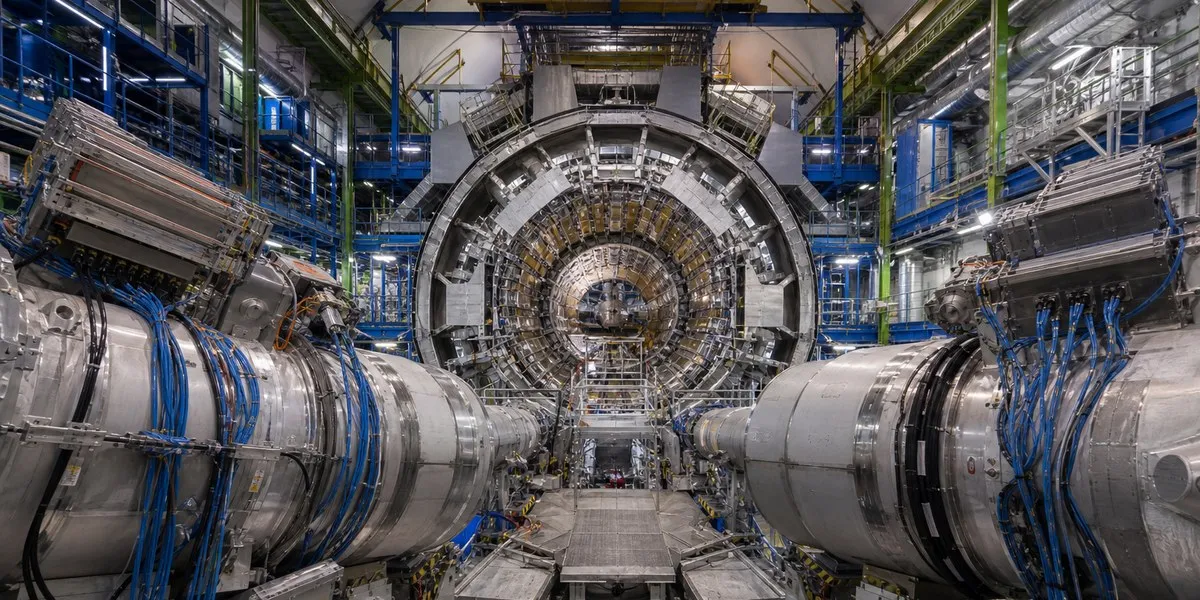
Scientists who analyzed data from the CMS detector at CERN’s Large Hadron Collider for 2016–2018 found no evidence of the formation of microscopic quantum black holes. At the same time, the result made it possible to rule out some theoretical models under which such objects could arise during proton collisions, ScienceDaily reports.
Quantum black holes are hypothetical extremely small and short-lived objects. Their possible formation is associated with models that predict additional spatial dimensions. In such models, gravity at very short distances could be stronger than conventional ideas suggest, potentially making it possible to create black holes at energies accessible to the collider.
Constraints on theoretical models
The researchers looked for events with a characteristic nearly spherical distribution of decay products and an unusually high total particle energy. Under the models considered, the data obtained indicate that quantum black holes are unlikely at energies up to approximately 12 TeV. The analysis also constrains certain theories involving additional spatial dimensions.
More current news is available on the UA.News Telegram channel Telegram.
According to CMS experiment participant Tamás Vami, within the parameters of the theories studied, the measurements allow no more than two additional dimensions. The scientists emphasize that the absence of a signal narrows the range of possible explanations for the hierarchy problem—the question of why gravity is much weaker than the other fundamental interactions.
A new data analysis method
For the first time in particle physics data analysis, the study used the “phase-space distance” method. It uses a Support Vector Machine machine-learning algorithm to separate potential rare signals from a large number of ordinary collisions. The authors compared this approach with the sphericity measure and concluded that the phase-space distance method works more effectively for this type of search.
The same data were also used to search for sphaleron processes—hypothetical unstable field configurations that could be linked to the problem of matter-antimatter asymmetry in the Universe. No evidence of such processes was found either, but limits were set on the possible number of interactions with the corresponding transitions. In the future, the upgraded High Luminosity LHC is expected to provide significantly larger datasets for the search for rare phenomena.


