
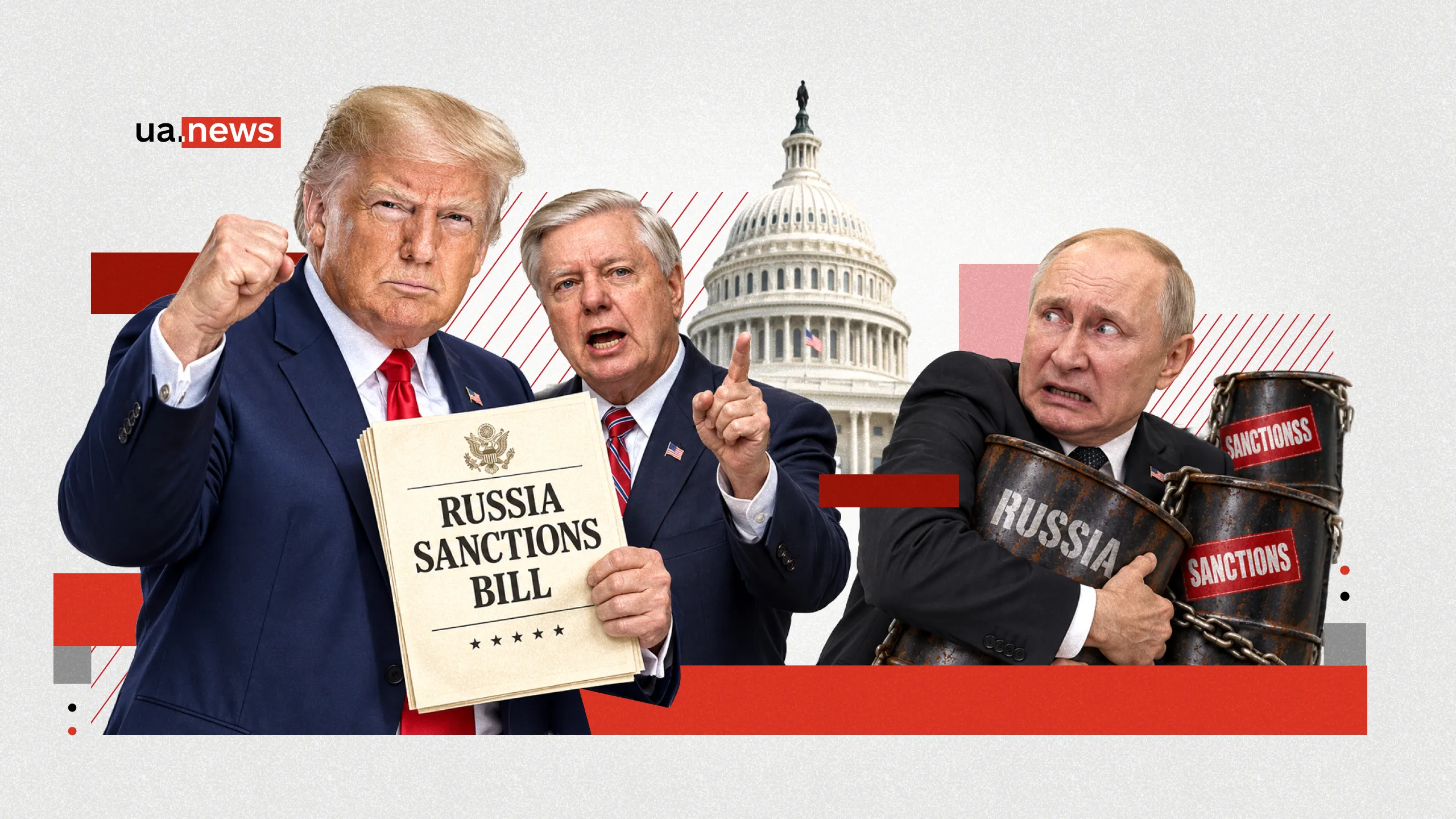
Yesterday, September 16, the U.S. House of Representatives passed a bill imposing “severe sanctions” against Russia and Iran: 262 in favor, 159 against. The bill, named after the late Republican Senator Lindsey Graham, has already been sent to President Donald Trump for his signature.
The law provides for unprecedented secondary tariffs against countries that purchase Russian oil and gas, the expansion of sanctions against Russia’s energy and defense sectors, and measures to combat the “shadow fleet.” This decision marked the culmination of more than 1.5 years of negotiations, compromises, and political wrangling within the American establishment—and at the same time presented Trump with a choice that seems to offer no good options. Signing the bill means burying his own idea of peace with Moscow and risking a spike in fuel prices on the eve of the election. Not signing it means facing new accusations of working for the Kremlin amid the scandal involving a Russian oligarch.
What is this bill, where did it come from, why was it passed right now, and most importantly—how should Trump handle this dilemma? UA.News political analyst Mykyta Trachuk, along with experts, examined the issue.
What Is This Law and Why Has It Emerged Now?
The history of this bill began in April 2025, when Republican Senator Lindsey Graham, together with Democrat Richard Blumenthal, introduced a bill to Congress that was unofficially dubbed “hellish sanctions.” The initial version was truly hellish: it called for tariffs of up to 500% (!) on goods from any country that continues to purchase Russian oil, gas, and other strategic resources.
However, the Trump administration took a cautious stance on the initiative from the very beginning. Ultimately, the maximum tariffs were lowered from 500% to 100%, and the number of countries that could be subject to them was reduced from 60 to about a dozen.
So what exactly does the law contain? Its most important part is the secondary tariffs. The U.S. president gains the right to impose tariffs of up to 100% on goods from countries that are among the top five buyers of Russian oil and gas. The list of most likely targets includes China, India, Slovakia, Hungary, and Azerbaijan (for oil), as well as China, France, Japan, Hungary, and Belgium (for gas). However, exceptions are provided for countries where Russian gas accounts for less than 15% of imports and which are reducing their purchases—this applies to Japan, France, Hungary, and Belgium. The ranking of the top five buyers will be reviewed every 180 days. For goods imported directly into the U.S. from Russia, the bill provides for a tariff of up to 500%.
The second set of measures consists of sanctions against the Russian leadership and the financial sector. The bill mandates sanctions against Putin, Russia’s top political and military leadership, oligarchs and their family members, as well as against Russia’s largest banks.
The third set of measures concerns the fight against the “shadow fleet.” Sanctions are imposed on vessels used to transport Russian energy resources in circumvention of existing restrictions, as well as on their owners, operators, and affiliated companies.
The fourth pillar is the Iran track: at Trump’s request, provisions were included in the bill to extend existing sanctions against Iran, which served as a kind of “quid pro quo” for the president’s support of the bill.
It is important to understand one fundamental point: the law does not automatically impose sanctions. It grants the president the authority to impose them, but the president also receives broad powers to grant deferrals and exemptions from the sanctions regime. Critics of the law fear that it gives Trump too much power over tariffs without guaranteeing that sanctions will actually be enforced. In other words, Congress has passed a powerful tool, but whether it will be used is up to just one person.

Trump’s
Dilemma: Will the U.S. President Sign the Law?
According to media reports, Trump plans to sign the bill. However, the situation is much more complicated than it seems at first glance, and it’s not just about the law itself. As of now, Trump is actively promoting the idea of an “energy truce” between Russia and Ukraine. The U.S. president’s motivation is entirely pragmatic: fuel prices in the U.S. are rising, and this is taking a heavy toll on the Republican Party’s approval ratings and Trump’s personally ahead of the midterm congressional elections this November.
Oil and gasoline prices are currently rising worldwide. For example, Russian Urals crude is already more expensive than Brent, trading at over $120. So if Trump signs the “hellish sanctions” bill—which means the maximum tightening of restrictions on Russian energy resources—there will be no “energy truce.” Moscow has already stated that it is ready for a truce, but only on the condition that sanctions are lifted. Signing the bill on new sanctions, of course, would make this condition unfeasible.
Moreover, secondary tariffs against China and India—the largest buyers of Russian oil—could trigger a new global trade war. And if China and India decide to ignore American threats and continue buying Russian oil (which is entirely likely given the global energy shortage!), America’s influence on the global economy will plummet.
One development that goes a long way toward explaining the current situation is the recent visit by CIA Director John Ratcliffe to Moscow. It was the first visit by a CIA director to the Russian capital since 2021. Clearly, the purpose of the trip was to try to reach an agreement—both on Ukraine and on a broader range of issues. But the result spoke volumes: after Ratcliffe left Moscow, attacks on Ukraine—particularly on Kyiv—intensified sharply, and three weeks later, Congress passed a law imposing “hellish sanctions.” If this was indeed an attempt to reach an agreement, it clearly failed.
At the same time, Trump himself, following the vote in the House of Representatives, once again claimed that the war between Ukraine and Russia “will end soon.” This looks like an attempt to save face: as if to say, “I’m not signing the sanctions because the war is about to end anyway.” But does anyone besides Trump himself believe that? The question is rhetorical.
What’s Next: Four Scenarios
The most likely scenario is that Trump signs the bill but does not impose the sanctions. The bill gives the president the authority but does not require him to impose these tariffs. Trump may sign the bill to avoid accusations of “working for Putin,” but then use the provisions on deferrals and exemptions to effectively avoid imposing secondary tariffs against China and India. This approach would allow him to save face before Congress while avoiding a complete breakdown in relations with Moscow.
The second scenario is that Trump signs and fully implements the sanctions. In this case, the world can expect a sharp escalation: energy prices could rise even further, especially given the blockade of the Strait of Hormuz. China and India will face a choice—either cut back on purchases of Russian oil or pay 100% tariffs on their goods entering the U.S. Given the scale of Sino-American trade, this could trigger a full-scale trade war.
The third scenario: Trump vetoes the bill. But Congress can easily override the veto with a two-thirds majority in both chambers. This would put the president in an extremely awkward position.
The fourth scenario: Trump neither signs nor vetoes the bill. The bill will automatically become law in 10 days (excluding Sundays) unless Congress adjourns. This is effectively “tacit consent”—Trump will allow the law to take effect without assuming political responsibility for signing it.
Expert
Opinions
Political analyst Maksym Honcharenko points out that the history of “hellish sanctions” began right at the start of Trump’s second term. Back then, he began testing mechanisms of tariff pressure on other countries. And it actually produced results. In all these cases, the U.S. gained new leverage for negotiations—so now we are seeing this tool evolve in practice.
“As for Russia—they can have an effect. But not directly; rather, by creating trade isolation around the Russian Federation. Moscow’s main challenge now is to realize its resource-based trade potential without losing parallel imports. There are partners capable of ignoring the war unleashed by the Kremlin. That is why the U.S. is employing a strategy of economic pressure on these partners. The main goal is to make Russia an economically toxic partner and trade with it, in any form, clearly unprofitable. In fact, other countries face a dilemma: ‘Russian energy resources or the American market.’
The most that can be achieved this way is to make Russia an unprofitable partner for China. For now, China is maintaining diplomatic neutrality without giving up trade. According to China’s logic, the world order and clear rules of the game are more important. Lindsey Graham’s bill calls on Beijing to weigh the future benefits and losses. And if the losses outweigh the benefits, Russia may find itself cut off from the largest market possible,” says Maksym Goncharenko.
The expert notes that for Trump himself, this is yet another opportunity to initiate a negotiation process, armed with a tool for exerting serious economic pressure. There are also arguments in favor of a new conversation with Xi Jinping. Only this time, the conversation will be conducted from a utilitarian, pragmatic standpoint. This is the clearest language for both sides.
“In both the Iran and Russia cases, Trump has very significant leverage, which he may or may not choose to use. This is a strong negotiating position. Russia can counter this in only two ways: either by attempting to become self-sufficient, or by trying to “offset” the economic losses of its partner countries with lower prices. But neither approach will work here… For a resource-oriented country with limited market access, the main problem isn’t how to profitably sell its assets, but how to sell them at all. As a result, energy resources are already being traded below market price. Lowering prices even further would be a direct blow to its own economy. The result would be a shortage of funds in both the military and civilian sectors. Therefore, Russia will not be able to resist effectively. “It will have to negotiate or fall into a more rigid, almost vassal-like dependence on China,” Maxim Goncharenko is convinced.
Political scientist and director of the Institute of World Politics Yevhen Magda notes that the draft law on “hellish sanctions” has an extremely interesting fate.
“First, Lindsey Graham died after his visit to Ukraine—and I think there will be quite a few different conspiracy theories about this. Second, its passage—in which a quarter of the Democratic caucus in the House of Representatives participated—marks the first such instance during Trump’s second presidency where there was room for genuine bipartisan support for Ukraine. This bill creates a mechanism that strengthens the U.S. president’s powers but does not obligate him to necessarily exercise them. In other words, I would say that posthumously, Lindsey Graham gave Donald Trump one last gift by strengthening him, but allowing him to avoid putting pressure on Russia—and I have serious doubts about this—and instead to craft a specific position ahead of his meeting with Xi Jinping. There’s another fact: a Russian businessman financed Donald Trump’s son’s wedding. I think all of this makes signing the bill virtually unavoidable.
After signing it, Trump will say a great deal about what the sanctions should look like. He’s a good speaker. But whether those sanctions will be real, we’ll only see once they’re implemented, not just in promises. I think this is a very serious challenge that is significant for us and that we must address. I’d also like to note that the Ukraine Action Summit—a meeting between representatives of civil society organizations and their members of Congress—was recently held in Washington. And those members of the House of Representatives who are running for reelection generally took a more positive stance toward this bill,” says Yevhen Magda.
The expert points out that sanctions are not a tool that can unequivocally and immediately stop Russian aggression against Ukraine. But it is a tool familiar to the Western world, one that is constantly used there.
“Trump has the ball in his court. But if he views this solely as a golf course, that won’t be a good thing. It would be good for us if, instead of putting golf balls into holes, he were to put balls into Moscow’s goal—or Beijing’s, if he so chooses. But to do that, he needs to be more decisive. The House of Representatives has provided him with the tools to do so. The signature is a mere formality. I think he won’t delay, and the next month and a half leading up to the election will be marked by the potential imposition of sanctions,” Yevhen Magda concluded.
To sum up, the news of the passage of the “hellish sanctions” bill sounds powerful, but its real effect depends on one person—Donald Trump. And this is precisely where the main problem lies. Trump finds himself in a situation where refusing to sign the law will look bad, but signing it and imposing the sanctions will deal an even worse blow. So it is most likely that the American leader will choose a “third way”: he will sign the law but, one way or another, will not enforce it.
The “hellish sanctions” bill is a powerful tool. But a tool in and of itself solves nothing, as it is merely a means to an end. Whether Trump will take this tool in hand or leave it to “gather dust in a drawer” will become clear in the very near future.




