
China uses AI and drones to protect farms from bad weather
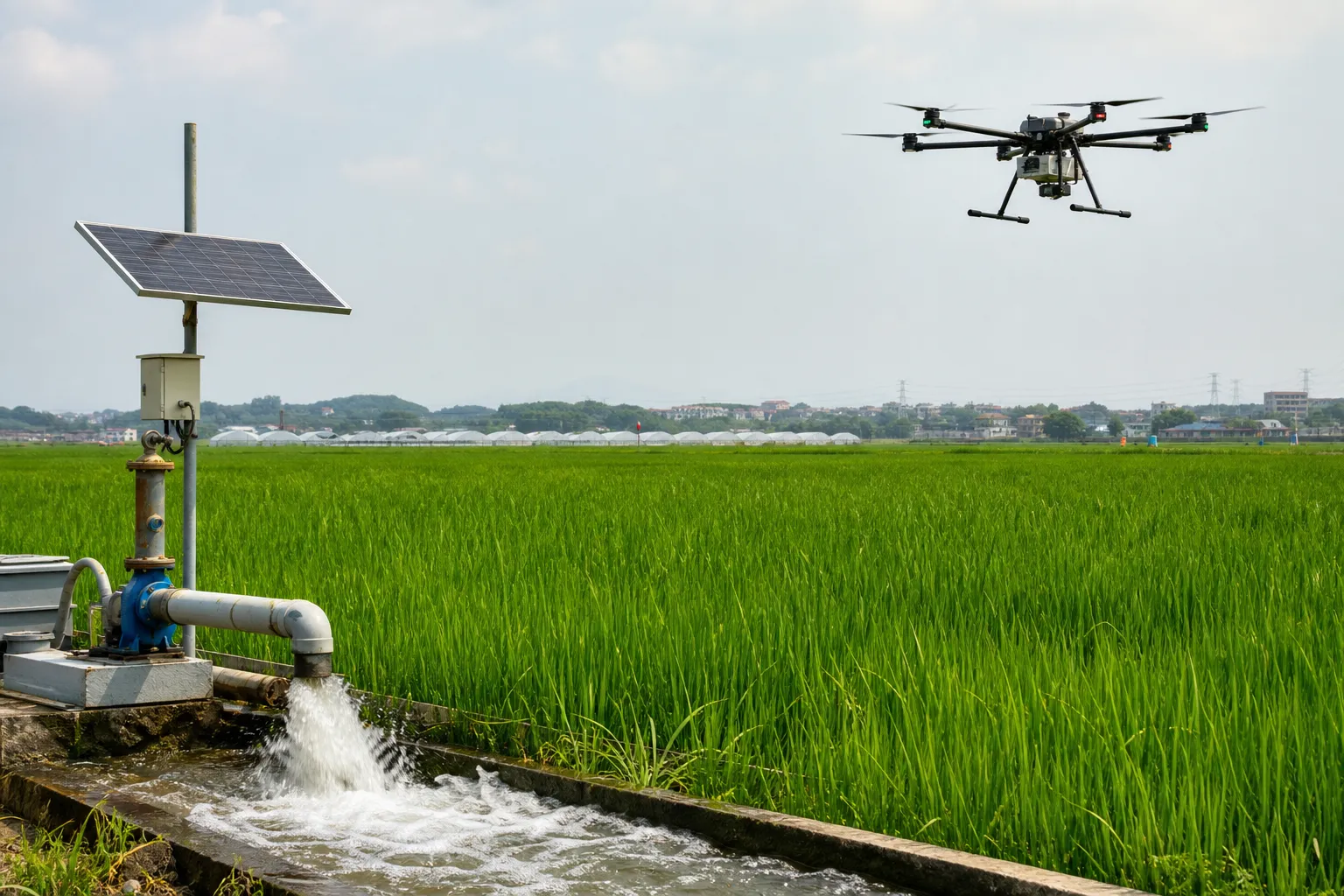
At a 67-hectare demonstration farm in Huizhou, Guangdong Province, sensors, drones, artificial intelligence and remote irrigation are used to grow rice, potatoes and corn, as well as to prepare for extreme weather. This was reported by Channel NewsAsia.
The demonstration farm is operated by Shenzhen-based agricultural technology company FN Holdings. Sensors collect data on weather, soil conditions, pests and plant development, while drones inspect crops from the air. Project manager Liu Lizhu said that the irrigation system can be controlled through a smartphone app without having to travel to the water pumps.
Preparing for typhoons
Guangdong is frequently affected by typhoons, which create risks for farmers. Two days before Typhoon Noul made landfall in Huizhou in late July, farm workers began reinforcing fences and equipment and clearing drainage routes.
After the typhoon, only a small part of the farm was seriously affected. According to Liu Lizhu, rice at the demonstration farm did not lodge, while crops across significant areas of neighboring farmers' fields were bent or flattened. He attributed the difference to a combination of technology and planting schedules, early warnings, preventive measures and stronger infrastructure. In particular, the farm's greenhouses withstood the storm, while some nearby structures were destroyed.
More current news is available on the UA.News Telegram channel Telegram.
Liu also said that, thanks to intelligent management and a scientific approach to irrigation and fertilization, rice yields can be about 5–10% higher than in traditional farming. According to him, using drones to spray pesticides can be dozens of times more efficient than conventional methods, and the equipment requires one operator.
Equipment costs and forecasts
FN Holdings trains farmers in smart farming methods and farm management. The company also uses drones and satellite remote sensing to assess damage after natural disasters by comparing images taken before and after an event. Sean Zhou, vice president of FN Holdings' research center, noted that small farmers often cannot afford expensive equipment. In his view, centralization and operating on a larger scale would make it possible to distribute infrastructure costs.
Researchers at the Hong Kong University of Science and Technology are developing an AI model for early forecasting of severe thunderstorms. Professor Su Hui said that traditional methods usually provide between 45 minutes and two hours of warning, whereas her team's model can forecast such phenomena up to four hours in advance. It analyzes infrared data from China's FengYun-4A geostationary meteorological satellite and was trained on four years of data. The model is being tested by meteorological authorities in Hong Kong and mainland China.


